Thank you for visiting SNEWPapers!
Sign up free
Editorial
April 6, 1833
New Hampshire Statesman And State Journal
Concord, Merrimack County, New Hampshire
What is this article about?
A letter to Congregational and Presbyterian churches in New Hampshire encourages generous donations to home missions, arguing that biblical promises and historical examples show God blesses liberal givers rather than impoverishing them. Cites American Home Missionary Society's 1832 impact: $50,000 expended for 10,000 converts. Signed by A. Rankin, April 1, 1833.
Clipping
OCR Quality
95%
Excellent
Full Text
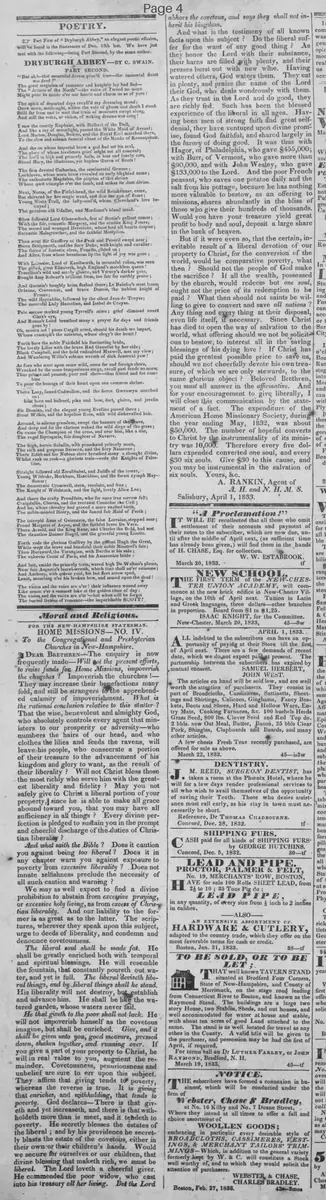
Moral and Religious.
FOR THE NEW-HAMPSHIRE STATESMAN.
HOME MISSIONS—NO. IV.
To the Congregational and Presbyterian
Churches in New-Hampshire.
DEAR BRETHREN—The enquiry is now frequently made—Will not the present efforts, to raise funds for Home Missions, impoverish the churches? Impoverish the churches! They may increase their benefactions many fold, and still be strangers to the apprehended calamity of impoverishment. What is the rational conclusion relative to this matter?
That the wise, benevolent and almighty God, who absolutely controls every agent that ministers to our prosperity or adversity—who numbers the hairs of our head, and who clothes the lilies and feeds the ravens, will leave his people, who consecrate a portion of their treasure to the advancement of his kingdom and glory to want, as the result of their liberality? Will not Christ bless those the most richly who serve him with the greatest liberality and fidelity? May you not safely give to Christ a liberal portion of your property, since he is able to make all grace abound toward you, that you may have all sufficiency in all things? Every divine perfection is pledged to sustain you in the prompt and cheerful discharge of the duties of Christian liberality?
And what saith the Bible? Does it caution you against being too liberal? Does it in any chapter warn you against exposure to poverty from excessive liberality? Does not innate selfishness preclude the necessity of all such caution and warning?
We may as well expect to find a divine prohibition to abstain from excessive praying, or excessive holy living, as from excess of Christian liberality. And our liability to the former is as great as to the latter. The scriptures, wherever they speak upon this subject, urge to deeds of liberality, and condemn and denounce covetousness.
The liberal soul shall be made fat. He shall be greatly enriched both with temporal and spiritual blessings. He will resemble the fountain, that constantly poureth out water, and yet is full. The liberal deviseth liberal things, and by liberal things shall he stand. His liberality will not destroy, but establish and advance him. He shall be like the watered garden, whose waters never fail.
He that giveth to the poor shall not lack. He will not impoverish himself as the covetous imagine, but shall be enriched. Give, and it shall be given unto you, good measure, pressed down, shaken together, and running over. If you give a part of your property to Christ, he will in real value to you, augment the remainder. Covetousness, penuriousness and unbelief are sure to err upon this subject.
They affirm that giving tends to poverty, whereas the reverse is true. It is giving that enriches, and withholding, that tends to poverty. God declares—There is that giveth and yet increaseth, and there is that withholdeth more than is meet, and it tendeth to poverty. He secretly blesses the estates of the liberal; and by his providence he secretly blasts the estate of the covetous, either in their own or their children's hands. Would we secure for ourselves or our children, that divine blessing that maketh rich, we must be liberal. The Lord loveth a cheerful giver. He commended the poor widow, who cast into his treasury all her living. But the Lord abhors the covetous, and says they shall not inherit his kingdom.
And what is the testimony of all known facts upon this subject? Do the liberal suffer for the want of any good thing? As they honor the Lord with their substance, their barns are filled with plenty, and their presses burst out with new wine. Having watered others, God waters them. They eat in plenty, and praise the name of the Lord their God, who deals wondrously with them. As they trust in the Lord and do good, they are richly fed. Such has been the blessed experience of the liberal in all ages. Having been men of strong faith and great self-denial, they have ventured upon divine promise, found God faithful, and shared largely in the luxury of doing good. It was thus with Hagor, of Philadelphia, who gave $455,000; with Burr, of Vermont, who gave more than $90,000, and with John Wesley, who gave $133,000 to the Lord. And the poor French peasant, who saves one potato daily and the salt from his pottage, because he has nothing more valuable to bestow, as an offering to missions, shares abundantly in the bliss of those who give their hundreds of thousands.
Would you have your treasure yield great profit to body and soul, deposit a large share in the bank of heaven.
But if it were even so, that the certain, inevitable result of a liberal devotion of our property to Christ, for the conversion of the world, would be comparative poverty, what then? Should not the people of God make the sacrifice? If all the wealth, possessed by the church, would redeem but one soul, ought not the price of its redemption to be paid? What then should not saints be willing to give to convert and save all nations?
Any thing and every thing at their disposal, even life itself, if necessary. Since Christ has died to open the way of salvation to the world, what offering should we not be solicitous to bestow, to interest all in the saving blessings of his dying love? If Christ has paid the greatest possible price to save us, should we not cheerfully devote his own treasure, of which we are only stewards, to the same glorious object? Beloved Brethren, you must all answer in the affirmative. And for your encouragement to give liberally, I will close this communication by the statement of a fact. The expenditure of the American Home Missionary Society, during the year ending May, 1832, was about $50,000. The number of hopeful converts to Christ by the instrumentality of its ministry was 10,000. Therefore every five dollars expended converted one soul, and every $30 six souls. Give $30 to this cause, and you may be instrumental in the salvation of six souls. Yours, &c.
A. RANKIN, Agent of
A. H. and N. H. M. S.
Salisbury, April 1, 1833.
FOR THE NEW-HAMPSHIRE STATESMAN.
HOME MISSIONS—NO. IV.
To the Congregational and Presbyterian
Churches in New-Hampshire.
DEAR BRETHREN—The enquiry is now frequently made—Will not the present efforts, to raise funds for Home Missions, impoverish the churches? Impoverish the churches! They may increase their benefactions many fold, and still be strangers to the apprehended calamity of impoverishment. What is the rational conclusion relative to this matter?
That the wise, benevolent and almighty God, who absolutely controls every agent that ministers to our prosperity or adversity—who numbers the hairs of our head, and who clothes the lilies and feeds the ravens, will leave his people, who consecrate a portion of their treasure to the advancement of his kingdom and glory to want, as the result of their liberality? Will not Christ bless those the most richly who serve him with the greatest liberality and fidelity? May you not safely give to Christ a liberal portion of your property, since he is able to make all grace abound toward you, that you may have all sufficiency in all things? Every divine perfection is pledged to sustain you in the prompt and cheerful discharge of the duties of Christian liberality?
And what saith the Bible? Does it caution you against being too liberal? Does it in any chapter warn you against exposure to poverty from excessive liberality? Does not innate selfishness preclude the necessity of all such caution and warning?
We may as well expect to find a divine prohibition to abstain from excessive praying, or excessive holy living, as from excess of Christian liberality. And our liability to the former is as great as to the latter. The scriptures, wherever they speak upon this subject, urge to deeds of liberality, and condemn and denounce covetousness.
The liberal soul shall be made fat. He shall be greatly enriched both with temporal and spiritual blessings. He will resemble the fountain, that constantly poureth out water, and yet is full. The liberal deviseth liberal things, and by liberal things shall he stand. His liberality will not destroy, but establish and advance him. He shall be like the watered garden, whose waters never fail.
He that giveth to the poor shall not lack. He will not impoverish himself as the covetous imagine, but shall be enriched. Give, and it shall be given unto you, good measure, pressed down, shaken together, and running over. If you give a part of your property to Christ, he will in real value to you, augment the remainder. Covetousness, penuriousness and unbelief are sure to err upon this subject.
They affirm that giving tends to poverty, whereas the reverse is true. It is giving that enriches, and withholding, that tends to poverty. God declares—There is that giveth and yet increaseth, and there is that withholdeth more than is meet, and it tendeth to poverty. He secretly blesses the estates of the liberal; and by his providence he secretly blasts the estate of the covetous, either in their own or their children's hands. Would we secure for ourselves or our children, that divine blessing that maketh rich, we must be liberal. The Lord loveth a cheerful giver. He commended the poor widow, who cast into his treasury all her living. But the Lord abhors the covetous, and says they shall not inherit his kingdom.
And what is the testimony of all known facts upon this subject? Do the liberal suffer for the want of any good thing? As they honor the Lord with their substance, their barns are filled with plenty, and their presses burst out with new wine. Having watered others, God waters them. They eat in plenty, and praise the name of the Lord their God, who deals wondrously with them. As they trust in the Lord and do good, they are richly fed. Such has been the blessed experience of the liberal in all ages. Having been men of strong faith and great self-denial, they have ventured upon divine promise, found God faithful, and shared largely in the luxury of doing good. It was thus with Hagor, of Philadelphia, who gave $455,000; with Burr, of Vermont, who gave more than $90,000, and with John Wesley, who gave $133,000 to the Lord. And the poor French peasant, who saves one potato daily and the salt from his pottage, because he has nothing more valuable to bestow, as an offering to missions, shares abundantly in the bliss of those who give their hundreds of thousands.
Would you have your treasure yield great profit to body and soul, deposit a large share in the bank of heaven.
But if it were even so, that the certain, inevitable result of a liberal devotion of our property to Christ, for the conversion of the world, would be comparative poverty, what then? Should not the people of God make the sacrifice? If all the wealth, possessed by the church, would redeem but one soul, ought not the price of its redemption to be paid? What then should not saints be willing to give to convert and save all nations?
Any thing and every thing at their disposal, even life itself, if necessary. Since Christ has died to open the way of salvation to the world, what offering should we not be solicitous to bestow, to interest all in the saving blessings of his dying love? If Christ has paid the greatest possible price to save us, should we not cheerfully devote his own treasure, of which we are only stewards, to the same glorious object? Beloved Brethren, you must all answer in the affirmative. And for your encouragement to give liberally, I will close this communication by the statement of a fact. The expenditure of the American Home Missionary Society, during the year ending May, 1832, was about $50,000. The number of hopeful converts to Christ by the instrumentality of its ministry was 10,000. Therefore every five dollars expended converted one soul, and every $30 six souls. Give $30 to this cause, and you may be instrumental in the salvation of six souls. Yours, &c.
A. RANKIN, Agent of
A. H. and N. H. M. S.
Salisbury, April 1, 1833.
What sub-type of article is it?
Moral Or Religious
What keywords are associated?
Home Missions
Christian Liberality
Biblical Giving
American Home Missionary Society
Donations To Church
Religious Benevolence
What entities or persons were involved?
Congregational Churches
Presbyterian Churches
God
Christ
American Home Missionary Society
A. Rankin
Hagor
Burr
John Wesley
Editorial Details
Primary Topic
Encouragement For Donations To Home Missions
Stance / Tone
Strongly Supportive Of Christian Liberality
Key Figures
Congregational Churches
Presbyterian Churches
God
Christ
American Home Missionary Society
A. Rankin
Hagor
Burr
John Wesley
Key Arguments
God Blesses Those Who Give Liberally To His Kingdom
Bible Urges Liberality And Condemns Covetousness
Liberal Givers Are Enriched Temporally And Spiritually
Historical Examples Show Prosperity For Generous Donors
Even If Giving Led To Poverty, Christians Should Sacrifice For Souls
A.H.M.S. 1832: $50,000 Yielded 10,000 Converts