Thank you for visiting SNEWPapers!
Sign up free
Editorial
January 28, 1835
Morning Star
Limerick, York County, Maine
What is this article about?
An editorial warns against the dangers of tight dress, particularly corsets, which injure the lungs and overall health by restricting breathing and blood purification. It uses analogies to alcohol and lead poisoning, explains lung mechanics, and links to moral reform, noting degeneration if practices continue.
Clipping
OCR Quality
98%
Excellent
Full Text
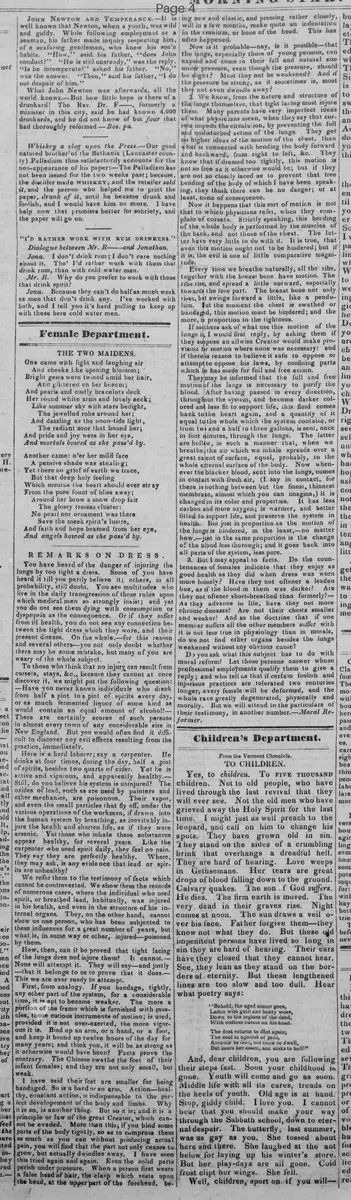
REMARKS ON DRESS.
You have heard of the danger of injuring the lungs by too tight a dress. Some of you have heard it till you partly believe it; others, in all probability, still doubt. You see multitudes who live in the daily transgression of those rules upon which medical men so strongly insist; and yet you do not see them dying with consumption or dyspepsia as the consequence. Or if they suffer from ill health, you do not see any connection between the tight dress which they wore, and their present disease. On the whole,-for this reason and several others--you not only doubt whether there may be some mistake, but many of you are weary of the whole subject.
To those who think that no injury can result from corsets, stays, &c., because they cannot at once discover it, we might put the following question: -Have you never known individuals who drank from half a pint to a pint of spirits every day, or as much fermented liquor of some kind as would contain an equal amount of alcohol?- There are certainly scores of such persons in almost every town of any considerable size in New England. But you would often find it difficult to discover any evil effects resulting from the practice, immediately.
Here is a hard laborer; say a carpenter. He drinks at four times, during the day, half a pint of spirits, besides two quarts of cider. Yet he is active and vigorous, and apparently healthy.- Still, do you believe his system is uninjured? The oxides of lead, such as are used by painters and other mechanics, are poisonous. Their vapor, and even the small particles that fly off, under the various operations of the workmen, if drawn into the human system by breathing, as inevitably injure the health and shorten life, as if they were arsenic. Yet those who inhale these substances appear healthy, for several years. Like the carpenter who used spirit daily, they feel no pain. They say they are perfectly healthy. Where, they may ask, is any evidence that lead or spirits are unhealthy?
We refer them to the testimony of facts which cannot be controverted. We show them the records of numerous cases, where the individual who used spirit, or breathed lead, habitually, was injured in his health, and even in the structure of his internal organs. They, on the other hand, cannot show us one person, who has been subjected to these influences for a great number of years, but what is, in some way or other, injured--poisoned by them.
How, then, can it be proved that tight lacing of the lungs does not injure them? It cannot.- None will attempt it. They will say-and justly —that.it belongs to us to prove that it does.- This we are ever ready to attempt.
First, from analogy. If you bandage, tightly. any other part of the system, for a considerable time, it is apt to become weaker. The more a portion of the frame which is furnished with muscles, those curious instruments of motion; is used, provided it is not over-exerted, the more vigorous it is. Bind up an arm, or a hand, or a foot, and keep it bound up twelve hours of the day for many years; and think you, it will be as strong as it otherwise would have been? Facts prove the contrary. The Chinese swathe the feet of their infant females; and they are not only small, but weak.
I have said their feet are smaller for being bandaged. So is a hand or an arm. Action-healthy, constant action, is indispensable to the perfect development of the body and limbs. Why it is so, is another thing. But so it is; and it is a principle or law of the great Creator, which cannot be evaded. More than this; if you bind some parts of the body tightly, so as to compress them as much as you can without producing actual pain, you will find that the part not only ceases to grow, but actually dwindles away. I have seen this tried again and again. Even the solid parts perish under pressure. When a person first wears a false head of hair, the clasp which rests upon the head, at the upper part of the forehead, being new and elastic, and pressing rather closely, will in a few months, make quite an indentation in the cranium, or bone of the head: This has often happened.
Now is it probable-nay, is it possible-that the lungs, especially those of young persons, can expand and come to their full and natural size under pressure, even though the pressure, should be slight? Must they not be weakened? And of the pressure be strong, as it sometimes is, must they not even dwindle away?
2. We know, from the nature and structure of the lungs themselves, that tight lacing must injure them. Many parents have very imperfect ideas of what physicians mean, when they say that corsets impede the circulation, by preventing the full and undisturbed action of the lungs. They get no higher ideas of the motion of the chest, than what is connected with bending the body forward and backward, from right to left, &c. They know that if dressed too tightly, this motion is not so free as it otherwise would be; but if they are not so closely laced as to prevent that free bending of the body of which I have been speaking, they think there can be no danger; or at least, none of consequence.
Now it happens that this sort of motion is not that to which physicians refer, when they complain of corsets. Strictly speaking, this bending of the whole body is performed by the muscles of the back, and not those of the chest. The latter have very little to do with it. It is true, that even this motion ought not to be hindered; but if it is, the evil is one of little comparative magnitude.
Every time we breathe naturally, all the ribs, together with the breast bone, have motion. The ribs rise, and spread a little outward, especially towards the fore part. The breast bone not only rises, but swings forward a little, like a pendulum. But the moment the chest is swathed or bandaged, this motion must be hindered; and the more, in proportion to the tightness.
If mothers ask of what use this motion of the lungs is, I would first reply, by asking them if they suppose an allwise Creator would make provision for motion where none was necessary: and if there is reason to believe it safe to oppose or attempt to oppose his laws, by confining parts which he has made for full and free action.
They may be informed that the full and free motion of the lungs is necessary to purify the blood. After having passed in every direction, throughout the system, and become darker colored and less fit to support life, this fluid comes back to the heart again, and a quantity of it equal to the whole which the system contains, or from two and a half to three gallons, is sent, once in four minutes, through the lungs. The latter are hollow, in such a manner that, when we breathe the air which we inhale spreads over a great extent of surface, equal, probably, to the whole external surface of the body. Now whenever the blacker blood, sent into the lungs, comes in contact with fresh air, (I say in contact, for there is nothing between but the finest, thinnest membrane, almost which you can imagine,) it is changed in its color and properties. It has less carbon and more oxygen; is warmer, and better fitted to support life, and preserve the system in health. But just in proportion as the motion of the lungs is hindered, in the least,-no matter how,-just in the same proportion is the change of the blood less thorough; and it goes back into all parts of the system, less pure.
3. But I may appeal to facts. Do the countenances of females indicate that they enjoy as good health as they did when dress was worn more loosely? Have they not oftener a leaden hue, as if the blood in them was darker? Are they not oftener short-breathed than formerly?- As they advance in life, have they not more chronic diseases? Are not their chests smaller and weaker? And as the doctrine that if one member suffers all the other members suffer with it is not less true in physiology than in morals, do we not find other organs besides the lungs weakened without any obvious cause?
Do you ask what this subject has to do with moral reform? Let those persons answer whose professional employments qualify them to give a reply; and who tell us that if certain foolish and injurious practices are tolerated two centuries longer, every female will be deformed, and the whole race greatly degenerated, physically and morally. But we will attend to the particulars of their testimony, in another number.-Moral Reformer.
You have heard of the danger of injuring the lungs by too tight a dress. Some of you have heard it till you partly believe it; others, in all probability, still doubt. You see multitudes who live in the daily transgression of those rules upon which medical men so strongly insist; and yet you do not see them dying with consumption or dyspepsia as the consequence. Or if they suffer from ill health, you do not see any connection between the tight dress which they wore, and their present disease. On the whole,-for this reason and several others--you not only doubt whether there may be some mistake, but many of you are weary of the whole subject.
To those who think that no injury can result from corsets, stays, &c., because they cannot at once discover it, we might put the following question: -Have you never known individuals who drank from half a pint to a pint of spirits every day, or as much fermented liquor of some kind as would contain an equal amount of alcohol?- There are certainly scores of such persons in almost every town of any considerable size in New England. But you would often find it difficult to discover any evil effects resulting from the practice, immediately.
Here is a hard laborer; say a carpenter. He drinks at four times, during the day, half a pint of spirits, besides two quarts of cider. Yet he is active and vigorous, and apparently healthy.- Still, do you believe his system is uninjured? The oxides of lead, such as are used by painters and other mechanics, are poisonous. Their vapor, and even the small particles that fly off, under the various operations of the workmen, if drawn into the human system by breathing, as inevitably injure the health and shorten life, as if they were arsenic. Yet those who inhale these substances appear healthy, for several years. Like the carpenter who used spirit daily, they feel no pain. They say they are perfectly healthy. Where, they may ask, is any evidence that lead or spirits are unhealthy?
We refer them to the testimony of facts which cannot be controverted. We show them the records of numerous cases, where the individual who used spirit, or breathed lead, habitually, was injured in his health, and even in the structure of his internal organs. They, on the other hand, cannot show us one person, who has been subjected to these influences for a great number of years, but what is, in some way or other, injured--poisoned by them.
How, then, can it be proved that tight lacing of the lungs does not injure them? It cannot.- None will attempt it. They will say-and justly —that.it belongs to us to prove that it does.- This we are ever ready to attempt.
First, from analogy. If you bandage, tightly. any other part of the system, for a considerable time, it is apt to become weaker. The more a portion of the frame which is furnished with muscles, those curious instruments of motion; is used, provided it is not over-exerted, the more vigorous it is. Bind up an arm, or a hand, or a foot, and keep it bound up twelve hours of the day for many years; and think you, it will be as strong as it otherwise would have been? Facts prove the contrary. The Chinese swathe the feet of their infant females; and they are not only small, but weak.
I have said their feet are smaller for being bandaged. So is a hand or an arm. Action-healthy, constant action, is indispensable to the perfect development of the body and limbs. Why it is so, is another thing. But so it is; and it is a principle or law of the great Creator, which cannot be evaded. More than this; if you bind some parts of the body tightly, so as to compress them as much as you can without producing actual pain, you will find that the part not only ceases to grow, but actually dwindles away. I have seen this tried again and again. Even the solid parts perish under pressure. When a person first wears a false head of hair, the clasp which rests upon the head, at the upper part of the forehead, being new and elastic, and pressing rather closely, will in a few months, make quite an indentation in the cranium, or bone of the head: This has often happened.
Now is it probable-nay, is it possible-that the lungs, especially those of young persons, can expand and come to their full and natural size under pressure, even though the pressure, should be slight? Must they not be weakened? And of the pressure be strong, as it sometimes is, must they not even dwindle away?
2. We know, from the nature and structure of the lungs themselves, that tight lacing must injure them. Many parents have very imperfect ideas of what physicians mean, when they say that corsets impede the circulation, by preventing the full and undisturbed action of the lungs. They get no higher ideas of the motion of the chest, than what is connected with bending the body forward and backward, from right to left, &c. They know that if dressed too tightly, this motion is not so free as it otherwise would be; but if they are not so closely laced as to prevent that free bending of the body of which I have been speaking, they think there can be no danger; or at least, none of consequence.
Now it happens that this sort of motion is not that to which physicians refer, when they complain of corsets. Strictly speaking, this bending of the whole body is performed by the muscles of the back, and not those of the chest. The latter have very little to do with it. It is true, that even this motion ought not to be hindered; but if it is, the evil is one of little comparative magnitude.
Every time we breathe naturally, all the ribs, together with the breast bone, have motion. The ribs rise, and spread a little outward, especially towards the fore part. The breast bone not only rises, but swings forward a little, like a pendulum. But the moment the chest is swathed or bandaged, this motion must be hindered; and the more, in proportion to the tightness.
If mothers ask of what use this motion of the lungs is, I would first reply, by asking them if they suppose an allwise Creator would make provision for motion where none was necessary: and if there is reason to believe it safe to oppose or attempt to oppose his laws, by confining parts which he has made for full and free action.
They may be informed that the full and free motion of the lungs is necessary to purify the blood. After having passed in every direction, throughout the system, and become darker colored and less fit to support life, this fluid comes back to the heart again, and a quantity of it equal to the whole which the system contains, or from two and a half to three gallons, is sent, once in four minutes, through the lungs. The latter are hollow, in such a manner that, when we breathe the air which we inhale spreads over a great extent of surface, equal, probably, to the whole external surface of the body. Now whenever the blacker blood, sent into the lungs, comes in contact with fresh air, (I say in contact, for there is nothing between but the finest, thinnest membrane, almost which you can imagine,) it is changed in its color and properties. It has less carbon and more oxygen; is warmer, and better fitted to support life, and preserve the system in health. But just in proportion as the motion of the lungs is hindered, in the least,-no matter how,-just in the same proportion is the change of the blood less thorough; and it goes back into all parts of the system, less pure.
3. But I may appeal to facts. Do the countenances of females indicate that they enjoy as good health as they did when dress was worn more loosely? Have they not oftener a leaden hue, as if the blood in them was darker? Are they not oftener short-breathed than formerly?- As they advance in life, have they not more chronic diseases? Are not their chests smaller and weaker? And as the doctrine that if one member suffers all the other members suffer with it is not less true in physiology than in morals, do we not find other organs besides the lungs weakened without any obvious cause?
Do you ask what this subject has to do with moral reform? Let those persons answer whose professional employments qualify them to give a reply; and who tell us that if certain foolish and injurious practices are tolerated two centuries longer, every female will be deformed, and the whole race greatly degenerated, physically and morally. But we will attend to the particulars of their testimony, in another number.-Moral Reformer.
What sub-type of article is it?
Science Or Medicine
Moral Or Religious
Social Reform
What keywords are associated?
Tight Dress
Corsets
Lung Injury
Blood Purification
Moral Reform
Female Health
New England
What entities or persons were involved?
Medical Men
Moral Reformer
Editorial Details
Primary Topic
Dangers Of Tight Dress On Lungs And Health
Stance / Tone
Strong Warning Against Tight Lacing And Advocacy For Loose Dress
Key Figures
Medical Men
Moral Reformer
Key Arguments
Tight Dress Injures Lungs Like Alcohol Or Lead Poisoning, Effects Not Immediate
Analogy: Binding Body Parts Weakens Them, As In Chinese Foot Binding
Lung Motion Essential For Blood Purification; Corsets Hinder It
Evidence From Declining Female Health: Leaden Hue, Shortness Of Breath, Chronic Diseases
Links To Moral Reform: Continued Practices Lead To Physical And Moral Degeneration