Thank you for visiting SNEWPapers!
Sign up free
The Poplar Standard
Poplar, Roosevelt County, Montana
What is this article about?
Northeast Montana's 1951 rain increasing program via cloud seeding signed up 55,643 acres at a Wolf Point meeting, with ongoing sign-ups and explanations by officials Willard Ruggles and Robert Taylor. Upcoming meetings scheduled in area towns.
Merged-components note: Merged continuation of the rain increase program article across pages 1 and 10.
Clippings
1 of 2
OCR Quality
Full Text
FARMERS PLEDGE 55,000 ACRES AT LOCAL MEETING MEMBERSHIP SIGN-UP CONTINUES TO GAIN MOMENTUM AS PRECIPITATION PROGRAM IS EXPLAINED IN AREA.
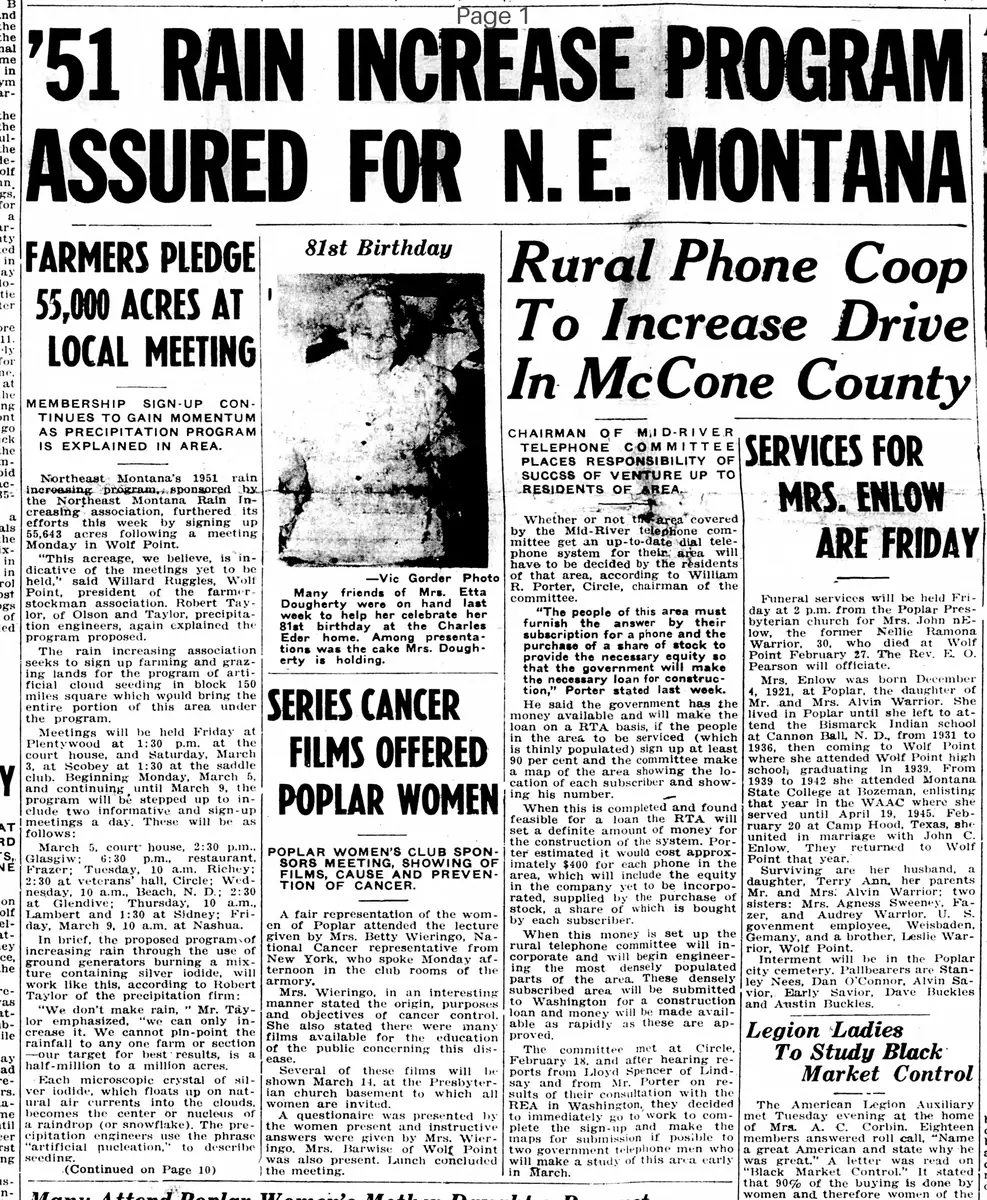
Northeast Montana's 1951 rain increasing program, sponsored by the Northeast Montana Rain Increasing association, furthered its efforts this week by signing up 55,643 acres following a meeting Monday in Wolf Point.
"This acreage, we believe, is indicative of the meetings yet to be held," said Willard Ruggles, Wolf Point, president of the farmer-stockman association. Robert Taylor, of Olson and Taylor, precipitation engineers, again explained the program proposed.
The rain increasing association seeks to sign up farming and grazing lands for the program of artificial cloud seeding in block 150 miles square which would bring the entire portion of this area under the program.
Meetings will be held Friday at Plentywood at 1:30 p.m. at the court house, and Saturday, March 3, at Scobey at 1:30 at the saddle club. Beginning Monday, March 5, and continuing until March 9, the program will be stepped up to include two informative and sign-up meetings a day. These will be as follows:
March 5, court house, 2:30 p.m., Glasgow; 6:30 p.m., restaurant, Frazer; Tuesday, 10 a.m. Richey; 2:30 at veterans' hall, Circle; Wednesday, 10 a.m., Beach, N. D.; 2:30 at Glendive; Thursday, 10 a.m. Lambert and 1:30 at Sidney; Friday, March 9, 10 a.m. at Nashua.
In brief, the proposed program of increasing rain through the use of ground generators burning a mixture containing silver iodide, will work like this, according to Robert Taylor of the precipitation firm:
"We don't make rain," Mr. Taylor emphasized, "we can only increase it. We cannot pin-point the rainfall to any one farm or section. Our target for best results, is a half-million to a million acres.
Each microscopic crystal of silver iodide, which floats up on natural air currents into the clouds, becomes the center or nucleus of a raindrop (or snowflake). The precipitation engineers use the phrase "artificial nucleation," to describe seeding. (Continued on Page 10)
FRIDAY, MARCH 2
RAIN INCREASE
(Continued from page 1)
The silver iodide, according to Taylor, causes precipitation in clouds at a level and temperature where nature doesn't operate. The silver iodide begins to work at 2 degrees F and in lower altitudes than does nature, which does the best job at minus 10 degrees F.
All types of clouds are not seeded. Those described as light, fluffy clouds, are not the rain producing type, the scientists say, but the heavy, dark clouds, usually producing some moisture, are seeded.
In the area it is estimated there will be at least 25 to 30 cloud seeding opportunities during the 1951 growing season. This is based on weather and precipitation reports over a 25-year period.
What sub-type of article is it?
What keywords are associated?
What entities or persons were involved?
Where did it happen?
Domestic News Details
Primary Location
Northeast Montana
Event Date
1951
Key Persons
Outcome
55,643 acres signed up; ongoing membership drive targeting half-million to a million acres; estimated 25-30 cloud seeding opportunities in 1951 growing season
Event Details
The Northeast Montana Rain Increasing association held a meeting in Wolf Point where farmers pledged 55,643 acres for a cloud seeding program using silver iodide to enhance precipitation over a 150-mile square block of farming and grazing lands. Upcoming meetings scheduled in various towns to continue sign-ups and explanations.