Thank you for visiting SNEWPapers!
Sign up free
The Bossier Banner
Benton, Bellevue, Bossier County, Louisiana
What is this article about?
In Naples, an English naval officer falls in love with young Italian Pepita and marries her hastily before sailing. Friends play the government lottery; the American wins a fortune but dies from drunken excess. The narrator nearly wins big based on superstitious signs from the wedding but misses due to a detail about the steamship.
Clipping
OCR Quality
Full Text
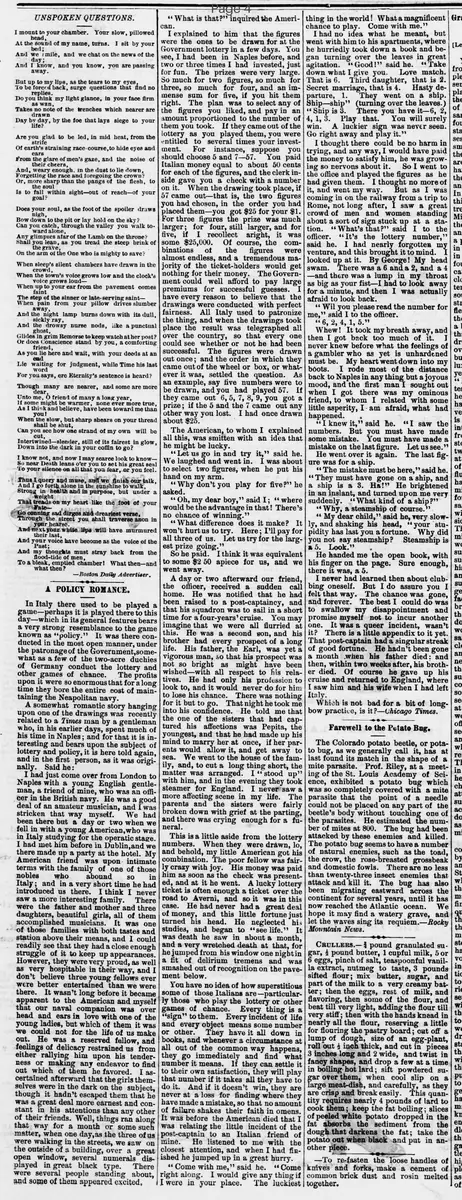
POLICY ROMANCE.
In Italy there used to be played a
game—perhaps it is played there to this
day—which in its general features bears
a very strong resemblance to the game
known as "policy." It was there con-
ducted in the most open manner, under
the patronage of the Government, somewhat as a few of the two-acre duchies
of Germany conduct the lottery and
other games of chance. The profits
upon it were so enormous that for a long
time they bore the entire cost of main-
taining the Neapolitan navy.
A somewhat romantic story hanging
upon one of the drawings was recently
related to a Times man by a gentleman
who, in his earlier days, spent much of
his time in Naples; and for that it is in-
teresting and bears upon the subject of
lottery and policy, it is here told again,
and in the first person, as it was origi-
nally. Said he:
I had just come over from London to
Naples with a young English gentle-
man, a friend of mine, who was an offi-
cer in the British navy. He was a good
deal of an amateur musician, and I was
stricken that way myself.
We had
been there but a day or two when we
fell in with a young American, who was
in Italy studying for the operatic stage.
I had met him before in Dublin, and we
there made up a party at the hotel. My
American friend was upon intimate
terms with the family of one of those
nobles
who
abound
so
in
Italy; and in a very short time he had
introduced us there. I think I never
saw a more interesting family. There
were the father and mother and three
daughters, beautiful girls, all of them
accomplished musicians. It was one
of those families with both tastes and
station above their means, and I could
readily see that they had a close enough
struggle of it to keep up appearances.
However, they were very proud, as well
as very hospitable in their way, and I
don't believe three young fellows ever
were better entertained than we were
there. It wasn't long before it became
apparent to the American and myself
that our naval companion was over
head and ears in love with one of the
young ladies, but which of them it was
we could not for the life of us make
out. He was a reserved fellow, and
feelings of delicacy restrained us from
either rallying him upon his tender-
ness or making any endeavor to find
out which of them he favored. I as-
certained afterward that the girls them-
themselves were in the dark on the subject,
though it hadn't escaped them that he
was a great deal more earnest and con-
stant in his attentions than any other
of their friends. Well, things ran along
that way for a month or some such
matter, when one day, as the three of us
were walking in the streets, we saw on
the outside of a building, over a great
open window, several numerals dis-
played in great black type. There
were several people standing about,
and some of them appeared excited.
"What is that?" inquired the Ameri-
can.
I explained to him that the figures
were the ones to be drawn for at the
Government lottery in a few days. You
see, I had been in Naples before, and
two or three times I had invested, just
for fun. The prizes were very large.
So much for two figures, so much for
three, so much for four, and an im-
mense sum for five, if you hit them
right. The plan was to select any of
the figures you liked, and pay in an
amount proportioned to the number of
them you took. If they came out of the
lottery as you played them, you were
entitled to several times your invest-
ment.
For instance, suppose
you
should choose 5 and 7—57. You paid
Italian money equal to about 50 cents
for each of the figures, and the clerk in-
side gave you a check with a number
on it. When the drawing took place, if
57 came out—that is, the two figures
you had chosen, in the order you had
placed them—you got $25 for your $1.
For three figures the prize was much
larger; for four, still larger, and for
five, if I recollect aright, it was
some $25,000. Of course, the com-
binations of
the figures were
almost endless, and a tremendous ma-
jority of the ticket-holders would get
nothing for their money. The Govern-
ment could well afford to pay large
premiums for successful guesses. I
have every reason to believe that the
drawings were conducted with perfect
fairness. All Italy used to patronize
the thing, and when the drawings took
place the result was telegraphed all
over the country, so that every one
could see whether or not he had been
successful. The figures were drawn
out once; and the order in which they
came out of the wheel or box, or what-
ever it was, settled the question. As
an example, say five numbers were to
be drawn, and you had played 57. If
they came out 6, 5, 7, 8, 9, you got a
prize; if the 5 and the 7 came out any
other way you lost. I had once drawn
about $25.
The American, to whom I explained
all this, was smitten with an idea that
he might be lucky.
"Let us go in and try it," said he.
We laughed and went in. I was about
to select two figures, when he put his
hand on my arm.
"Why don't you play for five?" he
asked.
"Oh, my dear boy," said I; "where
would be the advantage in that! There's
no chance of winning."
"What difference does it make? It
won't hurt us to try. Here; I'll pay for
all three of us. Let us try for the larg-
est prize going."
So he paid. "I think it was equivalent
to some $2.50 apiece for us, and we
went away.
A day or two afterward our friend,
the officer, received a sudden call
home. He was notified that he had
been raised to a post-captaincy, and
that his squadron was to sail in a short
time for a four-years' cruise. You may
imagine that we were all flurried at
this. He was a second son, and his
brother had every prospect of a long
life. His father, the Earl, was yet a
vigorous man, so that his prospect was
not so bright as might have been
wished—with all respect to his rela-
tives. He had only his profession to
look to, and it would never do for him
to lose his chance. There was nothing
for it but to go. That night he took me
into his confidence. He told me that
the one of the sisters that had cap-
tured his affections was Pepita, the
youngest, and that he had made up his
mind to marry her at once, if her par-
ents would allow it, and get away to
sea. We went to the house of the fam-
ily, and, to cut a long thing short, the
matter was arranged. I stood up
with him, and in the evening they took
steamer for England. I never saw a
more affecting scene in my life. The
parents and the sisters were fairly
broken down with grief at the parting,
and there was crying enough for a fu-
neral.
This is a little aside from the lottery
numbers. When they were drawn, lo,
and behold, my little American got his
combination. The poor fellow was fair-
ly crazy with joy. His money was paid
him as soon as the check was present-
ed, and at it he went. A lucky lottery
ticket is often enough a ticket over the
road to Avernus, and so it was in this
case. He had never had a great deal
of money, and this little fortune just
turned his head. He neglected his
studies, and began to "see life." It
was death he saw in about a month,
and a very wretched death at that, for
he jumped from his window one night in
a fit of delirium tremens and was
smashed out of recognition on the pave-
ment below.
You have no idea of how superstitious
some of those Italians are—particularly
those who play the lottery or other
games of chance. Every thing is a
"sign" to them. Every incident of life
and every object means some number
or other. They have it all down in
books, and whenever a circumstance at
all out of the common way happens,
they go immediately and find what
number it means. If they can settle it
to their own satisfaction, they will play
that number if it takes all they have to
do it. And if it doesn't win, they are
never at a loss for finding where they
have made a mistake, so that no amount
of failure shakes their faith in omens.
It was before the American died that I
was relating the little incident of the
post-captain to an Italian friend of
mine. He listened to me with the
closest attention, and when I had fin-
ished he jumped up in a great hurry.
"Come with me," said he. "Come
right along. I would give any thing if
I were in your place. The luckiest
thing in the world! What a magnificent
chance to play. Come with me."
I had no idea what he meant, but
went with him to his apartments, where
he hurriedly took down a book and be-
gan turning over the leaves in great
agitation. "Good!" said he. "Take
down what I give you. Love match.
That is 6. Third daughter, that is 2.
Secret marriage, that is 4. Hasty de-
parture, 1. They went on a ship.
Ship—ship" (turning over the leaves.)
"Ship is 3. There you have it—6, 2,
4, 1, 3. Play that. You will surely
win. A luckier sign was never seen.
Go right away and play it."
I thought there could be no harm in
trying, and any way, I would have paid
the money to satisfy him, he was grow-
ing so nervous about it. So I went to
the office and played the figures as he
had given them. I thought no more of
it, and went my way. But as I was
coming in on the railway from a trip to
Rome, not long after, I saw a great
crowd of men and women standing
about a sort of sign stuck up at a sta-
tion. "What's that?" said I to the
officer. "It's the lottery number,"
said he. I had nearly forgotten my
venture, and this brought it to mind. I
looked up at it. By George! My head
swam. There was a 6 and a 2, and a 4
—and there was a lump in my throat
as big as your fist—I had to look away
for a minute, and then I was actually
afraid to look back.
"Will you please read the number for
me," said I to the officer.
"6, 2, 4, 1, 5."
Whew! It took my breath away, and
then I got back too much of it. I
never knew before what the feelings of
a gambler who is yet unhardened
must be. My heart went down into my
boots. I rode most of the distance
back to Naples in any thing but a joyous
mood, and the first man I sought out
when I got there was my ominous
friend, to whom I related with some
little asperity, I am afraid, what had
happened.
"I knew it," said he.
"I saw the
numbers. But you must have made
some mistake. You must have made a
mistake on the last figure. Let us see."
He went over it again. The last fig-
ure was for a ship.
"The mistake must be here," said he.
"They must have gone on a ship, and
a ship is a 3. Ha!" He brightened
in an instant, and turned upon me very
suddenly. "What kind of a ship?"
"Why, a steamship of course."
"My dear child," said he, very slow-
ly, and shaking his head, "your stu-
pidity has lost you a fortune. Why did
you not say steamship? Steamship is
a 5. Look."
He handed me the open book, with
his finger on the page. "Sure enough,
there it was, a 5.
I never had learned then about club-
bing oneself. But I do assure you I
felt that way. The chance was gone,
and forever. The best I could do was
to swallow my disappointment and
promise myself not to incur another
one. It was a queer incident, wasn't
it? There is a little appendix to it yet.
That post-captain had a singular streak
of good fortune. He hadn't been gone
a month when his father died; and
then, within two weeks after, his broth-
er died. Of course he gave up his
cruise and returned to England, where
I saw him and his wife when I had left
Italy.
Which is not bad for a bit of long-
bow practice, is it? Chicago Times.
What sub-type of article is it?
What themes does it cover?
What keywords are associated?
What entities or persons were involved?
Where did it happen?
Story Details
Key Persons
Location
Naples, Italy
Story Details
An English naval officer falls in love with the youngest daughter Pepita of an Italian noble family in Naples and marries her hastily before departing on a cruise. The narrator and friends play the government lottery; the American wins a large prize but squanders it and dies from delirium tremens. An Italian friend interprets the marriage as lucky omens for lottery numbers 6-2-4-1-3, but the narrator loses because the ship was a steamship (5) not a regular ship (3). The officer later inherits his father's title after family deaths.