Thank you for visiting SNEWPapers!
Sign up free
Letter to Editor
October 11, 1828
New Hampshire Statesman And Concord Register
Concord, Merrimack County, New Hampshire
What is this article about?
A citizen denounces General Andrew Jackson's 1814 execution of six Tennessee militia men as illegal and barbaric, claiming their three-month service under the 1795 Militia Act had expired, rendering them civilians immune to court martial. Calls for opposition to Jackson's presidential candidacy.
Clipping
OCR Quality
95%
Excellent
Full Text
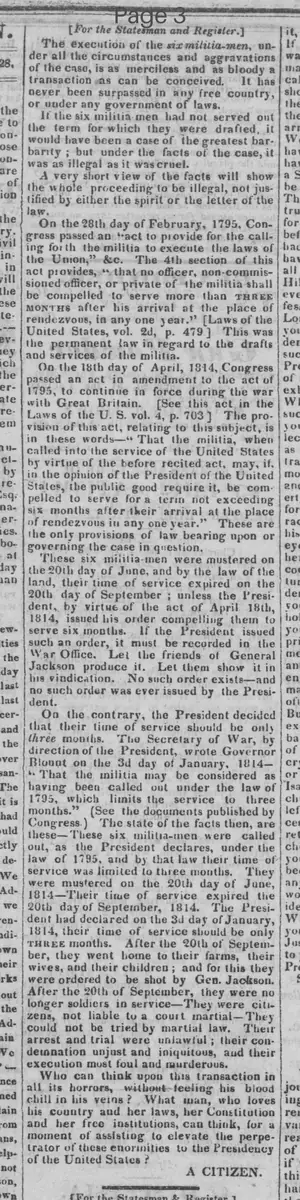
[For the Statesman and Register.]
The execution of the six militia-men, under all the circumstances and aggravations of the case, is as merciless and as bloody a transaction as can be conceived. It has never been surpassed in any free country, or under any government of laws.
If the six militia men had not served out the term for which they were drafted, it would have been a case of the greatest barbarity; but under the facts of the case, it was as illegal as it was cruel.
A very short view of the facts will show the whole proceeding to be illegal, not justified by either the spirit or the letter of the law.
On the 28th day of February, 1795, Congress passed an "act to provide for the calling forth the militia to execute the laws of the Union," &c. The 4th section of this act provides, "that no officer, non-commissioned officer, or private of the militia shall be compelled to serve more than THREE Months after his arrival at the place of rendezvous, in any one year." [Laws of the United States, vol. 2d, p. 479] This was the permanent law in regard to the drafts and services of the militia.
On the 18th day of April, 1814, Congress passed an act in amendment to the act of 1795, to continue in force during the war with Great Britain. [See this act in the Laws of the U. S. vol. 4. p. 703] The provision of this act, relating to this subject, is in these words—"That the militia, when called into the service of the United States by virtue of the before recited act, may, if, in the opinion of the President of the United States, the public good require it, be compelled to serve for a term not exceeding six months after their arrival at the place of rendezvous in any one year." These are the only provisions of law bearing upon or governing the case in question.
These six militia-men were mustered on the 20th day of June, and by the law of the land, their time of service expired on the 20th day of September; unless the President, by virtue of the act of April 18th, 1814, issued his order compelling them to serve six months. If the President issued such an order, it must be recorded in the War Office. Let the friends of General Jackson produce it. Let them show it in his vindication. No such order exists—and no such order was ever issued by the President.
On the contrary, the President decided that their time of service should be only three months. The Secretary of War, by direction of the President, wrote Governor Blount on the 3d day of January, 1814—"That the militia may be considered as having been called out under the law of 1795, which limits the service to three months." (See the documents published by Congress.) The state of the facts then, are these—These six militia-men were called out, as the President declares, under the law of 1795, and by that law their time of service was limited to three months. They were mustered on the 20th day of June, 1814—Their time of service expired the 20th day of September, 1814. The President had declared on the 3d day of January, 1814, their time of service should be only THREE months. After the 20th of September, they went home to their farms, their wives, and their children; and for this they were ordered to be shot by Gen. Jackson.
After the 20th of September, they were no longer soldiers in service—They were citizens, not liable to a court martial—They could not be tried by martial law. Their arrest and trial were unlawful; their condemnation unjust and iniquitous, and their execution most foul and murderous.
Who can think upon this transaction in all its horrors, without feeling his blood chill in his veins? What man, who loves his country and her laws, her Constitution and her free institutions, can think, for a moment of assisting to elevate the perpetrator of these enormities to the Presidency of the United States?
A CITIZEN.
The execution of the six militia-men, under all the circumstances and aggravations of the case, is as merciless and as bloody a transaction as can be conceived. It has never been surpassed in any free country, or under any government of laws.
If the six militia men had not served out the term for which they were drafted, it would have been a case of the greatest barbarity; but under the facts of the case, it was as illegal as it was cruel.
A very short view of the facts will show the whole proceeding to be illegal, not justified by either the spirit or the letter of the law.
On the 28th day of February, 1795, Congress passed an "act to provide for the calling forth the militia to execute the laws of the Union," &c. The 4th section of this act provides, "that no officer, non-commissioned officer, or private of the militia shall be compelled to serve more than THREE Months after his arrival at the place of rendezvous, in any one year." [Laws of the United States, vol. 2d, p. 479] This was the permanent law in regard to the drafts and services of the militia.
On the 18th day of April, 1814, Congress passed an act in amendment to the act of 1795, to continue in force during the war with Great Britain. [See this act in the Laws of the U. S. vol. 4. p. 703] The provision of this act, relating to this subject, is in these words—"That the militia, when called into the service of the United States by virtue of the before recited act, may, if, in the opinion of the President of the United States, the public good require it, be compelled to serve for a term not exceeding six months after their arrival at the place of rendezvous in any one year." These are the only provisions of law bearing upon or governing the case in question.
These six militia-men were mustered on the 20th day of June, and by the law of the land, their time of service expired on the 20th day of September; unless the President, by virtue of the act of April 18th, 1814, issued his order compelling them to serve six months. If the President issued such an order, it must be recorded in the War Office. Let the friends of General Jackson produce it. Let them show it in his vindication. No such order exists—and no such order was ever issued by the President.
On the contrary, the President decided that their time of service should be only three months. The Secretary of War, by direction of the President, wrote Governor Blount on the 3d day of January, 1814—"That the militia may be considered as having been called out under the law of 1795, which limits the service to three months." (See the documents published by Congress.) The state of the facts then, are these—These six militia-men were called out, as the President declares, under the law of 1795, and by that law their time of service was limited to three months. They were mustered on the 20th day of June, 1814—Their time of service expired the 20th day of September, 1814. The President had declared on the 3d day of January, 1814, their time of service should be only THREE months. After the 20th of September, they went home to their farms, their wives, and their children; and for this they were ordered to be shot by Gen. Jackson.
After the 20th of September, they were no longer soldiers in service—They were citizens, not liable to a court martial—They could not be tried by martial law. Their arrest and trial were unlawful; their condemnation unjust and iniquitous, and their execution most foul and murderous.
Who can think upon this transaction in all its horrors, without feeling his blood chill in his veins? What man, who loves his country and her laws, her Constitution and her free institutions, can think, for a moment of assisting to elevate the perpetrator of these enormities to the Presidency of the United States?
A CITIZEN.
What sub-type of article is it?
Persuasive
Political
Provocative
What themes does it cover?
Politics
Military War
Constitutional Rights
What keywords are associated?
Militia Execution
General Jackson
Illegal Court Martial
Militia Act 1795
War Of 1812
Presidential Candidacy
Constitutional Rights
What entities or persons were involved?
A Citizen
Statesman And Register
Letter to Editor Details
Author
A Citizen
Recipient
Statesman And Register
Main Argument
the execution of the six militia-men by general jackson was illegal and cruel because their three-month service term under the 1795 militia act had expired on september 20, 1814, with no presidential order extending it to six months, making them civilians not subject to court martial.
Notable Details
References 1795 Militia Act Limiting Service To Three Months
Cites 1814 Amendment Allowing Up To Six Months If Ordered By President
Notes No Such Presidential Order Exists
Mentions Secretary Of War Letter To Governor Blount On January 3, 1814
Militia Mustered June 20, 1814