Thank you for visiting SNEWPapers!
Sign up free
The Massachusetts Spy, Or, Thomas's Boston Journal
Boston, Suffolk County, Massachusetts
What is this article about?
Freeholders of Middlesex county assembled at Mile-End for a meeting where they nominated John Wilkes and John Glynn as parliamentary representatives, requiring them to sign a declaration advocating shorter parliaments, limits on placemen and pensioners, and repeal of acts like the Quebec Act and Boston Port Bill. The event featured speeches on English rights and American issues.
Clipping
OCR Quality
Full Text
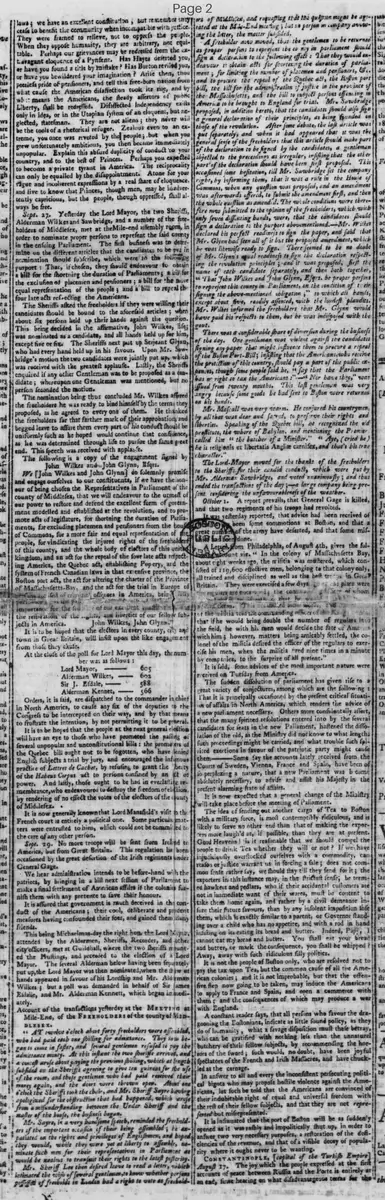
"At twelve o'clock about forty freeholders were assembled, who had paid each one shilling for admittance. They now began to come in faster, and several gentlemen refused to pay the admittance money. At this instant the two sheriffs arrived, and a contest arose about paying the previous shilling, which at length subsided on the Sheriffs agreeing to give ten guineas for the use of the room, and those gentlemen who had paid received their money again, and the doors were thrown open. About one o'clock the Sheriffs took the chair, and Mr. Sheriff Sayre having apologized for the obstruction that had happened, which arose from a misunderstanding between the Under Sheriff and the master of the house, the business began.
Mr. Sayre, in a very handsome speech, reminded the freeholders of the important occasion of their being assembled; he expatiated on the rights and privileges of Englishmen, and hoped they would, while they were yet at liberty to assemble, nominate such men for their representatives in Parliament as would be zealous to transmit their rights to the latest posterity.
Mr. Sheriff Lee then desired leave to read a letter, which intimated the wish of several gentlemen, to know whether persons possessed of freeholds in London had a right to vote as freeholders of Middlesex, and requesting that this question might be agitated at the Mile-End meeting; but no person owning the letter, the matter subsided.
A freeholder very moved, that the gentlemen to be returned as proper persons to represent the county in parliament should sign a declaration to the following effect: That they would endeavour to obtain acts for shortening the duration of parliament; for limiting the number of placemen and pensioners, &c. and to procure the repeal of the Quebec act, the Boston port bill, the bill for the administration of justice in the province of the Massachusetts, and the bill to subject persons offending in America to be brought to England for trial. Mr. Sawbridge proposed, in addition hereto, that the candidates should also sign a general declaration of their principles, as being founded on those of the revolution. After some debate, the last article was put separately, and when it had appeared that it was the general sense of the freeholders that this article should make part of the declaration to be signed by the candidates, a gentleman objected to the proceedings as irregular, insisting that the other part of the declaration should have been first proposed. This occasioned some hesitation, till Mr. Sawbridge set the company right, by informing them, that it was a rule in the House of Commons, when any question was proposed, and an amendment afterwards offered, to submit the amendment first, and then the whole question as amended. The whole conditions were therefore unanimously submitted to the opinion of the freeholders, which with only seven dissenting hands, were, that the candidates should sign a declaration to the purport abovementioned. Mr. Wilkes declared his perfect readiness to sign the paper, and said that Mr. Glynn had seen all of it but the proposed amendment, which he was likewise ready to sign. There seemed to be no doubt of Mr. Glynn's equal readiness to sign the declaration respecting the revolution principles; and it was proposed, first the name of each candidate separately, and then both together, That John Wilkes and John Glynn, Esqs. be proper persons to represent this county in Parliament, on the condition of their signing the above-mentioned obligation;" to which all hands, except about five, readily assented, with the loudest plaudits.
Mr. Wilkes informed the freeholders that Mr. Glynn would have paid his respects to them, but he was indisposed with the gout.
There was a considerable share of diversion during the business of the day. One gentleman was violent against the candidates signing any paper that might influence them to procure a repeal of the Boston Port-Bill; insisting that the Americans, who receive the protection of this country, should pay a part of the public expences, though some people said be, "ay that the Parliament has no right so tax the Americans:"s Nor have they," was issued from twenty mouths. This last gentleman was very angry because some goods he had sent to Boston were returned on his hands.
Mr. Macall was very warm. He conjured his countrymen, by all that was dear and sacred, to preserve their rights and liberties. Speaking of the Quebec bill, he recognized the old prostitute, the whore of Babylon, and mentioning the Premier, called him "the butcher of a Minister." "Aye, (cried he) he is religionis et libertatis Angliae carnifex, and that's his true character."
The Lord-Mayor moved for the thanks of the freeholders to the Sheriffs for their candid conduct, which were put by Mr. Alderman Sawbridge, and voted unanimously; and thus ended the transactions of the day with a large company being present considering the unfavourableness of the weather.
What sub-type of article is it?
What keywords are associated?
What entities or persons were involved?
Where did it happen?
Domestic News Details
Primary Location
Mile End, County Of Middlesex
Event Date
Yesterday
Key Persons
Outcome
john wilkes and john glynn nominated as representatives with near-unanimous support (only five dissenters), conditional on signing a declaration; thanks voted to the sheriffs.
Event Details
Freeholders met at Mile-End; after resolving admission issues, Sheriffs chaired the meeting. Speeches emphasized English rights; a letter on voting rights was read but dropped. A motion passed requiring candidates to sign a declaration for shorter parliaments, limiting placemen, and repealing Quebec Act, Boston Port Bill, and related acts, plus affirming revolution principles. Wilkes and Glynn agreed to sign; they were nominated with strong approval. Debates included American taxation and strong rhetoric against the Quebec Bill and Premier.