Thank you for visiting SNEWPapers!

Sign up free
Page thumbnail for The Rhode Island Republican
Foreign News May 8, 1822

The Rhode Island Republican

Newport, Newport County, Rhode Island

What is this article about?

Physician Theophilus Renaudot in Paris began France's first weekly newspaper in 1632 to share international news, gaining an exclusive privilege; inspired by Venetian Gazettes, which spread to England as Mercuries around 1642.

Clipping
OCR Quality

98% Excellent

Full Text

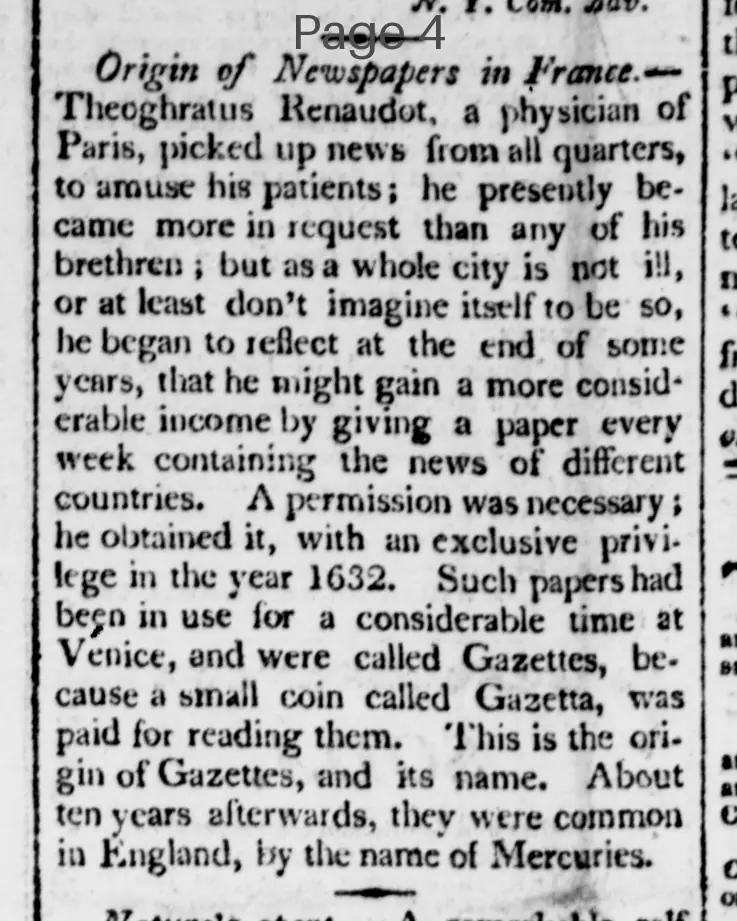
Origin of Newspapers in France.—Theophilus Renaudot, a physician of Paris, picked up news from all quarters, to amuse his patients; he presently became more in request than any of his brethren; but as a whole city is not ill, or at least don't imagine itself to be so, he began to reflect at the end of some years, that he might gain a more considerable income by giving a paper every week containing the news of different countries. A permission was necessary; he obtained it, with an exclusive privilege in the year 1632. Such papers had been in use for a considerable time at Venice, and were called Gazettes, because a small coin called Gazetta, was paid for reading them. This is the origin of Gazettes, and its name. About ten years afterwards, they were common in England, by the name of Mercuries.

What sub-type of article is it?

Newspaper History Gazette Origin

What keywords are associated?

Theophilus Renaudot French Newspapers Gazettes Venice England Mercuries

What entities or persons were involved?

Theophilus Renaudot

Where did it happen?

Paris

Foreign News Details

Primary Location

Paris

Event Date

1632

Key Persons

Theophilus Renaudot

Outcome

obtained permission with exclusive privilege for weekly news paper containing news of different countries

Event Details

Theophilus Renaudot, a physician of Paris, collected news to amuse patients and became popular, then started a weekly paper in 1632 after obtaining permission. Such papers were already in use in Venice called Gazettes, paid with a Gazetta coin. About ten years later, they became common in England as Mercuries.

Are you sure?