Thank you for visiting SNEWPapers!
Sign up free
The National Intelligencer And Washington Advertiser
Washington, District Of Columbia
What is this article about?
Editorial 'The Democrat, No. IV' defends popular sovereignty in American democracy against objections, arguing it resides in the collective people, refuting paradoxes and historical critiques with references to Montesquieu, Burlamaqui, and ancient Greece/Rome's achievements.
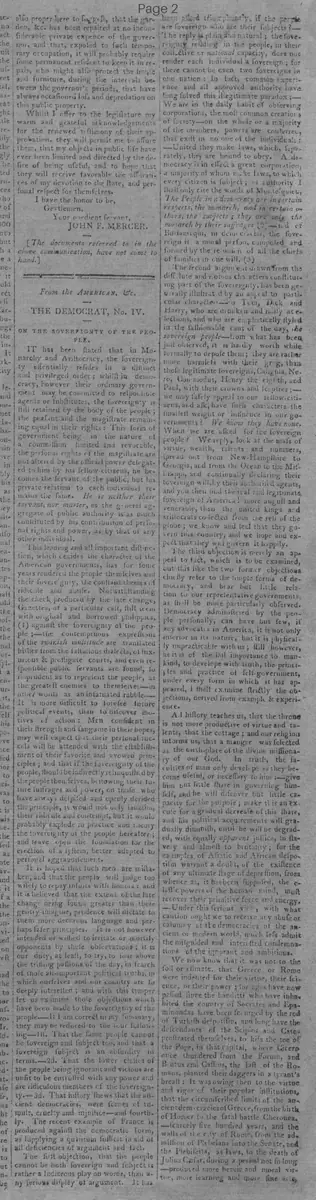
Merged-components note: Continuation of the editorial 'THE DEMOCRAT, No. IV. ON THE SOVEREIGNTY OF THE PEOPLE.' from page 2 to page 3. The second component was originally labeled 'story' but is part of this opinion piece.
Clippings
1 of 2
OCR Quality
Full Text
THE DEMOCRAT, No. IV.
ON THE SOVEREIGNTY OF THE PEOPLE.
IT has been stated that in Monarchy and Aristocracy, the sovereignty essentially resides in a distinct and privileged order; whilst in democracy, however their ordinary government may be committed to responsible agents or substitutes, the sovereignty is still retained by the body of the people; the peasant and the magistrate remaining equal in their rights: This form of government being in the nature of a commission limited and revocable, the personal rights of the magistrate are not altered by the official power delegated to him by his fellow-citizens, he becomes the servant of the public, but his private relation to each individual remains the same. He is neither their servant, nor master, as the general aggregate of public authority is as much constituted by his contribution of personal rights and power, as by that of any other individual.
This leading and all important distinction, which decides the character of the American governments, has for some years rendered the people themselves and their sovereignty, the constant themes of ridicule and abuse. Notwithstanding the check produced by the late change, Gazettes, of a particular cast, still teem with original and borrowed philippics, (1) against the sovereignty of the people; --the contemptuous expressions of the swinish multitude are translated hither from the sycophantic dialects, of luxurious & profligate courts, and even respectable public servants are found, so imprudent as to represent the people, as the greatest enemies to themselves--in other words as an infatuated rabble.
It is more difficult to foresee future political events, than to discover motives of action: Men confident in their strength and sanguine in their hopes, may well expect that their personal success will be attended with the establishment of their favorite and avowed principles; and that if the sovereignty of the people, should be indirectly relinquished by the people themselves, by bestowing their future suffrages and power, on those who have always despised and openly derided the principle, it would not only sanction their ridicule and contempt, but it would probably explode in practice and theory the sovereignty of the people hereafter; and leave open the foundation for the erection of a system, better adapted to personal aggrandizement.
It is hoped that such men are mistaken, and that the people will judge too wisely to repay insults with honors: and it is believed that the extent of the late change being found greater than these gentry imagine, prudence will dictate to them more decorous language and perhaps safer principles. It is not however intended or wished to irritate or mortify opponents by these observations; it is our duty, at least, to try, to soar above the trifling passions of the day, in search of those all-important political truths, in which ourselves and our country are so deeply interested; and with this temper let us examine those objections which have been made to the sovereignty of the people. If I am correct in my Summary, they may be reduced to the following--1st. That the same people cannot be sovereign and subject too, and that a sovereign subject is an absurdity in terms,--2d, That the lower classes of the people being ignorant and vicious are unfit to be entrusted with any power and are ridiculous members of the sovereignty.--3d. That history shows that the ancient democracies, were scenes of tumult, cruelty and injustice--and fourthly. The recent example of France is produced against the democratic form, as supplying a quantum sufficit in aid of all deficiencies of argument and fact.
The first objection, that the people cannot be both sovereign and subject is rather a ludicrous play on words, than any serious display of argument. It has been asked triumphantly, if the people are sovereign who are their subjects?-- The reply is plain and natural; the sovereignty residing in the people, in their collective or national capacity, does not render each individual a sovereign; for there cannot be even two sovereigns in one nation: In fact, common experience and all approved authority have long solved this illegitimate paradox;-- We are in the daily habit of observing corporations, the most common creations of society--on the whole or a majority of the members, powers are conferred, that exist in no one of the individuals; United they make laws, which, separately, they are bound to obey. A democracy is in effect a great corporation, a majority of whom make laws, to which every citizen is subject; as authority I shall only cite the words of Montesquieu, The People in a democracy are in certain respects, the monarch, and in certain others, the subjects; they are only the monarch by their suffrages and Buchanan, in democracies, the sovereign is a moral person, composed and formed by the reunion of all the chiefs of families in one will. (3)
The second argument is drawn from the dissolute and riotous characters constituting part of the sovereignty, has been generally illustrated by an appeal to particular characters--to Tom, Dick and Harry, who are drunken and noisy at elections, and who are emphatically styled in the fashionable cant of the day, the sovereign people--from what has been just observed, it is hardly worth while formally to depose them; they are rather more harmless with their grog, than those legitimate Sovereigns, Caligula, Nero, Commodus, Henry the eighth, and Paul, with their crowns and sceptres;-- we may safely appeal to our fellow-citizens, and ask, have such characters the smallest weight or influence in our governments? We know they have none. When we are asked for the sovereign people? We reply, look at the mass of virtue, wealth, talents and numbers, spread out from New-Hampshire to Georgia, and from the Ocean to the Mississippi, and continually declaring their sovereign will, by their authorized agents, and you then behold the real and legitimate sovereign of America! more august and venerable, than the united kings and aristocrats collected from the rest of the globe; we know and feel that they govern this country, and we hope and expect that they will govern it happily.
The third objection is merely an appeal to fact, which is to be examined, but this like the two former objections chiefly refer to the simple forms of democracy, and bear but little relation to our representative governments, as shall be more particularly observed. Democracy administered by the people personally, can have but few, if any advocates in America, it is not only inferior in its nature, but it is physically impracticable with us; till however, as it is of the last importance to mankind, to develope with truth, the principles and practice of self-government, under every form in which it has appeared, I shall examine strictly the objections, derived from example & experience.
All history teaches us, that the throne is not more productive of virtue and talents, than the cottage; and our religion informs us, that a manger was elected as the birth-place of the divine missionary of our God. In truth, the faculties of man only develop as they become useful, or necessary to him:--give him but little share in governing himself, and he will discover but little capacity for the purpose; make this an excuse for a gradual decrease of this share, and his political acquirements will gradually diminish, until he will be degraded, with equally apparent justice, to slavery and almost to brutality; for the examples of Asiatic and African despotism warrant a doubt, of the existence of any ultimate stage of depression, from whence as, it has been supposed, the elastic powers of the human mind, must recover their primitive force and energy, --Under this serious view, with what caution ought we to receive any abuse or calumny of the democracies of the ancient or modern world, much less admit the misguiding and interested condemnations of the ignorant and ambitious.
We now know that it was not to the soil or climate. that Greece or Rome were indebted for their virtue, their science, or their power; for ages have now passed since the banditti who have inhabited the country of Socrates and Epaminondas have been scourged by the rod of Turkish despotism, and long have the descendants of the Scipios and Catos prostrated themselves, to kiss the toe of the Pope, in that capital, where Cicero once thundered from the Forum, and Brutus and Cassius, the last of the Romans, planted their daggers in a tyrant's breast: It was owing then to the virtue and vigor of their popular institutions, that the circumscribed limits of the ancient democracies of Greece, from the birth of Homer to the fatal battle Cheronea.--scarcely five hundred years, and the walls of the city of Rome, from the admission of Plebeians into the Senate, and the Plebiscita, as laws, to the death of Julius Caesar, during a period not so long -produced more heroic and moral virtue, more learning and more fine arts than the whole human race besides, have Been able to rival, from their creation to the present day.
PUBLICOLA.
(Subject to be continued.)
(1) See for example in the Washington Federalist of Feb. 20th 1802, a piece styled the Extract. (2) Montesq. Esprit des loix lib. 2. chap. 2. (3) Burlamaq. Droit Penal. part 2, chap. I. sect. 10.
What sub-type of article is it?
What keywords are associated?
What entities or persons were involved?
Editorial Details
Primary Topic
Defense Of Popular Sovereignty In Democracy
Stance / Tone
Strongly Supportive Of The Sovereignty Of The People
Key Figures
Key Arguments