Thank you for visiting SNEWPapers!
Sign up free
Daily National Intelligencer
Washington, District Of Columbia
What is this article about?
Extracts from letters detail proceedings of the Connecticut Convention in Hartford on August 27-28: appointment of a committee to draft a constitution, adoption of rules including quorum requirements, and report of a preamble and bill of rights by the committee chaired by Pierpont Edwards.
Merged-components note: Continuation of the article on the Connecticut Constitutional Convention, including the full Bill of Rights.
Clipping
OCR Quality
Full Text
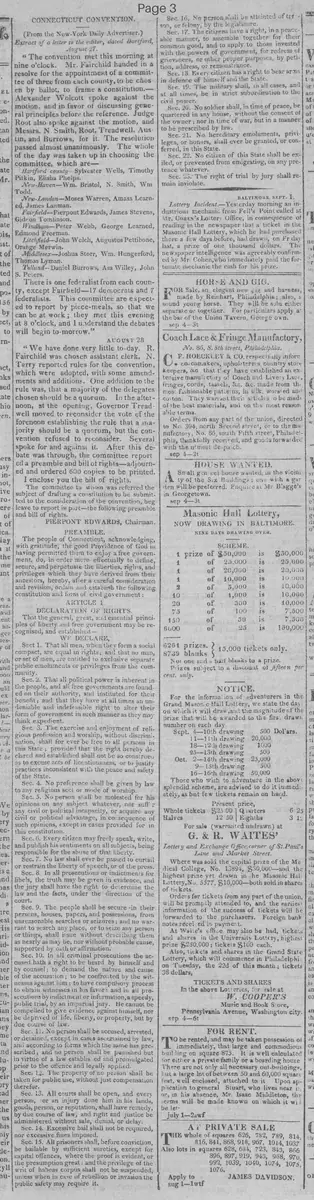
(From the New-York Daily Advertiser.)
Extract of a letter to the editor, dated Hartford, August 27.
"The convention met this morning at nine o'clock. Mr. Fairchild handed in a resolve for the appointment of a committee of three from each county, to be chosen by ballot, to frame a constitution.—Alexander Wolcott spoke against the motion, and in favor of discussing general principles before the reference. Judge Root also spoke against the motion, and Messrs. N. Smith, Root, Treadwell, Austin, and Burrows, for it. The resolution passed almost unanimously. The whole of the day was taken up in choosing the committee, which are—
Hartford county—Sylvester Wells, Timothy Pitkin, Elisha Phelps.
New-Haven—Wm. Bristol, N. Smith, Wm. Todd.
New-London—Moses Warren, Amasa Learned, James Lanman.
Fairfield—Pierpont Edwards, James Stevens, Gideon Tomlinson.
Windham—Peter Webb, George Learned, Edmond Freeman.
Litchfield—John Welch, Augustus Pettibone, Orange Merwin.
Middlesex—Joshua Storrs, Wm. Hungerford, Thomas Lyman.
Tolland—Daniel Burrows, Asa Willey, John S. Peters.
There is one federalist from each county, except Fairfield—17 democrats and 7 federalists. This committee are expected to report by piecemeal, so that we can be at work; they met this evening at 8 o'clock, and I understand the debates will begin to-morrow."
AUGUST 28
"We have done very little to-day. R. Fairchild was chosen assistant clerk. N. Terry reported rules for the convention, which were adopted, with some amendments and additions. One addition to the rule was, that a majority of the delegates chosen should be a quorum. In the afternoon, at the opening, Governor Treadwell moved to reconsider the vote of the forenoon establishing the rule that a majority should be a quorum, but the convention refused to reconsider. Several spoke for and against it. After this debate was through, the committee reported a preamble and bill of rights—adjourned and ordered 600 copies to be printed.
I enclose you the bill of rights.
The committee to whom was referred the subject of drafting a constitution to be submitted to the consideration of the convention, beg leave to report in part—the following preamble and bill of rights.
PIERPONT EDWARDS, Chairman.
PREAMBLE.
The people of Connecticut, acknowledging with gratitude, the good Providence of God in having permitted them to enjoy a free government, do, in order more effectually to define, secure, and perpetuate the liberties, rights, and privileges which they have derived from their ancestors, hereby, after a careful consideration and revision, ordain and establish the following constitution and form of civil government:
ARTICLE 1
DECLARATION OF RIGHTS.
That the general, great, and essential principles of liberty and free government may be recognized, and established—
WE DECLARE,
Sect. 1. That all men, when they form a social compact, are equal in rights; and that no man, or set of men, are entitled to exclusive separate public emoluments or privileges from the community.
Sec. 2. That all political power is inherent in the people, and all free governments are founded on their authority, and instituted for their benefit: and that they have at all times an undeniable and indefeasible right to alter their form of government in such manner as they may think expedient.
Sec. 3. The exercise and enjoyment of religious profession and worship, without discrimination, shall forever be free to all persons in this State; provided that the right hereby declared and established shall not be so construed as to excuse acts of licentiousness, or to justify practices inconsistent with the peace and safety of the State.
Sec. 4. No preference shall be given by law to any religious sect or mode of worship.
Sec. 5. No person shall be molested for his opinions on any subject whatever, nor suffer any civil or political incapacity, or acquire any civil or political advantage, in consequence of such opinions, except in cases provided for in this constitution.
Sec. 6. Every citizen may freely speak, write, and publish his sentiments on all subjects, being responsible for the abuse of that liberty.
Sec. 7. No law shall ever be passed to curtail or restrain the liberty of speech, or of the press.
Sec. 8. In all prosecutions or indictments for libels, the truth may be given in evidence, and the jury shall have the right to determine the law and the facts, under the direction of the court.
Sec. 9. The people shall be secure in their persons, houses, papers, and possessions, from unreasonable searches or seizures; and no warrant to search any place, or to seize any person or things, shall issue without describing them as nearly as may be, nor without probable cause, supported by Oath or affirmation.
Sec. 10. In all criminal prosecutions the accused hath a right to be heard by himself and by counsel; to demand the nature and cause of the accusation; to be confronted by the witnesses against him; to have compulsory process to obtain witnesses in his favor: and in all prosecutions by indictment or information, a speedy, public trial, by an impartial jury. He cannot be compelled to give evidence against himself, nor be deprived of life, liberty, or property, but by due course of law.
Sec. 11. No person shall be accused, arrested, or detained, except in cases ascertained by law, and according to forms which the same has prescribed; and no person shall be punished but in virtue of a law established and promulgated prior to the offence and legally applied.
Sec. 12. The property of no person shall be taken for public use, without just compensation therefor.
Sec. 13. All courts shall be open, and every person, for an injury done him in his lands, goods, person, or reputation, shall have remedy, by due course of law, and right and justice be administered without sale, denial, or delay.
Sec. 14. Excessive bail shall not be required, nor excessive fines imposed.
Sec. 15. All prisoners shall, before conviction, be bailable by sufficient sureties, except for capital offences, where the proof is evident, or the presumption great: and the privilege of the writ of habeas corpus shall not be suspended, unless when in case of rebellion or invasion the public safety may require it.
Sec. 16. No person shall be attainted of treason, or felony, by the legislature.
Sec. 17. The citizens have a right, in a peaceable manner, to assemble together for their common good, and to apply to those invested with the powers of government, for redress of grievances, or other proper purposes, by petition, address, or remonstrance.
Sec. 18. Every citizen has a right to bear arms in defence of himself and the State.
Sec. 19. The military shall, in all cases, and at all times, be in strict subordination to the civil power.
Sec. 20. No soldier shall, in time of peace, be quartered in any house, without the consent of the owner; nor in time of war, but in a manner to be prescribed by law.
Sec. 21. No hereditary emoluments, privileges, or honors, shall ever be granted, or conferred, in this State.
Sec. 22. No citizen of this State shall be exiled, or prevented from emigrating, on any pretence whatever.
Sec. 23. The right of trial by jury shall remain inviolate.
What sub-type of article is it?
What keywords are associated?
What entities or persons were involved?
Where did it happen?
Domestic News Details
Primary Location
Hartford, Connecticut
Event Date
August 27, August 28
Key Persons
Outcome
committee of 24 appointed (17 democrats, 7 federalists); rules adopted including majority quorum; preamble and bill of rights reported and 600 copies ordered printed.
Event Details
The Connecticut Convention met in Hartford to draft a new constitution. On August 27, a committee of three from each county was appointed by ballot after debate. The committee met that evening. On August 28, rules were adopted with amendments; a motion to reconsider quorum rule failed; committee reported preamble and bill of rights.