Thank you for visiting SNEWPapers!
Sign up free
Marble Hill Press
Marble Hill, Bollinger County, Missouri
What is this article about?
U.S. Department of Agriculture guidelines for equipping boxcars with false walls, stoves, and proper loading to protect winter potato shipments from frost damage, ensuring air circulation and preventing economic losses for farmers.
Clipping
OCR Quality
Full Text
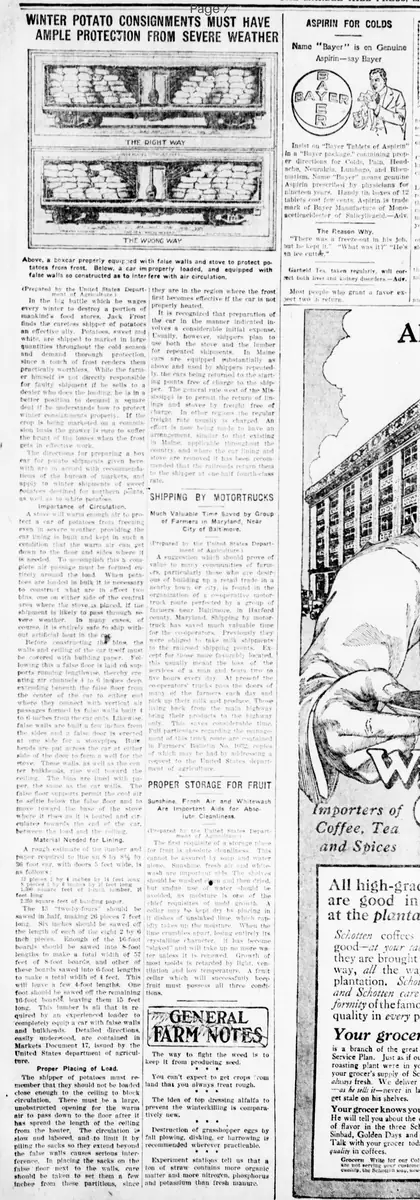
Above, a boxcar properly equipped with false walls and stove to protect potatoes from frost.
Below, a car improperly loaded, and equipped with false walls so constructed as to interfere with air circulation.
(Prepared by the United States Department of Agriculture.)
They are in the region where the frost is battling which he wages every winter to destroy a portion of mankind's food stores, Jack Frost finds the careless shipper of potatoes an effective ally. Potatoes, sweet and white, are shipped to market in large quantities throughout the cold season and demand thorough protection, since a touch of frost renders them practically worthless. While the farmer himself is not directly responsible for faulty shipment if he sells to a dealer who does the loading, he is in a better position to demand a square deal if he understands how to protect winter consignments properly. If the crop is being marketed on a commission basis the grower is sure to suffer the brunt of the losses when the frost gets in effective work.
The directions for preparing a box car for potato shipments given here with are in accord with recommendations of the bureau of markets, and apply to winter shipments of sweet potatoes destined for northern points, as well as to white potatoes.
Importance of Circulation.
A stove will warm enough air to protect a car of potatoes from freezing even in severe weather, providing the car lining is built and kept in such a condition that the warm air can get down to the floor and sides where it is needed. To accomplish this a complete air passage must be formed entirely around the load. When potatoes are loaded in bulk it is necessary to construct what are in effect two bins, one on either side of the central area where the stove is placed. If the shipment is likely to pass through severe weather, in many cases, of course, it is entirely safe to ship without artificial heat in the car.
Before constructing the lining, the walls and ceiling of the car itself must be covered with building paper. Following this a false floor is laid on supports running lengthwise thereby creating air channels 4 to 6 inches deep extending beneath the false floor from the center of the car to either end where they connect with vertical air passages formed by false walls built 4 to 6 inches from the car ends. Likewise false walls are built a few inches from the sides and, a false door is erected at one side for stove pipe. Bulk heads are put across the car at either side of the door to form a well for the stove. These walls as well as the center bulkheads, rise well toward the ceiling. The bins are lined with tar paper, the same as the car walls. The false floor supports permit the cool air to settle below the false floor and to move toward the base of the stove where it rises as it is heated and circulates towards the end of the car, between the load and the ceiling.
Material Needed for Lining.
A rough estimate of the lumber and paper required to line an 8 by 50 by 56 foot car, with doors 5 feet wide, is as follows:
13 pieces 2 by 4 inches by 14 feet long
8 pieces 2 by 6 inches by 6 feet long
150 square feet of 1 inch lumber, 15 feet long
250 square feet of building paper
The 13 "two-by fours" should be sawed in half, making 26 pieces 7 feet long. Six inches should be sawed off the length of each of the eight 2 by 6 inch pieces. Enough of the 16-foot boards should be sawed into 8-foot lengths to make a total width of 57 feet of 6 foot boards, and other of these boards sawed into 6-foot lengths to make a total width of 4 feet. This will leave a few 4-foot lengths. One foot should be sawed off the remaining 16-foot boards, leaving them 15 feet long. This lumber is all that is required by an experienced loader to completely equip a car with false walls and bulkheads. Detailed directions, easily understood, are contained in Markets Document 17, issued by the United States department of agriculture.
Proper Placing of Load.
The shipper of potatoes must remember that they should not be loaded close enough to the ceiling to block circulation. There must be a large, unobstructed opening for the warm air to pass down to the floor after it has spread the length of the ceiling from the heater. The circulation is slow and labored, and to limit it by piling the sacks so they extend beyond the false walls causes serious interference. In placing the sacks on the false floor next to the walls, care should be taken to set them a few inches from those partitions, since
First bulkheads effective if the car is not properly built.
It is recognized that preparation of the car in the manner indicated involves a considerable initial expense. Usually, however, shippers plan to use both the stove and the lumber for repeated shipments. In Maine cars are equipped substantially as above and used by shippers repeatedly, the cars being returned to the starting points free of charge to the shipper. The general rule west of the Mississippi is to permit the return of linings and stoves by freight free of charge. In other regions the regular freight rate usually is charged. An effort is now being made to have an arrangement, similar to that existing in Maine, applicable throughout the country, and where the car lining and stove are removed it has been recommended that the railroads return them to the shipper at the half fourth class rate.
What sub-type of article is it?
What keywords are associated?
Domestic News Details
Outcome
prevents frost damage to potato shipments, reducing economic losses for farmers and shippers.
Event Details
The United States Department of Agriculture provides detailed instructions for preparing boxcars to protect sweet and white potato shipments from frost during winter. Key elements include lining the car with building paper, constructing false walls and floors for air circulation, installing a stove for heating, and proper loading to avoid blocking airflow. Materials needed and construction steps are outlined, with references to reusable equipment and regional shipping practices.