Thank you for visiting SNEWPapers!
Sign up free
Constitutional Whig
Richmond, Virginia
What is this article about?
Article from London Courier discusses the emerging use of rail-roads with locomotive engines for transporting goods and passengers in Britain, highlighting advantages over canals, ongoing projects like Stockton-Darlington and Liverpool-Manchester lines, and a memorial from Liverpool merchants seeking support against canal monopolies. Dated 1824.
Clipping
OCR Quality
Full Text
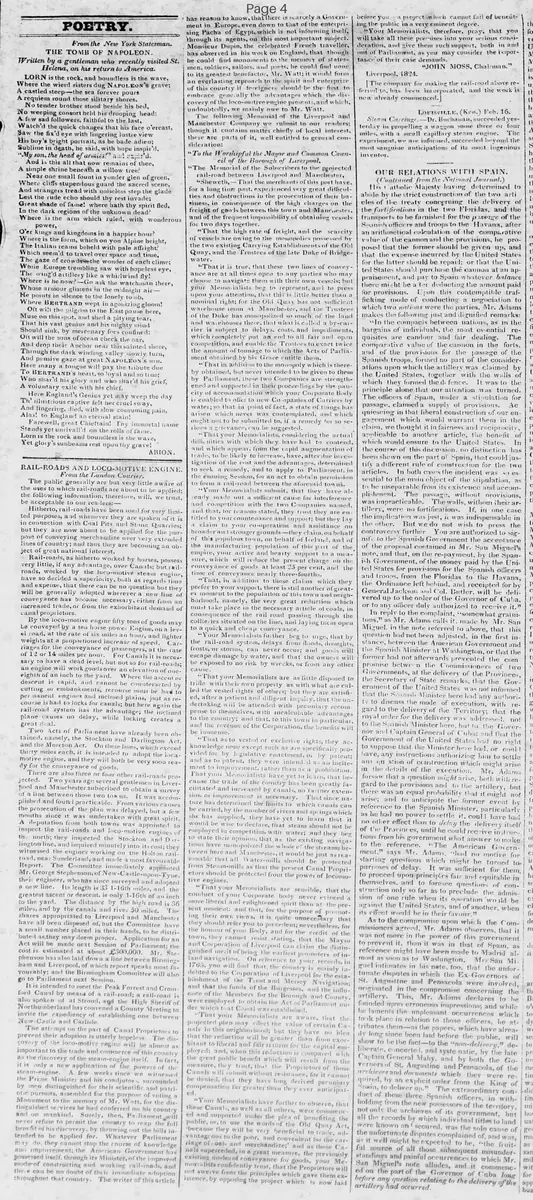
From the London Courier.
The public generally are but very little aware of the uses to which rail-roads are about to be applied; the following information, therefore, will, we trust, be acceptable to our readers:—
Hitherto, rail-roads have been used for very limited purposes, and whenever they are spoken of it is in connection with Coal Pits and Stone Quarries; but they are now about to be applied for the purpose of conveying merchandize over very extended lines of country; and thus they are becoming an object of great national interest.
Rail-roads, as hitherto worked by horses, possess very little, if any advantage, over Canals; but rail-roads, worked by the loco-motive steam engine, have so decided a superiority, both as regards time and expense, that there can be no question but they will be generally adopted wherever a new line of conveyance has become necessary, either from an increased trade, or from the exhorbitant demand of canal proprietors.
By the loco-motive engine fifty tons of goods may be conveyed by a ten horse power Engine, on a level road, at the rate of six miles an hour, and lighter weights at a proportioned increase of speed. Carriages for the conveyance of passengers, at the rate of 12 or 14 miles per hour. For Canals it is necessary to have a dead level, but not so for rail-roads; an engine will work goods over an elevation of one-eighth of an inch to the yard. Where the ascent or descent is rapid, and cannot be counteracted by cutting or embankments, recourse must be had to permanent engines and inclined planes, just as recourse is had to locks for canals; but here again the rail-road system has the advantage; the inclined plane causes no delay, while locking creates a great deal.
Two Acts of Parliament have already been obtained, namely, the Stockton and Darlington Act, and the Moreton Act. On these lines, which exceed thirty miles each, it is intended to adopt the loco-motive engine, and they will both be very soon ready for the conveyance of goods.
There are also three or four other rail-roads projected. Two years ago several gentlemen in Liverpool and Manchester subscribed to obtain a survey of a line between those two towns. It was accomplished and found practicable. From various causes the prosecution of the plan was delayed, but a few months since it was undertaken with great spirit. A deputation from both towns was appointed to inspect the rail-roads and loco-motive engines of the north; they inspected the Stockton and Darlington line, and inquired minutely into its cost; they witnessed the engines working on the Hetton rail-road, near Sunderland, and made a most favourable Report. The Committee immediately appointed Mr. George Stephenson, of New-Castle-upon-Tyne, their engineer, who has since surveyed and adopted a new line. Its length is 33 1-16th miles, and the greatest ascent or descent, is only 1-16th of an inch to the yard. The distance by the high road is 36 miles, and by the canals and river, 50 miles. The shares appropriated to Liverpool and Manchester have all been disposed of, but the Committee have a small number placed in their hands, to be distributed as they may deem proper. Application for an Act will be made next Session of Parliament; the cost is estimated at about £300,000. Mr. Stephenson has also laid down a line between Birmingham and Liverpool, of which report speaks most favourably; and the Birmingham Committee will also go to Parliament next Session.
It is intended to meet the Peak Forest and Cromford Canal by means of a rail-road; a rail-road is also spoken of at Stroud, and the High Sheriff of Northumberland has convened a County Meeting to invite the expediency of establishing one between New-Castle and Carlisle.
The attempt on the part of Canal Proprietors to prevent their adoption is utterly hopeless. The discovery of the loco-motive engine will be almost as important to the trade and commerce of this country as the discovery of the steam-engine itself. In fact, it is only a new application of the powers of the steam-engine. A few weeks since we witnessed the Prime Minister and his coadjutor, surrounded by men distinguished for their scientific and patriotic pursuits, assembled for the purpose of voting a Monument to the memory of Mr. Watt, for the distinguished services he had conferred on his country and on mankind. Surely, then, Parliament will never refuse to permit the country to reap the full benefit of his discovery, by throwing out the bills intended to be applied for. Whatever Parliament may do, they cannot stop the course of knowledge and improvement; the American Government has possessed itself, through its Minister, of the improved mode of constructing and working rail-roads, and there can be no doubt of their immediate adoption throughout that country. The writer of this article has reason to know, that there is scarcely a Government in Europe, even down to that of the enterprising Pacha of Egypt, which is not informing itself through its agents, on this most important subject.
Monsieur Dupin, the celebrated French traveller, has observed in his work on England, that though he could find monuments to the memory of statesmen, soldiers, sailors, and poets, he could find none to its greatest benefactor, Mr. Watt; it would form an everlasting reproach to the spirit and enterprise of this country if foreigners should be the first to embrace generally the advantages which the discovery of the loco-motive engine presents, and which, undoubtedly, we mainly owe to Mr. Watt.
The following Memorial of the Liverpool and Manchester Company we submit to our readers: though it contains matter chiefly of local interest, there are parts of it, well entitled to general consideration:
"To the Worshipful the Mayor and Common Council of the Borough of Liverpool.
"The Memorial of the Subscribers to the projected rail-road between Liverpool and Manchester,
"Sheweth,-That the merchants of this port have, for a long time past, experienced very great difficulties and obstructions in the prosecution of their business, in consequence of the high charges on the freight of goods between this town and Manchester, and of the frequent impossibility of obtaining vessels for two days together.
"That the high rate of freight, and the scarcity of vessels are owing to the monopolies possessed by the two existing Carrying Establishments of the Old Quay, and the Trustees of the late Duke of Bridgewater.
"That it is true, that these two lines of conveyance are at all times open to any parties who may choose to navigate them with their own vessels; but your Memorialists beg to represent, and to press upon your attention, that this is little better than a nominal right; for the Old Quay has not sufficient warehouse room at Manchester, and the Trustees of the Duke has monopolized so much of the land and warehouses there, that what is called a by-carrier is subject to delays, costs, and impediments, which completely put an end to all fair and open competition, and enable the Trustees to exact twice the amount of tonnage to which the Acts of Parliament obtained by his Grace entitle them.
"That in addition to the monopoly which is thereby obtained, but never intended to be given to them by Parliament, these two Companies are strengthened and supported in their proceedings by the paucity of accommodation which your Corporate Body is enabled to offer to new Companies of Carriers by water; so that in point of fact, a state of things has arisen which never was contemplated, and which ought not to be submitted to, if a remedy for so serious a grievance, can be suggested.
"That your Memorialists, considering the actual difficulties with which they have had to contend, and which appear, from the rapid augmentation of trade, to be likely to increase, have, after due investigation of the cost and the advantages, determined to seek a remedy, and to apply to Parliament, in the ensuing Session, for an act to obtain permission to form a rail-road between the aforesaid towns.
"Your Memorialists submit, that they have already made out a sufficient cause for interference and competition with the two Companies named, and that, for reasons stated, they trust they are entitled to your countenance and support; but they lay a claim to your co-operation and assistance on broader and stronger grounds—they claim, on behalf of this populous town, on behalf of Ireland, and of the manufacturing population of this part of the empire, your active and hearty support to a measure, which will reduce the present charge on the conveyance of goods at least 25 per cent, and the time of conveyance nearly three-fourths.
"That, in addition to these claims which they prefer to your support, there is still another of greater moment to the population of this town and neighborhood, namely, the very great reduction which must take place in the necessary article of coals, in consequence of the rail road passing through the collieries situated on the line, and laying them open to a quick and cheap conveyance.
"Your Memorialists further beg to urge, that by the rail-road system, delays from floods, droughts, frosts, or storms, can never occur; and goods will escape damage by water, and that the owners will be exposed to no risk by wrecks, or from any other cause.
"That your Memorialists are as little disposed to trifle with their own property as with what are called the vested rights of others; but they are satisfied, after a patient and diligent inquiry, that the undertaking will be attended with pecuniary recompense to themselves, with incalculable advantages to the country; and that, to this town in particular, and the revenue of the Corporation, the benefits will be immense.
"That as to vested or exclusive rights, they acknowledge none except such as are specifically provided for by legislative enactment, or by patent; and as to patent, they were intended as an incitement to improvement, rather than as a prohibition.
That your Memorialists have yet to learn, that because the trade of the country has been greatly facilitated and increased by canals, no further extension or improvement is necessary. That since nature has determined the limits to which canals can be carried, by the number of rivers and springs which she has supplied, they have yet to learn that it would be wise to declare, that steam should not be employed in competition with water; and they beg to state their opinion, that as the existing navigations have monopolized the whole of the streams between here and Manchester, it would be just as reasonable that all Water-mills should be protected from Steam-mills as that the present Canal Proprietors should be protected from the power of locomotive engines.
"That your Memorialists are sensible, that the conduct of your Corporate body never evinced a more liberal and enlightened spirit than at the present moment: and that, for the purpose of promoting their own views, it is quite unnecessary that they should refer you to precedent; nevertheless, for the honour of your Body, and for the credit of the town, they cannot resist stating, that the Mayor and Corporation of Liverpool can claim the distinguished merit of being the earliest promoters of inland navigation. On reference to your records, in 1768, you will find that, the country is mainly indebted to the Corporation of Liverpool for the establishment of the Trent and Mersey Navigation; and that the funds of the Burgesses, and the influence of the Members for the Borough and County, were employed to obtain the Act of Parliament under which that Canal was established.
That your Memorialists are aware, that the projected plan may effect the value of certain Canals in this neighborhood; but they have no idea that the reduction will be greater than from exhorbitant to liberal and fair returns for the capital employed; and, when this reduction is compared with the great public benefit which will result from the measure, they trust, that the Proprietors of those Canals will submit without resistance, for it cannot be denied, that they have long derived pecuniary compensation far greater than they ever anticipated.
"Your Memorialists have further to observe, that these Canals, as well as all others, were commenced and supported under the plea of benefitting the public, or, to use the words of the Old Quay Act, 'because they will be very beneficial to trade, advantageous to the poor, and convenient for the carriage of coals and merchandize;' and as these Canals superceded, in a great measure, the previously existing modes of conveyance for goods, your Memorialists confidently trust, that the Proprietors will not swerve from the principles which gave them existence, by opposing the project which is now laid before you -a project -which cannot fail of benefitting the public in a very eminent degree.
"Your Memorialists, therefore, pray, that you will take all these premises into your serious consideration, and give them such support, both in and out of Parliament, as you may consider the importance of their case demands.
"JOHN MOSS, Chairman.
Liverpool, 1824."
The company for making the rail-road above referred to, has been incorporated, and the work is now already commenced.
What sub-type of article is it?
What keywords are associated?
What entities or persons were involved?
Where did it happen?
Foreign News Details
Primary Location
England
Event Date
1824
Key Persons
Outcome
acts of parliament obtained for stockton-darlington and moreton lines; liverpool-manchester rail-road projected at 33 1/16 miles, cost £300,000, application for act next session; work commenced; expected reductions in freight costs by 25%, time by three-fourths, cheaper coals.
Event Details
Rail-roads shifting from limited uses to national merchandise transport via loco-motive engines, superior to canals in speed and cost; 50 tons at 6 mph on level; passenger carriages at 12-14 mph; projects include Stockton-Darlington (over 30 miles), Moreton, Liverpool-Manchester (surveyed by Stephenson, shares sold), Birmingham-Liverpool; other proposals at Peak Forest, Stroud, Newcastle-Carlisle; canal proprietors' opposition futile; international interest from America, Europe, Egypt; memorial from Liverpool subscribers to Mayor details monopolies by Old Quay and Bridgewater Trustees, seeks support for rail-road to reduce charges and delays.