Thank you for visiting SNEWPapers!
Sign up free
Literary
June 21, 1935
The Midland Journal
Rising Sun, Cecil County, Maryland
What is this article about?
In this chapter of the Western novel, Sheriff Hopper reveals that banker John Mason was murdered by two shots, not an accident, despite the inquest verdict. Tensions rise at Bar Hook ranch as Hopper suspects withheld information from owner Campo Ragland and others, including newcomer Kentucky Jones. Cook Zack Sanders' murder complicates matters. Suspicion falls on ranch hand Joe St. Marie after a mysterious gunshot.
Clipping
OCR Quality
98%
Excellent
Full Text
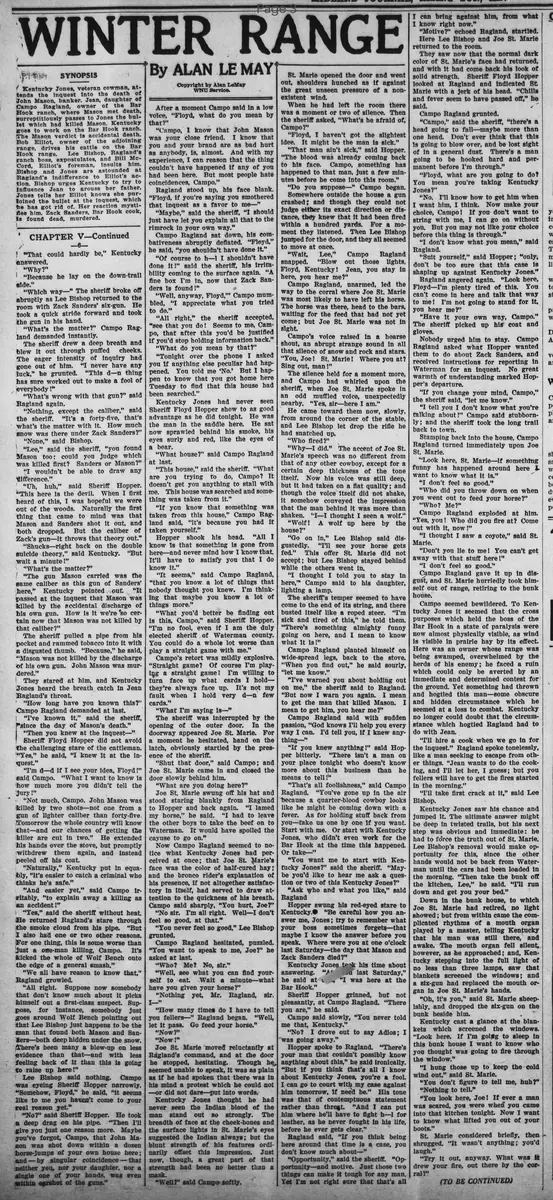
WINTER RANGE
By ALAN LE MAY
Copyright by Alan LeMay
WNU Service.
SYNOPSIS
Kentucky Jones, veteran cowman, attends the inquest into the death of John Mason, banker. Jean, daughter of Campo Ragland, owner of the Bar Hook ranch, where Mason met death, surreptitiously passes to Jones the bullet which had killed Mason. Kentucky goes to work on the Bar Hook ranch. The Mason verdict is accidental death. Bob Elliot, owner of the adjoining range, drives his cattle on the Bar Hook range. Lee Bishop, Ragland's ranch boss, expostulates, and Bill McCord, Elliot's foreman, insults him. Bishop and Jones are astounded at Ragland's indifference to Elliot's action. Bishop urges Kentucky to try to influence Jean to arouse her father. Jones tells her Elliot knows she purloined the bullet at the inquest, which he has got rid of. Her reaction mystifies him. Zack Sanders, Bar Hook cook, is found dead, murdered.
CHAPTER V—Continued
"That could hardly be," Kentucky answered.
"Why?"
"Because he lay on the down-trail side."
"Which way—" The sheriff broke off abruptly as Lee Bishop returned to the room with Zack Sanders' six-gun. He took a quick stride forward and took the gun in his hand.
"What's the matter?" Campo Ragland demanded instantly.
The sheriff drew a deep breath and blew it out through puffed cheeks. The eager intensity of inquiry had gone out of him. "I never have any luck," he grunted. "This d—n thing has sure worked out to make a fool of everybody!"
"What's wrong with that gun?" said Ragland again.
"Nothing, except the caliber," said the sheriff. "It's a forty-five, that's what's the matter with it. How much snow was there under Zack Sanders?"
"None," said Bishop.
"Lee," said the sheriff, "you found Mason too: could you judge which was killed first? Sanders or Mason?"
"I wouldn't be able to draw any difference."
"Uh, huh," said Sheriff Hopper. This here is the devil. When I first heard of this, I was hopeful we were out of the woods. Naturally the first thing that came to mind was that Mason and Sanders shot it out, and both dropped. But the caliber of Zack's gun—it throws that theory out."
"Shucks—right back on the double suicide theory," said Kentucky. "But wait a minute!"
"What's the matter?"
"The gun Mason carried was the same caliber as this gun of Sanders' here," Kentucky pointed out. "It passed at the inquest that Mason was killed by the accidental discharge of his own gun. How is it we're so certain now that Mason was not killed by that caliber?"
The sheriff pulled a pipe from his pocket and rammed tobacco into it with a disgusted thumb. "Because," he said, "Mason was not killed by the discharge of his own gun. John Mason was murdered."
They stared at him, and Kentucky Jones heard the breath catch in Jean Ragland's throat.
"How long have you known this?"
Campo Ragland demanded at last.
"I've known it," said the sheriff, "since the day of Mason's death."
"Then you knew at the inquest—"
Sheriff Floyd Hopper did not avoid the challenging stare of the cattleman.
"Yes," he said, "I knew it at the inquest."
"I'm d—d if I see your idea, Floyd!" said Campo.
"What I want to know is how much more you didn't tell the jury!"
"Not much, Campo. John Mason was killed by two shots—not one from a gun of lighter caliber than forty-five. Tomorrow the whole country will know that—and our chances of getting the killer are cut in two." He extended his hands over the stove, but promptly withdrew them again, and instead peeled off his coat.
"Naturally," Kentucky put in equably, "it's easier to catch a criminal who thinks he's safe."
"And easier yet," said Campo irritably, "to explain away a killing as an accident!"
"Yes," said the sheriff without heat. He returned Ragland's stare through the smoke cloud from his pipe. "But I also had one or two other reasons. For one thing, this is some worse than just a one-man killing, Campo. It's kicked the whole of Wolf Bench onto the edge of a general smash."
"We all have reason to know that," Ragland growled.
"All right. Suppose now somebody that don't know much about it picks himself out a first-class suspect. Suppose, for instance, somebody just goes around Wolf Bench pointing out that Lee Bishop just happens to be the man that found both Mason and Sanders—both deep hidden under the snow. There's been many a blow-up on less evidence than that—and with less feeling back of it than this is going to raise up here!"
Lee Bishop said nothing. Campo was eyeing Sheriff Hopper narrowly.
"Somehow, Floyd," he said, "it seems like to me you haven't come to your real reason yet."
"No?" said Sheriff Hopper. He took a deep drag on his pipe. "Then I'll give you just one reason more. Maybe you've forgot, Campo, that John Mason was shot down within a dozen horse-jumps of your own house here; and—by singular coincidence—that neither you, nor your daughter, nor a single one of your hands, was even within earshot of the guns."
After a moment Campo said in a low voice, "Floyd, what do you mean by that?"
"Campo, I know that John Mason was your close friend. I know that you and your brand are as bad hurt as anybody is, almost. And with my experience, I can reason that the thing couldn't have happened if any of you had been here. But most people hate coincidences, Campo."
Ragland stood up, his face blank.
"Floyd, if you're saying you smothered that inquest as a favor to me—"
"Maybe," said the sheriff, "I should just have let you explain all that to the rimrock in your own way."
Campo Ragland sat down, his combativeness abruptly deflated. "Floyd," he said, "you shouldn't have done it."
"Of course to h—l I shouldn't have done it!" said the sheriff, his irritability coming to the surface again. "A fine box I'm in, now that Zack Sanders is found!"
"Well, anyway, Floyd," Campo mumbled, "I appreciate what you tried to do."
"All right," the sheriff accepted. "See that you do! Seems to me, Campo, that after this you'd be justified if you'd stop holding information back."
"What do you mean by that?"
"Tonight over the phone I asked you if anything else peculiar had happened. You told me 'No.' But I happen to know that you got home here Tuesday to find that this house had been searched."
Kentucky Jones had never seen Sheriff Floyd Hopper show to as good advantage as he did tonight. He was the man in the saddle here. He sat now sprawled behind his smoke, his eyes surly and red, like the eyes of a bear.
"What house?" said Campo Ragland at last.
"This house," said the sheriff. "What are you trying to do, Campo? It doesn't get you anything to stall with me. This house was searched and something was taken from it."
"If you know that something was taken from this house," Campo Ragland said, "it's because you had it taken yourself."
Hopper shook his head. "All I know is that something is gone from here—and never mind how I know that. It'll have to satisfy you that I do know it."
"It seems," said Campo Ragland, "that you know a lot of things that nobody thought you knew. I'm thinking that maybe you know a lot of things more."
"What you'd better be finding out is this, Campo," said Sheriff Hopper. "I'm no fool, even if I am the duly elected sheriff of Waterman county. You could do a whole lot worse than play a straight game with me."
Campo's retort was mildly explosive.
"Straight game? Of course I'm playing a straight game! I'm willing to turn face up what cards I hold—they're always face up. It's not my fault when I hold very d—n few cards."
"What I'm saying is—"
The sheriff was interrupted by the opening of the outer door. In the doorway appeared Joe St. Marie. For a moment he hesitated, hand on the latch, obviously startled by the presence of the sheriff.
"Shut that door," said Campo; and Joe St. Marie came in and closed the door slowly behind him.
"What are you doing here?"
Joe St. Marie swung off his hat and stood staring blankly from Ragland to Hopper and back again. "I lamed my horse," he said. "I had to leave the other boys to take the beef on to Waterman. It would have spoiled the cayuse to go on."
Now Campo Ragland seemed to notice what Kentucky Jones had perceived at once: that Joe St. Marie's face was the color of half-cured hay; and the bronco rider's explanation of his presence, if not altogether satisfactory in itself, had served to draw attention to the quickness of his breath.
Campo said sharply, "You hurt, Joe?"
"No sir. I'm all right. Well—I don't feel so good, at that."
"You never feel so good," Lee Bishop grunted.
Campo Ragland hesitated, puzzled.
"You want to speak to me, Joe?" he asked at last.
"Who? Me? No, sir."
"Well, see what you can find yourself to eat. Wait a minute—what have you given your horse?"
"Nothing yet, Mr. Ragland, sir. I—"
"How many times do I have to tell you fellers—" Ragland began. "Well, let it pass. Go feed your horse."
"Now?"
"Now!"
Joe St. Marie moved reluctantly at Ragland's command, and at the door he stopped, hesitating. Though he seemed unable to speak, it was as plain as if he had spoken that there was in his mind a protest which he could not—or did not dare—put into words.
Kentucky Jones thought he had never seen the Indian blood of the man stand out so strongly. The breadth of face at the cheek-bones and the surface lights in St. Marie's eyes suggested the Indian always; but the blunt strength of his features ordinarily offset this impression. Just now, though, a great part of that strength had been no better than a mask.
"Well?" said Campo softly.
St. Marie opened the door and went out, shoulders hunched as if against the great unseen pressure of a non-existent wind.
When he had left the room there was a moment or two of silence. Then the sheriff asked, "What's he afraid of, Campo?"
"Floyd, I haven't got the slightest idee. It might be the man is sick."
"That man ain't sick," said Hopper. "The blood was already coming back to his face. Campo, something has happened to that man, just a few minutes before he come into this room."
"Do you suppose—" Campo began.
Somewhere outside the house a gun crashed; and though they could not judge either its exact direction or distance, they knew that it had been fired within a hundred yards. For a moment they listened. Then Lee Bishop jumped for the door, and they all seemed to move at once.
"Wait, Lee," Campo Ragland snapped. "Blow out those lights, Floyd, Kentucky! Jean, you stay in here, you hear me?"
Campo Ragland, unarmed, led the way to the corral where Joe St. Marie was most likely to have left his horse. The horse was there, head to the bars waiting for the feed that had not yet come; but Joe St. Marie was not in sight.
Campo's voice raised in a hoarse shout, an abrupt strange sound in all that silence of snow and rock and stars.
"You, Joe! St. Marie! Where you at? Sing out, man!"
The silence held for a moment more and Campo had whirled upon the sheriff, when Joe St. Marie spoke in an odd muffled voice, unexpectedly nearby.
"Yes, sir—here I am."
He came toward them now, slowly, from around the corner of the stable, and Lee Bishop let drop the rifle he had snatched up.
"Who fired?"
"Why—I did." The accent of Joe St. Marie's speech was no different from that of any other cowboy, except for a certain deep thickness of the tone itself. Now his voice was still deep, but it had taken on a flat quality; and though the voice itself did not shake, it somehow conveyed the impression that the man behind it was more than shaken. "I—I thought I seen a wolf."
"Wolf! A wolf up here by the house?"
"Go on in," Lee Bishop said disgustedly. "I'll see your horse gets fed." This offer St. Marie did not accept; but Lee Bishop stayed behind while the others went in.
"I thought I told you to stay in here," Campo said to his daughter lighting a lamp.
The sheriff's temper seemed to have come to the end of its string, and there busted itself like a roped steer. "I'm sick and tired of this," he told them. "There's something almighty funny going on here, and I mean to know what it is!"
Campo Ragland planted himself on wide-spread legs, back to the stove.
"When you find out," he said sourly, "let me know."
"I've warned you about holding out on me," the sheriff said to Ragland. "But now I warn you again. I mean to get the man that killed Mason. I mean to get him, you hear me?"
Campo Ragland said with sudden passion, "God knows I'll help you every way I can. I'd tell you, if I knew anything—"
"If you knew anything!" said Hopper bitterly. "There isn't a man on your place tonight who doesn't know more about this business than he means to tell!"
"That's all foolishness," said Campo Ragland. "You've gone up in the air because a quarter-blood cowboy looks like he might be coming down with a fever. As for holding stuff back from you—take us one by one if you want. Start with me. Or start with Kentucky Jones, who didn't even work for the Bar Hook at the time this happened. Or take—"
"You want me to start with Kentucky Jones?" said the sheriff. "Maybe you'd like to hear me ask a question or two of this Kentucky Jones?"
"Ask who and what you like," said Ragland.
Hopper swung his red-eyed stare to Kentucky. "Be careful how you answer me, Jones; try to remember what your boss sometimes forgets—that maybe I know the answer before you speak. Where were you at one o'clock last Saturday—the day that Mason and Zack Sanders died?"
Kentucky Jones took his time about answering.
"I was here at the Bar Hook," he said at last.
Sheriff Hopper grinned, but not pleasantly, at Campo Ragland. "There you are," he said.
Campo said slowly, "You never told me that, Kentucky."
"No? I drove out to say Adios; I was going away."
Hopper spoke to Ragland. "There's your man that couldn't possibly know anything about this," he said ironically. But if you think that's all I know about Kentucky Jones, you're a fool. I can go to court with my case against him tomorrow, if need be." His tone was that of contemptuous statement rather than threat. "And I can put him where he'll have to fight h—l for leather, as he never fought in his life, before he ever gets clear."
Ragland said, "If you think being here around that time is a case, you don't know much about—"
"Opportunity," said the sheriff. "Opportunity—and motive. Just those two things can make it tough for any man. Yet I'm not right sure that that's all I can bring against him, from what I know right now."
"Motive?" echoed Ragland, startled.
Here Lee Bishop and Joe St. Marie returned to the room. They saw now that the normal dark color of St. Marie's face had returned, and with it had come back his look of solid strength. Sheriff Floyd Hopper looked at Ragland and indicated St. Marie with a jerk of his head. "Chills and fever seem to have passed off," he said.
Campo Ragland grunted.
"Campo," said the sheriff, "there's a head going to fall—maybe more than one head. Don't ever think that this is going to blow over, and be lost sight of in a general dust. There's a man going to be hooked hard and permanent before I'm through."
"Floyd, what are you going to do? You mean you're taking Kentucky Jones?"
"No. I'll know how to get him when I want him, I think. Now make your choice, Campo! If you don't want to string with me, I can go on without you. But you may not like your choice before this thing is through."
"I don't know what you mean," said Ragland.
"Suit yourself," said Hopper; "only don't be too sure that this case is shaping up against Kentucky Jones."
Ragland angered again. "Look here, Floyd—I'm plenty tired of this. You can't come in here and talk that way to me! I'm not going to stand for it, you hear me?"
"Have it your own way, Campo."
The sheriff picked up his coat and gloves. Nobody urged him to stay. Campo Ragland asked what Hopper wanted them to do about Zack Sanders, and received instructions for reporting in Waterman for an inquest. No great warmth of understanding marked Hopper's departure.
"If you change your mind, Campo," the sheriff said, "let me know."
"I tell you I don't know what you're talking about!" Campo said stubbornly; and the sheriff took the long trail back to town.
Stamping back into the house, Campo Ragland turned immediately upon Joe St. Marie.
"Look here, St. Marie—if something funny has happened around here I want to know what it is."
"I don't feel so good."
"Who did you throw down on when you went out to feed your horse?"
"Who? Me?"
Campo Ragland exploded at him.
"Yes, you! Who did you fire at? Come out with it, now!"
"I thought I saw a coyote," said St. Marie.
"Don't lie to me! You can't get away with that stuff here!"
"I don't feel so good."
Campo Ragland gave it up in disgust, and St. Marie hurriedly took himself out of range, retiring to the bunk house.
Campo seemed bewildered. To Kentucky Jones it seemed that the cross purposes which held the boss of the Bar Hook in a state of paralysis were now almost physically visible, as wind is visible in prairie hay by its effect. Here was an owner whose range was being swamped, overwhelmed by the herds of his enemy: he faced a ruin which could only be averted by an immediate and determined contest for the ground. Yet something had thrown and hogtied this man—some obscure and hidden circumstance which he seemed at a loss to combat. Kentucky no longer could doubt that the circumstance which hogtied Ragland had to do with Jean.
"I'll hire a cook when we go in for the inquest." Ragland spoke tonelessly, like a man seeking to escape from other things. "Jean wants to do the cooking, and I'll let her, I guess; but you fellers will have to get the fires started in the morning."
"I'll take first crack at it," said Lee Bishop.
Kentucky Jones saw his chance and jumped it. The ultimate answer might be deep in twisted trails, but his next step was obvious and immediate: he had to force the truth out of St. Marie. Lee Bishop's removal would make opportunity for this, since the other hands would not be back from Waterman until the cars had been loaded in the morning. "Then take the bunk off the kitchen, Lee," he said. "I'll run down and get you your bed."
Down in the bunk house, to which Joe St. Marie had retired, no light showed; but from within came the complicated rhythms of a mouth organ played by a master, telling Kentucky that his man was still there, and awake. The mouth organ fell silent, however, as he approached; and, Kentucky stepping into the full light of no less than three lamps, saw that blankets screened the windows; and a six-gun had replaced the mouth organ in Joe St. Marie's hands.
"Oh, it's you," said St. Marie sheepishly, and dropped the six-gun on the bunk beside him.
Kentucky cast a glance at the blankets which screened the windows.
"Look here. If I'm going to sleep in this bunk house I want to know who you thought was going to fire through the window."
"I hung those up to keep the cold wind out," said St. Marie.
"You don't figure to tell me, huh?"
"Nothing to tell."
"You look here, Joe! If ever a man was scared, you were when you came into that kitchen tonight. Now I want to know what lifted you out of your boots."
St. Marie considered briefly, then shrugged. "It wasn't anything; you'd laugh."
"Try it out, anyway. What was it drew your fire, out there by the corral?"
(TO BE CONTINUED)
By ALAN LE MAY
Copyright by Alan LeMay
WNU Service.
SYNOPSIS
Kentucky Jones, veteran cowman, attends the inquest into the death of John Mason, banker. Jean, daughter of Campo Ragland, owner of the Bar Hook ranch, where Mason met death, surreptitiously passes to Jones the bullet which had killed Mason. Kentucky goes to work on the Bar Hook ranch. The Mason verdict is accidental death. Bob Elliot, owner of the adjoining range, drives his cattle on the Bar Hook range. Lee Bishop, Ragland's ranch boss, expostulates, and Bill McCord, Elliot's foreman, insults him. Bishop and Jones are astounded at Ragland's indifference to Elliot's action. Bishop urges Kentucky to try to influence Jean to arouse her father. Jones tells her Elliot knows she purloined the bullet at the inquest, which he has got rid of. Her reaction mystifies him. Zack Sanders, Bar Hook cook, is found dead, murdered.
CHAPTER V—Continued
"That could hardly be," Kentucky answered.
"Why?"
"Because he lay on the down-trail side."
"Which way—" The sheriff broke off abruptly as Lee Bishop returned to the room with Zack Sanders' six-gun. He took a quick stride forward and took the gun in his hand.
"What's the matter?" Campo Ragland demanded instantly.
The sheriff drew a deep breath and blew it out through puffed cheeks. The eager intensity of inquiry had gone out of him. "I never have any luck," he grunted. "This d—n thing has sure worked out to make a fool of everybody!"
"What's wrong with that gun?" said Ragland again.
"Nothing, except the caliber," said the sheriff. "It's a forty-five, that's what's the matter with it. How much snow was there under Zack Sanders?"
"None," said Bishop.
"Lee," said the sheriff, "you found Mason too: could you judge which was killed first? Sanders or Mason?"
"I wouldn't be able to draw any difference."
"Uh, huh," said Sheriff Hopper. This here is the devil. When I first heard of this, I was hopeful we were out of the woods. Naturally the first thing that came to mind was that Mason and Sanders shot it out, and both dropped. But the caliber of Zack's gun—it throws that theory out."
"Shucks—right back on the double suicide theory," said Kentucky. "But wait a minute!"
"What's the matter?"
"The gun Mason carried was the same caliber as this gun of Sanders' here," Kentucky pointed out. "It passed at the inquest that Mason was killed by the accidental discharge of his own gun. How is it we're so certain now that Mason was not killed by that caliber?"
The sheriff pulled a pipe from his pocket and rammed tobacco into it with a disgusted thumb. "Because," he said, "Mason was not killed by the discharge of his own gun. John Mason was murdered."
They stared at him, and Kentucky Jones heard the breath catch in Jean Ragland's throat.
"How long have you known this?"
Campo Ragland demanded at last.
"I've known it," said the sheriff, "since the day of Mason's death."
"Then you knew at the inquest—"
Sheriff Floyd Hopper did not avoid the challenging stare of the cattleman.
"Yes," he said, "I knew it at the inquest."
"I'm d—d if I see your idea, Floyd!" said Campo.
"What I want to know is how much more you didn't tell the jury!"
"Not much, Campo. John Mason was killed by two shots—not one from a gun of lighter caliber than forty-five. Tomorrow the whole country will know that—and our chances of getting the killer are cut in two." He extended his hands over the stove, but promptly withdrew them again, and instead peeled off his coat.
"Naturally," Kentucky put in equably, "it's easier to catch a criminal who thinks he's safe."
"And easier yet," said Campo irritably, "to explain away a killing as an accident!"
"Yes," said the sheriff without heat. He returned Ragland's stare through the smoke cloud from his pipe. "But I also had one or two other reasons. For one thing, this is some worse than just a one-man killing, Campo. It's kicked the whole of Wolf Bench onto the edge of a general smash."
"We all have reason to know that," Ragland growled.
"All right. Suppose now somebody that don't know much about it picks himself out a first-class suspect. Suppose, for instance, somebody just goes around Wolf Bench pointing out that Lee Bishop just happens to be the man that found both Mason and Sanders—both deep hidden under the snow. There's been many a blow-up on less evidence than that—and with less feeling back of it than this is going to raise up here!"
Lee Bishop said nothing. Campo was eyeing Sheriff Hopper narrowly.
"Somehow, Floyd," he said, "it seems like to me you haven't come to your real reason yet."
"No?" said Sheriff Hopper. He took a deep drag on his pipe. "Then I'll give you just one reason more. Maybe you've forgot, Campo, that John Mason was shot down within a dozen horse-jumps of your own house here; and—by singular coincidence—that neither you, nor your daughter, nor a single one of your hands, was even within earshot of the guns."
After a moment Campo said in a low voice, "Floyd, what do you mean by that?"
"Campo, I know that John Mason was your close friend. I know that you and your brand are as bad hurt as anybody is, almost. And with my experience, I can reason that the thing couldn't have happened if any of you had been here. But most people hate coincidences, Campo."
Ragland stood up, his face blank.
"Floyd, if you're saying you smothered that inquest as a favor to me—"
"Maybe," said the sheriff, "I should just have let you explain all that to the rimrock in your own way."
Campo Ragland sat down, his combativeness abruptly deflated. "Floyd," he said, "you shouldn't have done it."
"Of course to h—l I shouldn't have done it!" said the sheriff, his irritability coming to the surface again. "A fine box I'm in, now that Zack Sanders is found!"
"Well, anyway, Floyd," Campo mumbled, "I appreciate what you tried to do."
"All right," the sheriff accepted. "See that you do! Seems to me, Campo, that after this you'd be justified if you'd stop holding information back."
"What do you mean by that?"
"Tonight over the phone I asked you if anything else peculiar had happened. You told me 'No.' But I happen to know that you got home here Tuesday to find that this house had been searched."
Kentucky Jones had never seen Sheriff Floyd Hopper show to as good advantage as he did tonight. He was the man in the saddle here. He sat now sprawled behind his smoke, his eyes surly and red, like the eyes of a bear.
"What house?" said Campo Ragland at last.
"This house," said the sheriff. "What are you trying to do, Campo? It doesn't get you anything to stall with me. This house was searched and something was taken from it."
"If you know that something was taken from this house," Campo Ragland said, "it's because you had it taken yourself."
Hopper shook his head. "All I know is that something is gone from here—and never mind how I know that. It'll have to satisfy you that I do know it."
"It seems," said Campo Ragland, "that you know a lot of things that nobody thought you knew. I'm thinking that maybe you know a lot of things more."
"What you'd better be finding out is this, Campo," said Sheriff Hopper. "I'm no fool, even if I am the duly elected sheriff of Waterman county. You could do a whole lot worse than play a straight game with me."
Campo's retort was mildly explosive.
"Straight game? Of course I'm playing a straight game! I'm willing to turn face up what cards I hold—they're always face up. It's not my fault when I hold very d—n few cards."
"What I'm saying is—"
The sheriff was interrupted by the opening of the outer door. In the doorway appeared Joe St. Marie. For a moment he hesitated, hand on the latch, obviously startled by the presence of the sheriff.
"Shut that door," said Campo; and Joe St. Marie came in and closed the door slowly behind him.
"What are you doing here?"
Joe St. Marie swung off his hat and stood staring blankly from Ragland to Hopper and back again. "I lamed my horse," he said. "I had to leave the other boys to take the beef on to Waterman. It would have spoiled the cayuse to go on."
Now Campo Ragland seemed to notice what Kentucky Jones had perceived at once: that Joe St. Marie's face was the color of half-cured hay; and the bronco rider's explanation of his presence, if not altogether satisfactory in itself, had served to draw attention to the quickness of his breath.
Campo said sharply, "You hurt, Joe?"
"No sir. I'm all right. Well—I don't feel so good, at that."
"You never feel so good," Lee Bishop grunted.
Campo Ragland hesitated, puzzled.
"You want to speak to me, Joe?" he asked at last.
"Who? Me? No, sir."
"Well, see what you can find yourself to eat. Wait a minute—what have you given your horse?"
"Nothing yet, Mr. Ragland, sir. I—"
"How many times do I have to tell you fellers—" Ragland began. "Well, let it pass. Go feed your horse."
"Now?"
"Now!"
Joe St. Marie moved reluctantly at Ragland's command, and at the door he stopped, hesitating. Though he seemed unable to speak, it was as plain as if he had spoken that there was in his mind a protest which he could not—or did not dare—put into words.
Kentucky Jones thought he had never seen the Indian blood of the man stand out so strongly. The breadth of face at the cheek-bones and the surface lights in St. Marie's eyes suggested the Indian always; but the blunt strength of his features ordinarily offset this impression. Just now, though, a great part of that strength had been no better than a mask.
"Well?" said Campo softly.
St. Marie opened the door and went out, shoulders hunched as if against the great unseen pressure of a non-existent wind.
When he had left the room there was a moment or two of silence. Then the sheriff asked, "What's he afraid of, Campo?"
"Floyd, I haven't got the slightest idee. It might be the man is sick."
"That man ain't sick," said Hopper. "The blood was already coming back to his face. Campo, something has happened to that man, just a few minutes before he come into this room."
"Do you suppose—" Campo began.
Somewhere outside the house a gun crashed; and though they could not judge either its exact direction or distance, they knew that it had been fired within a hundred yards. For a moment they listened. Then Lee Bishop jumped for the door, and they all seemed to move at once.
"Wait, Lee," Campo Ragland snapped. "Blow out those lights, Floyd, Kentucky! Jean, you stay in here, you hear me?"
Campo Ragland, unarmed, led the way to the corral where Joe St. Marie was most likely to have left his horse. The horse was there, head to the bars waiting for the feed that had not yet come; but Joe St. Marie was not in sight.
Campo's voice raised in a hoarse shout, an abrupt strange sound in all that silence of snow and rock and stars.
"You, Joe! St. Marie! Where you at? Sing out, man!"
The silence held for a moment more and Campo had whirled upon the sheriff, when Joe St. Marie spoke in an odd muffled voice, unexpectedly nearby.
"Yes, sir—here I am."
He came toward them now, slowly, from around the corner of the stable, and Lee Bishop let drop the rifle he had snatched up.
"Who fired?"
"Why—I did." The accent of Joe St. Marie's speech was no different from that of any other cowboy, except for a certain deep thickness of the tone itself. Now his voice was still deep, but it had taken on a flat quality; and though the voice itself did not shake, it somehow conveyed the impression that the man behind it was more than shaken. "I—I thought I seen a wolf."
"Wolf! A wolf up here by the house?"
"Go on in," Lee Bishop said disgustedly. "I'll see your horse gets fed." This offer St. Marie did not accept; but Lee Bishop stayed behind while the others went in.
"I thought I told you to stay in here," Campo said to his daughter lighting a lamp.
The sheriff's temper seemed to have come to the end of its string, and there busted itself like a roped steer. "I'm sick and tired of this," he told them. "There's something almighty funny going on here, and I mean to know what it is!"
Campo Ragland planted himself on wide-spread legs, back to the stove.
"When you find out," he said sourly, "let me know."
"I've warned you about holding out on me," the sheriff said to Ragland. "But now I warn you again. I mean to get the man that killed Mason. I mean to get him, you hear me?"
Campo Ragland said with sudden passion, "God knows I'll help you every way I can. I'd tell you, if I knew anything—"
"If you knew anything!" said Hopper bitterly. "There isn't a man on your place tonight who doesn't know more about this business than he means to tell!"
"That's all foolishness," said Campo Ragland. "You've gone up in the air because a quarter-blood cowboy looks like he might be coming down with a fever. As for holding stuff back from you—take us one by one if you want. Start with me. Or start with Kentucky Jones, who didn't even work for the Bar Hook at the time this happened. Or take—"
"You want me to start with Kentucky Jones?" said the sheriff. "Maybe you'd like to hear me ask a question or two of this Kentucky Jones?"
"Ask who and what you like," said Ragland.
Hopper swung his red-eyed stare to Kentucky. "Be careful how you answer me, Jones; try to remember what your boss sometimes forgets—that maybe I know the answer before you speak. Where were you at one o'clock last Saturday—the day that Mason and Zack Sanders died?"
Kentucky Jones took his time about answering.
"I was here at the Bar Hook," he said at last.
Sheriff Hopper grinned, but not pleasantly, at Campo Ragland. "There you are," he said.
Campo said slowly, "You never told me that, Kentucky."
"No? I drove out to say Adios; I was going away."
Hopper spoke to Ragland. "There's your man that couldn't possibly know anything about this," he said ironically. But if you think that's all I know about Kentucky Jones, you're a fool. I can go to court with my case against him tomorrow, if need be." His tone was that of contemptuous statement rather than threat. "And I can put him where he'll have to fight h—l for leather, as he never fought in his life, before he ever gets clear."
Ragland said, "If you think being here around that time is a case, you don't know much about—"
"Opportunity," said the sheriff. "Opportunity—and motive. Just those two things can make it tough for any man. Yet I'm not right sure that that's all I can bring against him, from what I know right now."
"Motive?" echoed Ragland, startled.
Here Lee Bishop and Joe St. Marie returned to the room. They saw now that the normal dark color of St. Marie's face had returned, and with it had come back his look of solid strength. Sheriff Floyd Hopper looked at Ragland and indicated St. Marie with a jerk of his head. "Chills and fever seem to have passed off," he said.
Campo Ragland grunted.
"Campo," said the sheriff, "there's a head going to fall—maybe more than one head. Don't ever think that this is going to blow over, and be lost sight of in a general dust. There's a man going to be hooked hard and permanent before I'm through."
"Floyd, what are you going to do? You mean you're taking Kentucky Jones?"
"No. I'll know how to get him when I want him, I think. Now make your choice, Campo! If you don't want to string with me, I can go on without you. But you may not like your choice before this thing is through."
"I don't know what you mean," said Ragland.
"Suit yourself," said Hopper; "only don't be too sure that this case is shaping up against Kentucky Jones."
Ragland angered again. "Look here, Floyd—I'm plenty tired of this. You can't come in here and talk that way to me! I'm not going to stand for it, you hear me?"
"Have it your own way, Campo."
The sheriff picked up his coat and gloves. Nobody urged him to stay. Campo Ragland asked what Hopper wanted them to do about Zack Sanders, and received instructions for reporting in Waterman for an inquest. No great warmth of understanding marked Hopper's departure.
"If you change your mind, Campo," the sheriff said, "let me know."
"I tell you I don't know what you're talking about!" Campo said stubbornly; and the sheriff took the long trail back to town.
Stamping back into the house, Campo Ragland turned immediately upon Joe St. Marie.
"Look here, St. Marie—if something funny has happened around here I want to know what it is."
"I don't feel so good."
"Who did you throw down on when you went out to feed your horse?"
"Who? Me?"
Campo Ragland exploded at him.
"Yes, you! Who did you fire at? Come out with it, now!"
"I thought I saw a coyote," said St. Marie.
"Don't lie to me! You can't get away with that stuff here!"
"I don't feel so good."
Campo Ragland gave it up in disgust, and St. Marie hurriedly took himself out of range, retiring to the bunk house.
Campo seemed bewildered. To Kentucky Jones it seemed that the cross purposes which held the boss of the Bar Hook in a state of paralysis were now almost physically visible, as wind is visible in prairie hay by its effect. Here was an owner whose range was being swamped, overwhelmed by the herds of his enemy: he faced a ruin which could only be averted by an immediate and determined contest for the ground. Yet something had thrown and hogtied this man—some obscure and hidden circumstance which he seemed at a loss to combat. Kentucky no longer could doubt that the circumstance which hogtied Ragland had to do with Jean.
"I'll hire a cook when we go in for the inquest." Ragland spoke tonelessly, like a man seeking to escape from other things. "Jean wants to do the cooking, and I'll let her, I guess; but you fellers will have to get the fires started in the morning."
"I'll take first crack at it," said Lee Bishop.
Kentucky Jones saw his chance and jumped it. The ultimate answer might be deep in twisted trails, but his next step was obvious and immediate: he had to force the truth out of St. Marie. Lee Bishop's removal would make opportunity for this, since the other hands would not be back from Waterman until the cars had been loaded in the morning. "Then take the bunk off the kitchen, Lee," he said. "I'll run down and get you your bed."
Down in the bunk house, to which Joe St. Marie had retired, no light showed; but from within came the complicated rhythms of a mouth organ played by a master, telling Kentucky that his man was still there, and awake. The mouth organ fell silent, however, as he approached; and, Kentucky stepping into the full light of no less than three lamps, saw that blankets screened the windows; and a six-gun had replaced the mouth organ in Joe St. Marie's hands.
"Oh, it's you," said St. Marie sheepishly, and dropped the six-gun on the bunk beside him.
Kentucky cast a glance at the blankets which screened the windows.
"Look here. If I'm going to sleep in this bunk house I want to know who you thought was going to fire through the window."
"I hung those up to keep the cold wind out," said St. Marie.
"You don't figure to tell me, huh?"
"Nothing to tell."
"You look here, Joe! If ever a man was scared, you were when you came into that kitchen tonight. Now I want to know what lifted you out of your boots."
St. Marie considered briefly, then shrugged. "It wasn't anything; you'd laugh."
"Try it out, anyway. What was it drew your fire, out there by the corral?"
(TO BE CONTINUED)
What sub-type of article is it?
Prose Fiction
What themes does it cover?
Political
War Peace
Commerce Trade
What keywords are associated?
Western Fiction
Murder Mystery
Ranch Conflict
Sheriff Investigation
Bar Hook Ranch
Kentucky Jones
Campo Ragland
What entities or persons were involved?
By Alan Le May
Literary Details
Title
Chapter V—Continued
Author
By Alan Le May
Subject
Sheriff's Investigation Into Murders At Bar Hook Ranch
Key Lines
"Because," He Said, "Mason Was Not Killed By The Discharge Of His Own Gun. John Mason Was Murdered."
"I've Known It," Said The Sheriff, "Since The Day Of Mason's Death."
"Opportunity—And Motive. Just Those Two Things Can Make It Tough For Any Man."
"I Thought I Seen A Wolf."
"What Was It Drew Your Fire, Out There By The Corral?"