Thank you for visiting SNEWPapers!
Sign up free
Editorial
February 29, 1832
Republican Herald
Providence, Providence County, Rhode Island
What is this article about?
An editorial signed 'PUBLIUS' critiques 'A Subscriber's' defense of a new Election Law, arguing it unconstitutionally allows legislators to perpetuate themselves in office without majority election, violating charter requirements for majority votes in state officer elections. References 1806 events and historical practices.
Clipping
OCR Quality
95%
Excellent
Full Text
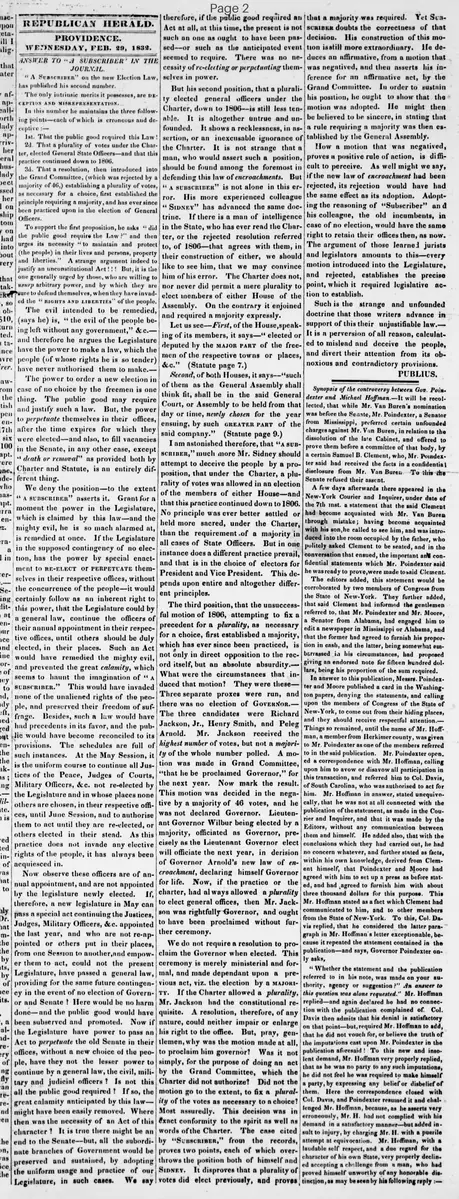
ANSWER TO "A SUBSCRIBER" IN THE JOURNAL.
"A Subscriber" on the new Election Law, has published his second number. The only intrinsic merits it possesses, are DECEPTION AND MISREPRESENTATION.
In this number he maintains the three following points each of which is erroneous and deceptive :
1st. That the public good required this Law!
2d. That a plurality of votes under the Charter, elected General State Officers and that this practice continued down to 1806.
3d. That a resolution, then introduced into the Grand Committee, (which was rejected by a majority of 46,) establishing a plurality of votes, as necessary for a choice, first established the principle requiring a majority, and has ever since been practiced upon in the election of General Officers.
To support the first proposition, he asks "did the public good require the Law?" and then urges its necessity to maintain and protect (the people) in their lives and persons, property and liberties."
A strange argument indeed to justify an unconstitutional Act ! !! But, it is the one generally urged by those, who are willing to usurp arbitrary power, and by which they are sure to defend themselves, when they have invaded the RIGHTS AND LIBERTIES of the people.
The evil intended to be remedied, (says he) is, "the evil of the people being left without any government," &c. and therefore he argues the Legislature have the power to make a law, which the people (of whose rights he is so tender) have never authorised them to make.
The power to order a new election in case of no choice by the freemen is one thing. The public good may require and justify such a law. But, the power to perpetuate themselves in their offices, after the time expires for which they were elected and also, to fill vacancies in the Senate, in any other case, except "death or removal" as provided both by Charter and Statute, is an entirely different thing.
We deny the position to the extent "A SUBSCRIBER" asserts it. Grant for a moment the power in the Legislature, which is claimed by this law and the mighty evil, he is so much alarmed at, is remedied at once. If the Legislature in the supposed contingency of no election, has the power by special enactment to RE-ELECT Or PERPETUATE themselves in their respective offices, without the concurrence of the people it would certainly follow as an inherent right to this power, that the Legislature could by a general law, continue the officers of their annual appointment in their respective offices, until others should be duly elected, in their places. Such an Act would have remedied the mighty evil, and prevented the great calamity, which seems to haunt the imagination of "A SUBSCRIBER."
This would have invaded none of the unalienable rights of the people, and preserved their freedom of suffrage.
Besides, such a law would have had precedents in its favor, and the public would have become reconciled to its provisions. The schedules are full of such instances. At the May Session, it is the uniform course to continue all Justices of the Peace, Judges of Courts, Military Officers, &c. not re-elected by the Legislature and in whose places none others are chosen, in their respective offices, until June Session, and to authorise them to act until they are re-elected, or others elected in their stead. As this practice does not invade any elective rights of the people, it has always been acquiesced in.
Now observe these officers are of annual appointment, and are not appointed by the legislature newly elected.
If, therefore, a new legislature in May can pass a special act continuing the Justices, Judges, Military Officers, &c. appointed the last year, and who are not re-appointed or others put in their places, from one Session to another, and empower them to act, could not the present Legislature, have passed a general law, providing for the same future contingency in the event of no election of Governor and Senate ? Here would be no harm done and the public good would have been subserved and promoted. Now if the Legislature have power to pass an Act to perpetuate the old Senate in their offices, without a new choice of the people, have they not the lesser power to continue by a general law, the civil, military and judicial officers ? Is not this all the public good required ? If so, the great calamity anticipated by this law might have been easily removed. Where then was the necessity of an Act of this character ? It is true there might be an end to the Senate but, all the subordinate branches of Government would be preserved and sustained, by adopting the uniform usage and practice of our Legislature, in such cases. We say therefore, if the public good required an Act at all, at this time, the present is not such an one as ought to have been passed or such as the anticipated event seemed to require. There was no necessity of re-electing or perpetuating themselves in power.
But his second position, that a plurality elected general officers under the Charter, down to 1806 is still less tenable. It is altogether untrue and unfounded. It shows a recklessness, in assertion, or an inexcusable ignorance of the Charter. It is not strange that a man, who would assert such a position, should be found among the foremost in defending this law of encroachments. But "A SUBSCRIBER" is not alone in this error. His more experienced colleague "Sidney" has advanced the same doctrine. If there is a man of intelligence in the State, who has ever read the Charter, or the rejected resolution referred to, of 1806 that agrees with them, in their construction of either, we should like to see him, that we may convince him of his error. The Charter does not, nor never did permit a mere plurality to elect members of either House of the Assembly. On the contrary it enjoined and required a majority expressly.
Let us see First, of the House, speaking of its members, it says "elected or deputed by the MAJOR PART of the freemen of the respective towns or places, &c." (Statute page 7.)
Second, of both Houses, it says "such of them as the General Assembly shall think fit, shall be in the said General Court, or Assembly to be held from that day or time, newly chosen for the year ensuing, by such GREATER PART of the said company." (Statute page 9.)
I am astonished therefore, that "A SUBSCRIBER," much more Mr. Sidney should attempt to deceive the people by a proposition, that under the Charter, a plurality of votes was allowed in an election of the members of either House and that this practice continued down to 1806.
No principle was ever better settled or held more sacred, under the Charter, than the requirement of a majority in all cases of State Officers. But in one instance does a different practice prevail, and that is in the choice of electors for President and Vice President. This depends upon entire and altogether different principles.
The third position, that the unsuccessful motion of 1806, attempting to fix a precedent for a plurality, as necessary for a choice, first established a majority, which has ever since been practiced, is not only in direct opposition to the record itself, but an absolute absurdity. What were the circumstances that induced that motion? They were these Three separate proxies were run, and there was no election of Governor. The three candidates were Richard Jackson, Jr., Henry Smith, and Peleg Arnold. Mr. Jackson received the highest number of votes, but not a majority of the whole number polled. A motion was made in Grand Committee, "that he be proclaimed Governor," for the next year. Now mark the result.
This motion was decided in the negative by a majority of 46 votes, and he was not declared Governor. Lieutenant Governor Wilbur being elected by a majority, officiated as Governor, precisely as the Lieutenant Governor elect will officiate the next year, in derision of Governor Arnold's new Law of encroachment, declaring himself Governor for life. Now, if the practice or the charter, had always allowed a plurality to elect general offices, then Mr. Jackson was rightfully Governor, and ought to have been proclaimed without further ceremony
We do not require a resolution to proclaim the Governor when elected. This ceremony is merely ministerial and formal, and made dependant upon a previous act, viz. the election by a MAJORITY. If the Charter allowed a plurality, Mr. Jackson had the constitutional requisite. A resolution, therefore, of any nature, could neither impair or enlarge his right to the office. But, pray, gentlemen, why was the motion made at all, to proclaim him governor? Was it not simply, for the purpose of doing an act by the Grand Committee, which the Charter did not authorize? Did not the motion go to the extent, to fix a plurality of the votes as necessary to a choice? Most assuredly. This decision was in exact conformity to the spirit as well as words of the Charter. The case cited by "SUBSCRIBER," from the records proves two points, each of which overthrows the position both of himself and Sidney. It disproves that a plurality of votes did elect previously, and proves that a majority was required. Yet SUBSCRIBER doubts the correctness of that decision. His construction of this motion is still more extraordinary. He deduces an affirmative, from a motion that was negatived, and then asserts his inference for an affirmative act, by the Grand Committee. In order to sustain his position, he ought to show that the motion was adopted. He might then be believed to be sincere, in stating that a rule requiring a majority was then established by the General Assembly
How a motion that was negatived, proves a positive rule of action, is difficult to perceive. As well might we say, if the new law of encroachment had been rejected, its rejection would have had the same effect as its adoption. Adopting the reasoning of "Subscriber" and his colleague, the old incumbents, in case of no election, would have the same right to retain their offices then, as now.
The argument of those learned jurists and legislators amounts to this every motion introduced into the Legislature, and rejected, establishes the precise point, which it required legislative action to establish.
Such is the strange and unfounded doctrine that those writers advance in support of this their unjustifiable law. It is a perversion of all reason, calculated to mislead and deceive the people, and divert their attention from its obnoxious and contradictory provisions.
PUBLIUS.
"A Subscriber" on the new Election Law, has published his second number. The only intrinsic merits it possesses, are DECEPTION AND MISREPRESENTATION.
In this number he maintains the three following points each of which is erroneous and deceptive :
1st. That the public good required this Law!
2d. That a plurality of votes under the Charter, elected General State Officers and that this practice continued down to 1806.
3d. That a resolution, then introduced into the Grand Committee, (which was rejected by a majority of 46,) establishing a plurality of votes, as necessary for a choice, first established the principle requiring a majority, and has ever since been practiced upon in the election of General Officers.
To support the first proposition, he asks "did the public good require the Law?" and then urges its necessity to maintain and protect (the people) in their lives and persons, property and liberties."
A strange argument indeed to justify an unconstitutional Act ! !! But, it is the one generally urged by those, who are willing to usurp arbitrary power, and by which they are sure to defend themselves, when they have invaded the RIGHTS AND LIBERTIES of the people.
The evil intended to be remedied, (says he) is, "the evil of the people being left without any government," &c. and therefore he argues the Legislature have the power to make a law, which the people (of whose rights he is so tender) have never authorised them to make.
The power to order a new election in case of no choice by the freemen is one thing. The public good may require and justify such a law. But, the power to perpetuate themselves in their offices, after the time expires for which they were elected and also, to fill vacancies in the Senate, in any other case, except "death or removal" as provided both by Charter and Statute, is an entirely different thing.
We deny the position to the extent "A SUBSCRIBER" asserts it. Grant for a moment the power in the Legislature, which is claimed by this law and the mighty evil, he is so much alarmed at, is remedied at once. If the Legislature in the supposed contingency of no election, has the power by special enactment to RE-ELECT Or PERPETUATE themselves in their respective offices, without the concurrence of the people it would certainly follow as an inherent right to this power, that the Legislature could by a general law, continue the officers of their annual appointment in their respective offices, until others should be duly elected, in their places. Such an Act would have remedied the mighty evil, and prevented the great calamity, which seems to haunt the imagination of "A SUBSCRIBER."
This would have invaded none of the unalienable rights of the people, and preserved their freedom of suffrage.
Besides, such a law would have had precedents in its favor, and the public would have become reconciled to its provisions. The schedules are full of such instances. At the May Session, it is the uniform course to continue all Justices of the Peace, Judges of Courts, Military Officers, &c. not re-elected by the Legislature and in whose places none others are chosen, in their respective offices, until June Session, and to authorise them to act until they are re-elected, or others elected in their stead. As this practice does not invade any elective rights of the people, it has always been acquiesced in.
Now observe these officers are of annual appointment, and are not appointed by the legislature newly elected.
If, therefore, a new legislature in May can pass a special act continuing the Justices, Judges, Military Officers, &c. appointed the last year, and who are not re-appointed or others put in their places, from one Session to another, and empower them to act, could not the present Legislature, have passed a general law, providing for the same future contingency in the event of no election of Governor and Senate ? Here would be no harm done and the public good would have been subserved and promoted. Now if the Legislature have power to pass an Act to perpetuate the old Senate in their offices, without a new choice of the people, have they not the lesser power to continue by a general law, the civil, military and judicial officers ? Is not this all the public good required ? If so, the great calamity anticipated by this law might have been easily removed. Where then was the necessity of an Act of this character ? It is true there might be an end to the Senate but, all the subordinate branches of Government would be preserved and sustained, by adopting the uniform usage and practice of our Legislature, in such cases. We say therefore, if the public good required an Act at all, at this time, the present is not such an one as ought to have been passed or such as the anticipated event seemed to require. There was no necessity of re-electing or perpetuating themselves in power.
But his second position, that a plurality elected general officers under the Charter, down to 1806 is still less tenable. It is altogether untrue and unfounded. It shows a recklessness, in assertion, or an inexcusable ignorance of the Charter. It is not strange that a man, who would assert such a position, should be found among the foremost in defending this law of encroachments. But "A SUBSCRIBER" is not alone in this error. His more experienced colleague "Sidney" has advanced the same doctrine. If there is a man of intelligence in the State, who has ever read the Charter, or the rejected resolution referred to, of 1806 that agrees with them, in their construction of either, we should like to see him, that we may convince him of his error. The Charter does not, nor never did permit a mere plurality to elect members of either House of the Assembly. On the contrary it enjoined and required a majority expressly.
Let us see First, of the House, speaking of its members, it says "elected or deputed by the MAJOR PART of the freemen of the respective towns or places, &c." (Statute page 7.)
Second, of both Houses, it says "such of them as the General Assembly shall think fit, shall be in the said General Court, or Assembly to be held from that day or time, newly chosen for the year ensuing, by such GREATER PART of the said company." (Statute page 9.)
I am astonished therefore, that "A SUBSCRIBER," much more Mr. Sidney should attempt to deceive the people by a proposition, that under the Charter, a plurality of votes was allowed in an election of the members of either House and that this practice continued down to 1806.
No principle was ever better settled or held more sacred, under the Charter, than the requirement of a majority in all cases of State Officers. But in one instance does a different practice prevail, and that is in the choice of electors for President and Vice President. This depends upon entire and altogether different principles.
The third position, that the unsuccessful motion of 1806, attempting to fix a precedent for a plurality, as necessary for a choice, first established a majority, which has ever since been practiced, is not only in direct opposition to the record itself, but an absolute absurdity. What were the circumstances that induced that motion? They were these Three separate proxies were run, and there was no election of Governor. The three candidates were Richard Jackson, Jr., Henry Smith, and Peleg Arnold. Mr. Jackson received the highest number of votes, but not a majority of the whole number polled. A motion was made in Grand Committee, "that he be proclaimed Governor," for the next year. Now mark the result.
This motion was decided in the negative by a majority of 46 votes, and he was not declared Governor. Lieutenant Governor Wilbur being elected by a majority, officiated as Governor, precisely as the Lieutenant Governor elect will officiate the next year, in derision of Governor Arnold's new Law of encroachment, declaring himself Governor for life. Now, if the practice or the charter, had always allowed a plurality to elect general offices, then Mr. Jackson was rightfully Governor, and ought to have been proclaimed without further ceremony
We do not require a resolution to proclaim the Governor when elected. This ceremony is merely ministerial and formal, and made dependant upon a previous act, viz. the election by a MAJORITY. If the Charter allowed a plurality, Mr. Jackson had the constitutional requisite. A resolution, therefore, of any nature, could neither impair or enlarge his right to the office. But, pray, gentlemen, why was the motion made at all, to proclaim him governor? Was it not simply, for the purpose of doing an act by the Grand Committee, which the Charter did not authorize? Did not the motion go to the extent, to fix a plurality of the votes as necessary to a choice? Most assuredly. This decision was in exact conformity to the spirit as well as words of the Charter. The case cited by "SUBSCRIBER," from the records proves two points, each of which overthrows the position both of himself and Sidney. It disproves that a plurality of votes did elect previously, and proves that a majority was required. Yet SUBSCRIBER doubts the correctness of that decision. His construction of this motion is still more extraordinary. He deduces an affirmative, from a motion that was negatived, and then asserts his inference for an affirmative act, by the Grand Committee. In order to sustain his position, he ought to show that the motion was adopted. He might then be believed to be sincere, in stating that a rule requiring a majority was then established by the General Assembly
How a motion that was negatived, proves a positive rule of action, is difficult to perceive. As well might we say, if the new law of encroachment had been rejected, its rejection would have had the same effect as its adoption. Adopting the reasoning of "Subscriber" and his colleague, the old incumbents, in case of no election, would have the same right to retain their offices then, as now.
The argument of those learned jurists and legislators amounts to this every motion introduced into the Legislature, and rejected, establishes the precise point, which it required legislative action to establish.
Such is the strange and unfounded doctrine that those writers advance in support of this their unjustifiable law. It is a perversion of all reason, calculated to mislead and deceive the people, and divert their attention from its obnoxious and contradictory provisions.
PUBLIUS.
What sub-type of article is it?
Constitutional
Suffrage
Legal Reform
What keywords are associated?
Election Law
Majority Vote
Charter Rights
Legislative Power
Plurality Election
Constitutional Violation
Public Good
Grand Committee
What entities or persons were involved?
A Subscriber
Sidney
Publius
Richard Jackson Jr.
Henry Smith
Peleg Arnold
Lieutenant Governor Wilbur
Legislature
Grand Committee
Editorial Details
Primary Topic
Opposition To The New Election Law
Stance / Tone
Strongly Critical Of The Law As Unconstitutional And Deceptive
Key Figures
A Subscriber
Sidney
Publius
Richard Jackson Jr.
Henry Smith
Peleg Arnold
Lieutenant Governor Wilbur
Legislature
Grand Committee
Key Arguments
The Law Unconstitutionally Allows Perpetuation Of Legislators In Office Without Majority Election
Public Good Does Not Require This Specific Law; Alternatives Like Continuing Subordinate Officers Exist
Charter Always Required Majority Votes For State Officers, Not Plurality, Contrary To Claims
1806 Resolution Rejecting Plurality For Governor Election Confirms Majority Requirement
Defenders' Arguments Rely On Deception And Misinterpretation Of History