Thank you for visiting SNEWPapers!
Sign up free
The Weekly Visitor
Central Falls, Providence County, Rhode Island
What is this article about?
In Boston, privileged teenager Edith Moreton meets poor Irish girl Bridget Flanagan. They spot a fire in a warehouse, raise the alarm together, saving the block from destruction. Edith aids the injured Bridget, who is sent to a home in New Hampshire.
Clipping
OCR Quality
Full Text
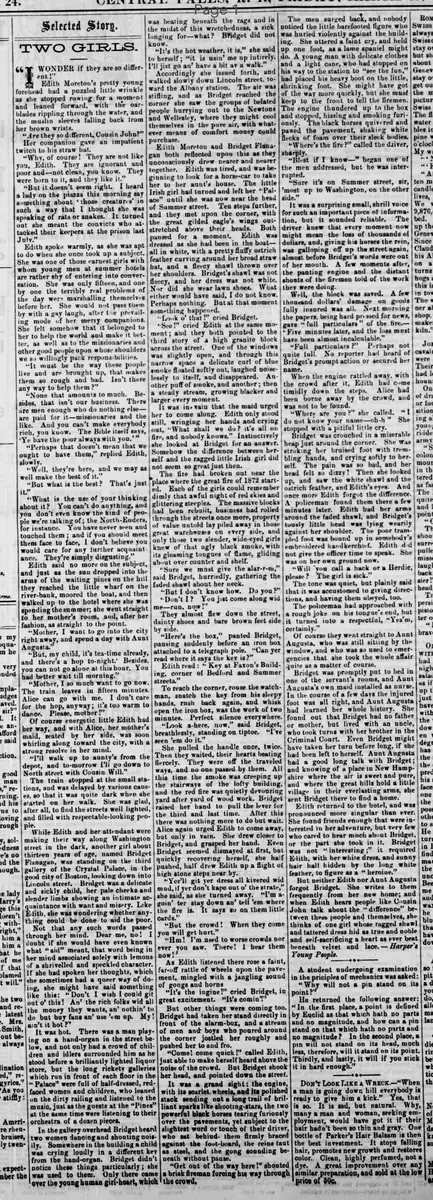
TWO GIRLS.
"I wonder if they are so different!"
Edith Moreton's pretty young forehead had a puzzled little wrinkle as she stopped rowing for a moment and leaned forward, with the oar-blades rippling through the water, and the muslin sleeves falling back from her brown wrists.
"Are they so different, Cousin John?"
Her companion gave an impatient twitch to his straw hat.
"Why, of course! They are not like you, Edith. They are ignorant and poor and-not clean, you know. They were born to it, and they like it."
"But it doesn't seem right. I heard a lady on the piazza this morning say something about 'those creatures' in such a way that I thought she was speaking of rats or snakes. It turned out she meant the convicts who attacked their keepers at the prison last July."
Edith spoke warmly, as she was apt to do when she once took up a subject. She was one of those earnest girls with whom young men at summer hotels are rather shy of entering into conversation. She was only fifteen, and one by one the terribly real problems of the day were marshalling themselves before her. She would not pass them by with a gay laugh, after the prevailing mode of her merry companions. She felt somehow that it belonged to her to help the world and make it better, as well as to the missionaries and other good people upon whose shoulders we so willingly pack responsibilities.
"It must be the way these people live and are brought up, that makes them so rough and bad. Isn't there any way to help them?"
"None that amounts to much. Besides, that isn't our business. There are men enough who do nothing else- are paid for it-missionaries and the like. And you can't make everybody rich, you know. The Bible itself says, 'Ye have the poor always with you.'"
"Perhaps that doesn't mean that we ought to have them," replied Edith, slowly.
Well, they're here, and we may as well make the best of it."
"But what is the best? That's just it."
"What is the use of your thinking about it? You can't do anything, and you don't even know the kind of people we're talking of; the North-Enders, for instance. You have never seen and touched them; and if you should meet them face to face, I don't believe you would care for any further acquaintance. They're simply disgusting."
Edith said no more on the subject, and just as the sun dropped into the arms of the waiting pines on the hill they reached the little wharf on the river-bank, moored the boat, and then walked up to the hotel where she was spending the summer; she went straight to her mother's room, and, after her fashion, as straight to the point.
"Mother, I want to go into the city right away, and spend a day with Aunt Augusta."
"But, my child, it's tea-time already, and there's a hop to-night. Besides, you can not go alone at this hour. You had better wait till morning."
"Mother, I so much want to go now. The train leaves in fifteen minutes. Alice can go with me. I don't care for the hop, anyway; it's too warm to dance. Please, mother!"
Of course energetic little Edith had her way, and with Alice, her mother's maid, seated by her side, was soon whirling along toward the city, with a strong resolve in her mind.
"I'll walk up to aunty's from the depot, and to-morrow I'll go down to North street with Cousin Will."
The train stopped at the small stations, and was delayed by various causes, so that it was quite dark when she started on her walk. She was glad, after all, to find the streets well lighted, and filled with respectable-looking people.
While Edith and her attendant were making their way along Washington street in the dark, another girl about thirteen years of age, named Bridget Flanagan, was standing on the third gallery of the Crystal Palace, in the good city of Boston, looking down into Lincoln street. Bridget was a delicate and sickly child, her pale cheeks and slender limbs showing an intimate acquaintance with want and misery. Like Edith, she was wondering whether anything could be done to aid the poor.
It was hot. There was a man playing on a hand-organ in the street below, and not only had a crowd of children and idlers surrounded him as he stood before a brilliantly lighted liquor store, but the long rickety galleries which run in front of each floor in the "Palace" were full of half-dressed, red-faced women and children, who leaned on the dirty railing and listened to the music, just as the guests at the "Pines" at the same time were listening to their orchestra of a dozen pieces.
In the gallery overhead Bridget heard two women dancing and shouting noisily. Somewhere in the building a child was crying loudly in a different key from the hand-organ. Bridget didn't notice these things particularly; she was used to them. Only there came
was beating beneath the rags and in the midst of this wretchedness, a sick longing for--what? Bridget did not know.
"It's the hot weather. it is." she said to herself; "it is usin' me up intirely. I'll jist go an' have a bit av a walk."
Accordingly she issued forth, and walked slowly down Lincoln street, toward the Albany station. The air was stifling, and as Bridget reached the corner she saw the groups of belated people hurrying out to the Newtons and Wellesley, where they might cool themselves in the pure air, with whatever means of comfort money could purchase.
Edith Moreton and Bridget Flanagan both reflected upon this as they unconsciously drew nearer and nearer together. Edith was tired, and was beginning to look for a horse-car to take her to her aunt's house. The little Irish girl had turned and left her "Palace" until she was now near the head of Summer street. Ten steps further, and they met upon the corner, with the great gilded eagle's wings outstretched above their heads. Both paused for a moment. Edith was dressed as she had been in the boat-all in white, with a pretty fluffy ostrich feather curving around her broad straw hat, and a fleecy shawl thrown over her shoulders. Bridget's shawl was not fleecy, and her dress was not white. Nor did she wear lawn shoes. What either would have said, I do not know. Perhaps nothing. But at that moment something happened.
…Look o' that!" cried Bridget.
"See!" cried Edith at the same moment; and they both pointed to the third story of a high granite block across the street. One of the windows was slightly open, and through this narrow space a delicate curl of blue smoke floated softly out, laughed noiselessly to itself, and disappeared. Another puff of smoke, and another; then a steady stream, growing blacker and larger every moment.
It was in vain that the maid urged her to come along. Edith only stood still, wringing her hands and crying out, "What shall we do? it's all on fire, and nobody knows." Instinctively she looked at Bridget for an answer. Somehow the difference between herself and the ragged little Irish girl did not seem so great just then.
The fire had broken out near the place where the great fire of 1872 started. Each of the girls could remember dimly that awful night of red skies and glittering steeples. The massive blocks had been rebuilt, business had rolled through the streets once more, property of value untold lay piled away in those great warehouses on every side, and only those two slender, wide-eyed girls knew of that ugly black smoke, with its gleaming tongues of flame, gliding about over counter and shelf.
"Sure we must give the alar-r-m." said Bridget, hurriedly, gathering the faded shawl about her neck.
"But I don't know how. Do you?"
"Don't I? You jist come along wid me-run, now"
They almost flew down the street, dainty shoes and bare brown feet side by side.
"Here's the box," panted Bridget, pausing suddenly before an iron box attached to a telegraph pole. "Can yer read where it says the key is?"
Edith read: "Key at Faxon's Building, corner of Bedford and Summer streets."
To reach the corner, rouse the watchman, snatch the key from his sleepy hands, rush back again, and whisk open the iron box, was the work of two minutes. Perfect silence everywhere.
"Look a-here, now," said Bridget, breathlessly, standing on tiptoe. "I've seen 'em do it."
She pulled the handle once, twice. Then they waited, their hearts beating fiercely. They were off the traveled ways, and no one passed by them. All this time the smoke was creeping up the stairways of the lofty building, and the red fire was quietly devouring yard after yard of wood work. Bridget raised her hand to pull the lever for the third and last time. After this there was nothing more to do but wait. Alice again urged Edith to come away, but only in vain. She drew closer to Bridget, and grasped her hand. Even Bridget seemed dismayed at first, but quickly recovering herself, she half pushed, half drew Edith up a flight of high stone steps near by.
"Yer'll git yer dress all kivered wid mud, if yer don't kape out o' the strate," she said, as she turned away. "I'm a-goin' ter stay down an' tell 'em where the fire is. It says so on them little Cards."
"But the crowd! When they come you will get hurt."
"Ho! I'm used to worse crowds nor ever you saw. There! I hear them now!"
As Edith listened there rose a faint, far-off rattle of wheels upon the pavement, mingled with a jangling sound of gongs and horns
"It's the ingine!" cried Bridget, in great excitement. "It's comin'!"
But other things were coming too. Bridget had taken her stand directly in front of the alarm-box, and a stream of men and boys who poured around the corner jostled her roughly and pushed her to and fro.
"Come! come quick!" called Edith, just able to make herself heard above the noise of the crowd. But Bridget shook her head, and pointed down the street.
It was a grand sight: the engine, with its scarlet wheels, and its polished stack sending out a long trail of brilliant sparks like shooting-stars, the two powerful black horses tearing furiously over the pavements, yet subject to the slightest word or touch of their driver, who sat behind them firmly braced against the foot-board, the reins taut as steel, and the gong sounding beneath without pause.
"Get out of the way here!" shouted a brisk fireman forcing his way through the crowd,
The men surged back, and nobody noticed the little barefooted figure who was hurled violently against the building.
She uttered a faint cry, and held up one foot, as a lame spaniel might do. A young man with delicate clothes and a light cane, who had stopped on his way to the station to "see the fun," had placed his heavy boot on the little, shrinking foot. She might have got of the way more quickly, but she must keep to the front to tell the firemen.
The engine thundered up to the box and stopped, hissing and smoking furiously. The black horses quivered and pawed the pavement, shaking white flecks of foam over their sleek bodies.
"Where's the fire?" called the driver, sharply.
"Blest if I know-" began one of the men addressed, but he was interrupted.
"Sure it's on Summer street, sir. 'most up to Washington, on the other side."
It was a surprisingly small, shrill voice for such an important piece of information, but it sounded reliable. The driver knew that every moment now might mean the loss of thousands of dollars, and, giving his horses the rein, was galloping off up the street again, almost before Bridget's words were out of her mouth. A few moments after, the panting engine and the distant shouts of the firemen told of the work they were doing.
Well, the block was saved. A few thousand dollars' damage on goods fully insured was all. Next morning the papers, being hard pressed for news, gave full particulars of the fire.-
"Five minutes later, and the loss must have been almost incalculable."
"Full particulars?" Perhaps not quite full. No reporter had heard of Bridget's prompt action or secured her name.
When the engine rattled away, with the crowd after it, Edith had come timidly down the steps. Alice had been borne away by the crowd, and was not to be found.
"Where are you?" she called. "I do not know your name-oh-h" She stopped with a pitiful little cry.
Bridget was crouched in a miserable heap just around the corner. She was stroking her bruised foot with trembling hands, and crying softly to herself. The pain was so bad, and her head felt so dizzy! Then she looked up, and saw the white shawl and the ostrich feather, and Edith's eyes. And once more Edith forgot the difference.
A policeman found them there a few minutes later. Edith had her arms around the faded shawl, and Bridget's tousled little head was lying wearily against her shoulder. The poor trampled foot was bound up in somebody's embroidered handkerchief. Edith did not give the officer time to speak. She was on her own ground now.
"Will you call a hack or a Herdic, please? The girl is sick."
The tone was quiet, but plainly said that it was accustomed to giving directions, and having them obeyed, too.
The policeman had approached with a rough joke on his tongue's end, but it turned into a respectful, "Yes'm, certainly."
Of course they went straight to Aunt Augusta, who was still sitting by the window, and who was so used to emergencies that she took the whole affair quite as a matter of course.
Bridget was promptly put to bed in one of the servant's rooms, and Aunt Augusta's own maid installed as nurse.
In the course of a few days the injured foot was all right, and Aunt Augusta had learned her whole history. She found out that Bridget had no father or mother, but lived with an uncle, who took turns with her brother in the Criminal Court. Even Bridget might have taken her turn before long, if she had been left to herself. Aunt Augusta had a good long talk with Bridget: and knowing of a place in New Hampshire where the air is sweet and pure, and where the great hills hold a little village in their everlasting arms, she sent Bridget there to find a home.
Edith returned to the hotel, and was pronounced more singular than ever. She found friends enough that were interested in her adventure, but very few who cared to hear much about Bridget, or the part she took in it. Bridget was not "interesting;" it required Edith, with her white dress, and sunny hair half hidden by the long white feather, to figure as a "heroine."
But neither Edith nor Aunt Augusta forgot Bridget. She writes to them frequently from her new home; and when Edith hears people like Cousin John talk about the "difference" between these people and themselves, she thinks of one girl whose ragged shawl and tattered dress hid as true and noble and self-sacrificing a heart as ever beat beneath velvet and lace.-Harper's Young People.
What sub-type of article is it?
What themes does it cover?
What keywords are associated?
What entities or persons were involved?
Where did it happen?
Story Details
Key Persons
Location
Boston, Massachusetts (Summer Street, Washington Street, North End, Crystal Palace Tenement)
Event Date
Summer, After 1872
Story Details
Privileged Edith Moreton debates class differences with Cousin John at a summer hotel, then travels to Boston seeking to understand the poor. She meets sickly Bridget Flanagan from a tenement. They discover a warehouse fire near the 1872 fire site, retrieve an alarm key, sound the alarm, and direct firefighters, saving the block. Bridget is injured in the crowd; Edith cares for her, and Aunt Augusta sends Bridget to a home in New Hampshire.