Thank you for visiting SNEWPapers!
Sign up free
Story
October 10, 1960
The Augusta Courier
Augusta, Richmond County, Georgia
What is this article about?
Governor Ernest Vandiver addresses the Georgia State Chamber of Commerce council in Atlanta on September 20, 1960, outlining future needs in education, highways, mental health, and other areas, emphasizing the necessity of additional taxes from state or local levels to fund expansions.
Clipping
OCR Quality
92%
Excellent
Full Text
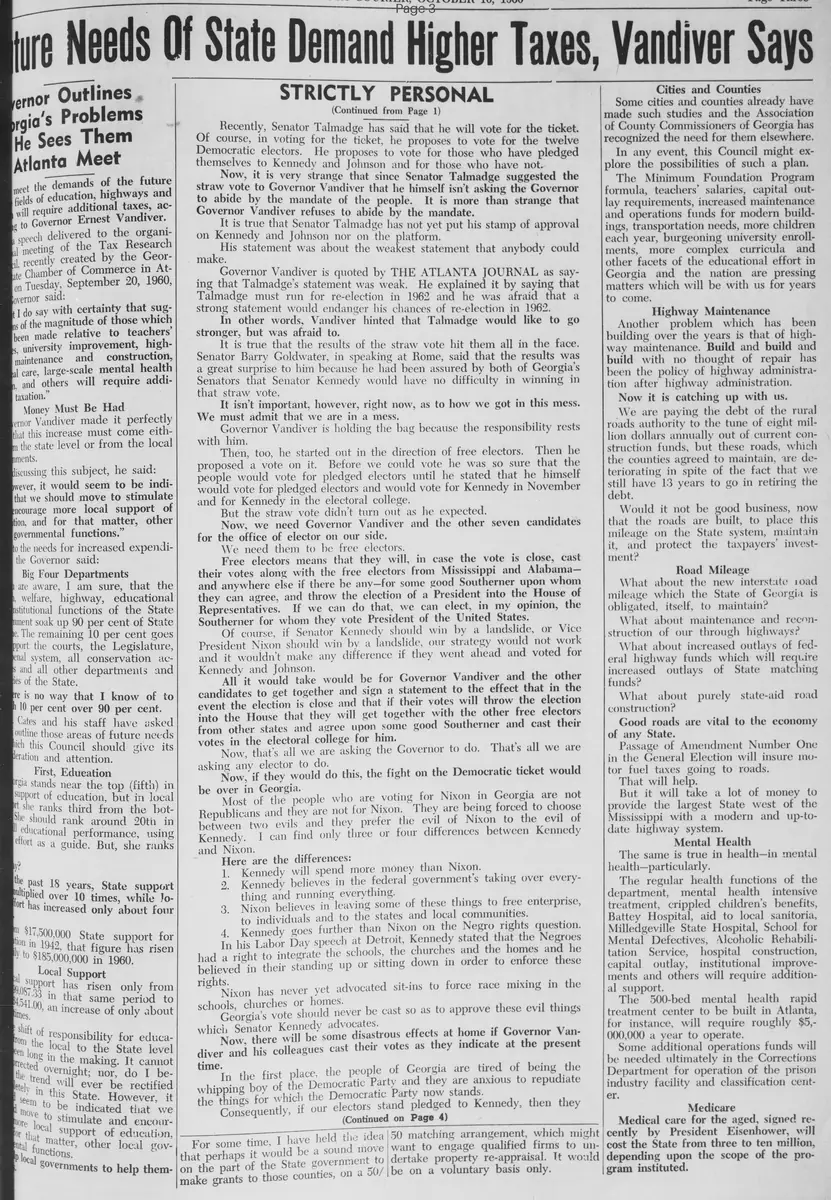
Future Needs of State Demand Higher Taxes, Vandiver Says
Governor Outlines Georgia's Problems
He Sees Them
Atlanta Meet
The fields of education, highways and others to meet the demands of the future according to Governor Ernest Vandiver.
It will require additional taxes, according to a speech delivered to the council, recently created by the Georgia State Chamber of Commerce in Atlanta on Tuesday, September 20, 1960.
Governor said:
Expansions of the magnitude of those which have been made relative to teachers salaries, university improvement, highways, hospital care, large-scale mental health facilities maintenance and construction, pensions, and others will require additional taxation.
Money Must Be Had
Governor Vandiver made it perfectly clear that this increase must come either from the state level or from the local governments.
In discussing this subject, he said:
However, it would seem to be indicated that we should move to stimulate and encourage more local support of education, and for that matter, other local governmental functions.
As to the needs for increased expenditures, the Governor said:
Big Four Departments
As you are aware, I am sure, that the health, welfare, highway, educational and institutional functions of the State government soak up 90 per cent of State revenue. The remaining 10 per cent goes to support the courts, the Legislature, the penal system, all conservation activities and all other departments and agencies of the State.
There is no way that I know of to stretch either 10 per cent over 90 per cent.
Cates and his staff have asked me to outline those areas of future needs which this Council should give its consideration and attention.
First, Education
Georgia stands near the top (fifth) in state support of education, but in local support she ranks third from the bottom.
She should rank around 20th in overall educational performance, using effort as a guide. But, she ranks last?
In the past 18 years, State support has multiplied over 10 times, while local effort has increased only about four times.
From $17,500,000 State support for education in 1942, that figure has risen dramatically to $185,000,000 in 1960.
Local Support
Local support has risen only from $9,087.33 in that same period to $54,541.00, an increase of only about six times.
This represents a shift of responsibility for education from the local to the State level which has been long in the making.
It cannot be corrected overnight; although the trend will continue completely in this State.
It would seem to be indicated that we should never do I believe we should move to stimulate and encourage more local support of education, for that matter, other local governmental functions.
Propose to local governments to help them meet their responsibilities.
For some time, I have held the idea of a 50 percent matching arrangement, which might serve to encourage on the part of the State government to undertake property re-appraisal. It would seem logical to want to engage qualified firms to make grants to those counties, on a 50/50 matching basis and it would be on a voluntary basis only.
Cities and Counties
Some cities and counties already have made such studies and the Association of County Commissioners of Georgia has recognized the need for them elsewhere.
In any event, this Council might explore the possibilities of such a plan.
The Minimum Foundation Program formula, teachers' salaries, capital outlay requirements, increased maintenance and operations funds for modern buildings, transportation needs, more children each year, burgeoning university enrollments, more complex curricula and other facets of the educational effort in Georgia and the nation are pressing matters which will be with us for years to come.
Highway Maintenance
Another problem which has been building over the years is that of highway maintenance. Build and build and build with no thought of repair has been the policy of highway administration after highway administration.
Now it is catching up with us.
We are paying the debt of the rural roads authority to the tune of eight million dollars annually out of current construction funds, but these roads, which the counties agreed to maintain, are deteriorating in spite of the fact that we still have 13 years to go in retiring the debt.
Would it not be good business, now that the roads are built, to place this mileage on the State system, maintain it, and protect the taxpayers' investment?
Road Mileage
What about the new interstate road mileage which the State of Georgia is obligated, itself, to maintain?
What about maintenance and reconstruction of our through highways?
What about increased outlays of federal highway funds which will require increased outlays of State matching funds?
What about purely state-aid road construction?
Good roads are vital to the economy of any State.
Passage of Amendment Number One in the General Election will insure motor fuel taxes going to roads.
That will help.
But it will take a lot of money to provide the largest State west of the Mississippi with a modern and up-to-date highway system.
Mental Health
The same is true in health-in mental health-particularly.
The regular health functions of the department, mental health intensive treatment, crippled children's benefits, Battey Hospital, aid to local sanitoria, Milledgeville State Hospital, School for Mental Defectives, Alcoholic Rehabilitation Service, hospital construction, capital outlay, institutional improvements and others will require additional support.
The 500-bed mental health rapid treatment center to be built in Atlanta, for instance, will require roughly $5,000,000 a year to operate.
Some additional operations funds will be needed ultimately in the Corrections Department for operation of the prison industry facility and classification center.
Medicare
Medical care for the aged, signed recently by President Eisenhower, will cost the State from three to ten million, depending upon the scope of the program instituted.
Governor Outlines Georgia's Problems
He Sees Them
Atlanta Meet
The fields of education, highways and others to meet the demands of the future according to Governor Ernest Vandiver.
It will require additional taxes, according to a speech delivered to the council, recently created by the Georgia State Chamber of Commerce in Atlanta on Tuesday, September 20, 1960.
Governor said:
Expansions of the magnitude of those which have been made relative to teachers salaries, university improvement, highways, hospital care, large-scale mental health facilities maintenance and construction, pensions, and others will require additional taxation.
Money Must Be Had
Governor Vandiver made it perfectly clear that this increase must come either from the state level or from the local governments.
In discussing this subject, he said:
However, it would seem to be indicated that we should move to stimulate and encourage more local support of education, and for that matter, other local governmental functions.
As to the needs for increased expenditures, the Governor said:
Big Four Departments
As you are aware, I am sure, that the health, welfare, highway, educational and institutional functions of the State government soak up 90 per cent of State revenue. The remaining 10 per cent goes to support the courts, the Legislature, the penal system, all conservation activities and all other departments and agencies of the State.
There is no way that I know of to stretch either 10 per cent over 90 per cent.
Cates and his staff have asked me to outline those areas of future needs which this Council should give its consideration and attention.
First, Education
Georgia stands near the top (fifth) in state support of education, but in local support she ranks third from the bottom.
She should rank around 20th in overall educational performance, using effort as a guide. But, she ranks last?
In the past 18 years, State support has multiplied over 10 times, while local effort has increased only about four times.
From $17,500,000 State support for education in 1942, that figure has risen dramatically to $185,000,000 in 1960.
Local Support
Local support has risen only from $9,087.33 in that same period to $54,541.00, an increase of only about six times.
This represents a shift of responsibility for education from the local to the State level which has been long in the making.
It cannot be corrected overnight; although the trend will continue completely in this State.
It would seem to be indicated that we should never do I believe we should move to stimulate and encourage more local support of education, for that matter, other local governmental functions.
Propose to local governments to help them meet their responsibilities.
For some time, I have held the idea of a 50 percent matching arrangement, which might serve to encourage on the part of the State government to undertake property re-appraisal. It would seem logical to want to engage qualified firms to make grants to those counties, on a 50/50 matching basis and it would be on a voluntary basis only.
Cities and Counties
Some cities and counties already have made such studies and the Association of County Commissioners of Georgia has recognized the need for them elsewhere.
In any event, this Council might explore the possibilities of such a plan.
The Minimum Foundation Program formula, teachers' salaries, capital outlay requirements, increased maintenance and operations funds for modern buildings, transportation needs, more children each year, burgeoning university enrollments, more complex curricula and other facets of the educational effort in Georgia and the nation are pressing matters which will be with us for years to come.
Highway Maintenance
Another problem which has been building over the years is that of highway maintenance. Build and build and build with no thought of repair has been the policy of highway administration after highway administration.
Now it is catching up with us.
We are paying the debt of the rural roads authority to the tune of eight million dollars annually out of current construction funds, but these roads, which the counties agreed to maintain, are deteriorating in spite of the fact that we still have 13 years to go in retiring the debt.
Would it not be good business, now that the roads are built, to place this mileage on the State system, maintain it, and protect the taxpayers' investment?
Road Mileage
What about the new interstate road mileage which the State of Georgia is obligated, itself, to maintain?
What about maintenance and reconstruction of our through highways?
What about increased outlays of federal highway funds which will require increased outlays of State matching funds?
What about purely state-aid road construction?
Good roads are vital to the economy of any State.
Passage of Amendment Number One in the General Election will insure motor fuel taxes going to roads.
That will help.
But it will take a lot of money to provide the largest State west of the Mississippi with a modern and up-to-date highway system.
Mental Health
The same is true in health-in mental health-particularly.
The regular health functions of the department, mental health intensive treatment, crippled children's benefits, Battey Hospital, aid to local sanitoria, Milledgeville State Hospital, School for Mental Defectives, Alcoholic Rehabilitation Service, hospital construction, capital outlay, institutional improvements and others will require additional support.
The 500-bed mental health rapid treatment center to be built in Atlanta, for instance, will require roughly $5,000,000 a year to operate.
Some additional operations funds will be needed ultimately in the Corrections Department for operation of the prison industry facility and classification center.
Medicare
Medical care for the aged, signed recently by President Eisenhower, will cost the State from three to ten million, depending upon the scope of the program instituted.
What sub-type of article is it?
Historical Event
What keywords are associated?
Georgia Taxes
Education Funding
Highway Maintenance
Mental Health Facilities
Local Support
State Revenue
What entities or persons were involved?
Ernest Vandiver
Cates
Dwight D. Eisenhower
Where did it happen?
Atlanta, Georgia
Story Details
Key Persons
Ernest Vandiver
Cates
Dwight D. Eisenhower
Location
Atlanta, Georgia
Event Date
September 20, 1960
Story Details
Governor Vandiver delivers a speech outlining Georgia's future needs in education, highways, mental health, and other public services, stressing the shift of responsibility from local to state levels and the need for additional taxation to fund expansions and maintenance.