Thank you for visiting SNEWPapers!
Sign up free
Editorial
September 29, 1864
The Tipton Advertiser
Tipton, Cedar County, Iowa
What is this article about?
The editorial criticizes the Democratic Party's 1864 Chicago platform for its duplicitous stance on Union preservation versus peace, and analyzes General McClellan's acceptance letter as an attempt to distance himself from the platform's ambiguities while still endorsing compromise.
Clipping
OCR Quality
95%
Excellent
Full Text
The Democratic Platform and the Democratic Candidate.
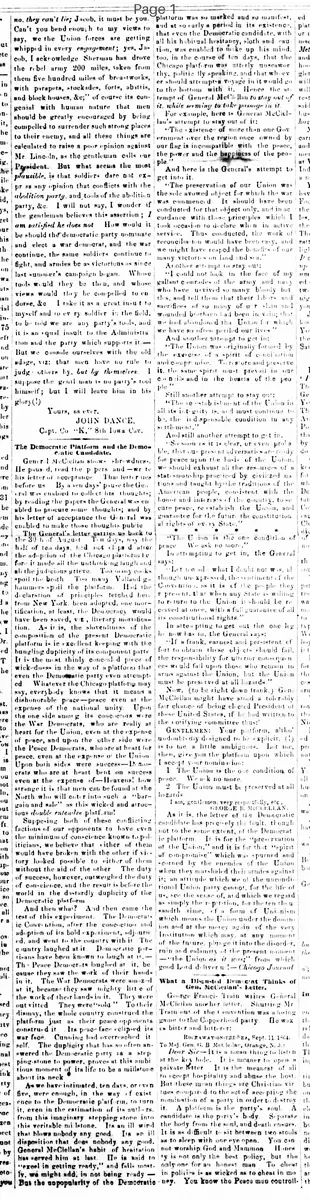
General McClellan saw shrewdness. He paused, read the papers and wrote his letter of acceptance. That letter lies before us. By a few days' pause the General was enabled to collect his thoughts; by reading the papers the General was enabled to procure some thoughts; and by his letter of acceptance the General was enabled to make those thoughts public. The General's letter carries us back to the 30th of August. Ten days, nay the half of ten days, had not elapsed after the adoption of the Chicago platform before it made all the young think ugly laugh and all the judicious grieve. Too many cooks spoil the broth. Too many Vallandigham hammers spoil the platform. Had the declaration of principles telegraphed hence from New York, been adopted, one mortification, at least, the Democracy would have been saved, viz, literary mortification. As it is, the slovenliness of the composition of the present Democratic platform is in excellent keeping with the bungling duplicity of its component parts. It is the most thinly concealed piece of wickedness in the way of a platform that even the Democratic party ever attempted. Whatever the Chicago platform may say, everybody knows that it means a dishonorable peace—peace even at the expense of the national unity. Upon the one side among its concoctors were the War Democrats, who are really at heart for the Union, even at the expense of peace, and upon the other side were the Peace Democrats, who are at heart for peace, even at the expense of the Union. Upon both sides were success-Democrats who are at heart bent on success even at the expense of—Heavens! how strange it is that men can be found at the North who will enter into such a "bargain and sale" as this wicked and atrocious double entendre platform! Supposing both of these conflicting factions of our opponents to have even the minimum of conscience known to politicians, we believe that either of them would have broken with the other if victory looked possible to either of them without the aid of the other. The duty of success, however, outweighed the duty of conscience, and the result is before the world in the dastardly duplicity of the Democratic platform. And then what? And then came the test of this experiment. The Democratic Convention, after the concoction and adoption of its bold experiment, adjourned and went to the country with it. The country laughed at it. Democratic papers have been known to laugh at it. The Peace Democrats laughed at it, because they saw the work of their hands in it. The War Democrats were amazed at it, because they saw mighty little of the work of their hands in it. They were outwitted. They were "sold." To their dismay, the whole country construed the platform just as their peace opponents construed it. Its peace face eclipsed its war face. Cunning had overreached itself. The duplicity that has so often answered the Democratic party as a stepping-stone to power, proves at this auspicious moment of its life to be a millstone about its neck. As we have intimated, ten days, or even five, were enough, in the way of existence to the Democratic platform, to turn it, even in the estimation of its authors, from this imaginary stepping stone into this veritable millstone. Its an ill wind that blows nobody any good. Its an ill disposition that does nobody any good. General McClellan's habit of hesitation has served him at last. He is said to "excel in getting ready," and fails most in not being ready. But the unpopularity of the Democratic platform was so marked and so manifest, and at so early a period in its existence, that even the Democratic candidate, with all his habitual hesitancy, sloth and caution, was enabled to make up his mind, too, in the course of ten days, that the Chicago platform was utterly unseaworthy, politically speaking, and that whoever should attempt a voyage in it would go to the bottom with it. Hence the attempt of General McClellan to stay out of it, while seeming to take passage in it. For example, here is General McClellan's attempt to stay out of it:
…The existence of more than one Government over the region once owned by our flag is incompatible with the peace, the power and the happiness of the people.
And here is the General's attempt to get into it.
"The preservation of our Union was the sole avowed object for which the war was commenced. It should have been conducted for that object only, and in accordance with those principles which I took occasion to declare when in active service. Thus conducted, the work of restoration would have been easy, and we might have reaped the benefits of our many victories on land and sea."
Another attempt to stay out:
…I could not look in the face of my gallant comrades of the army and navy who have survived so many bloody battles, and tell them that their labors and those sacrifices of so many of our slain and wounded brethren had been in vain; that we had abandoned the Union for which we have so often periled our lives.
And another attempt to get in:
"The Union was originally formed by the exercise of a spirit of conciliation and compromise. To restore and preserve it, the same spirit must prevail in our councils and in the hearts of the people."
Still another attempt to stay out:
The re-establishment of the Union in all its integrity is, and must continue to be, the indispensable condition in any settlement.
And still another attempt to get in.
…So soon as it is clear, or even probable, that our present adversaries are ready for peace upon the basis of the Union, we should exhaust all the resources of statesmanship practiced by civilized nations and taught by the traditions of the American people, consistent with the honor and interests of the country, to secure peace, re-establish the Union, and guarantee for the future the constitutional rights of every State."
"The Union is the one condition of peace. We ask no more."
In attempting to get in, the General says:
…I do not add what I doubt not was, though unexpressed, the sentiment of the Convention, as it is of the people they represent, that when any State is willing to return to the Union it should be received at once, with a full guarantee of all its constitutional rights."
In attempting to get out the one leg he now has in, the General says:
"If a frank, earnest and persistent effort to obtain those objects should fail, the responsibility for ulterior consequences will fall upon those who remain in arms against the Union, but the Union must be preserved at all hazards."
Now, (to be right down frank,) Gen. McClellan might have stood a tolerably fair chance of being elected President of these United States, if he had written to the notifying committee thus:
Gentlemen: Your platform, although undoubtedly designed to be explicit, is to me a little ambiguous. Let me, then, give you the platform upon which I accept your nomination:
1. The Union is the one condition of peace. We ask no more.
2. The Union must be preserved at all hazards.
I am, gentlemen, very respectfully, etc.
GEORGE B. McCLELLAN.
As it is, the letter of the Democratic candidate has precisely the fault, though not to the same extent, of the Democratic platform. It is for the preservation of the Union," and it is for that "spirit of compromise" which was spurned and scorned by the enemies of the Union when they marshaled their armies against it: an attitude which we of the unconditional Union party cannot, for the life of us, see the sense of, and which we regard as simply the repetition, for the ten thousandth time, of a form of Union which means the Union under the domination and at the mercy again of the very Institution which may, at any moment of the future, plunge it into the disorder, ruin and calamity of the present moment—the Union as it was: from which good Lord deliver us! (Chicago Journal.
General McClellan saw shrewdness. He paused, read the papers and wrote his letter of acceptance. That letter lies before us. By a few days' pause the General was enabled to collect his thoughts; by reading the papers the General was enabled to procure some thoughts; and by his letter of acceptance the General was enabled to make those thoughts public. The General's letter carries us back to the 30th of August. Ten days, nay the half of ten days, had not elapsed after the adoption of the Chicago platform before it made all the young think ugly laugh and all the judicious grieve. Too many cooks spoil the broth. Too many Vallandigham hammers spoil the platform. Had the declaration of principles telegraphed hence from New York, been adopted, one mortification, at least, the Democracy would have been saved, viz, literary mortification. As it is, the slovenliness of the composition of the present Democratic platform is in excellent keeping with the bungling duplicity of its component parts. It is the most thinly concealed piece of wickedness in the way of a platform that even the Democratic party ever attempted. Whatever the Chicago platform may say, everybody knows that it means a dishonorable peace—peace even at the expense of the national unity. Upon the one side among its concoctors were the War Democrats, who are really at heart for the Union, even at the expense of peace, and upon the other side were the Peace Democrats, who are at heart for peace, even at the expense of the Union. Upon both sides were success-Democrats who are at heart bent on success even at the expense of—Heavens! how strange it is that men can be found at the North who will enter into such a "bargain and sale" as this wicked and atrocious double entendre platform! Supposing both of these conflicting factions of our opponents to have even the minimum of conscience known to politicians, we believe that either of them would have broken with the other if victory looked possible to either of them without the aid of the other. The duty of success, however, outweighed the duty of conscience, and the result is before the world in the dastardly duplicity of the Democratic platform. And then what? And then came the test of this experiment. The Democratic Convention, after the concoction and adoption of its bold experiment, adjourned and went to the country with it. The country laughed at it. Democratic papers have been known to laugh at it. The Peace Democrats laughed at it, because they saw the work of their hands in it. The War Democrats were amazed at it, because they saw mighty little of the work of their hands in it. They were outwitted. They were "sold." To their dismay, the whole country construed the platform just as their peace opponents construed it. Its peace face eclipsed its war face. Cunning had overreached itself. The duplicity that has so often answered the Democratic party as a stepping-stone to power, proves at this auspicious moment of its life to be a millstone about its neck. As we have intimated, ten days, or even five, were enough, in the way of existence to the Democratic platform, to turn it, even in the estimation of its authors, from this imaginary stepping stone into this veritable millstone. Its an ill wind that blows nobody any good. Its an ill disposition that does nobody any good. General McClellan's habit of hesitation has served him at last. He is said to "excel in getting ready," and fails most in not being ready. But the unpopularity of the Democratic platform was so marked and so manifest, and at so early a period in its existence, that even the Democratic candidate, with all his habitual hesitancy, sloth and caution, was enabled to make up his mind, too, in the course of ten days, that the Chicago platform was utterly unseaworthy, politically speaking, and that whoever should attempt a voyage in it would go to the bottom with it. Hence the attempt of General McClellan to stay out of it, while seeming to take passage in it. For example, here is General McClellan's attempt to stay out of it:
…The existence of more than one Government over the region once owned by our flag is incompatible with the peace, the power and the happiness of the people.
And here is the General's attempt to get into it.
"The preservation of our Union was the sole avowed object for which the war was commenced. It should have been conducted for that object only, and in accordance with those principles which I took occasion to declare when in active service. Thus conducted, the work of restoration would have been easy, and we might have reaped the benefits of our many victories on land and sea."
Another attempt to stay out:
…I could not look in the face of my gallant comrades of the army and navy who have survived so many bloody battles, and tell them that their labors and those sacrifices of so many of our slain and wounded brethren had been in vain; that we had abandoned the Union for which we have so often periled our lives.
And another attempt to get in:
"The Union was originally formed by the exercise of a spirit of conciliation and compromise. To restore and preserve it, the same spirit must prevail in our councils and in the hearts of the people."
Still another attempt to stay out:
The re-establishment of the Union in all its integrity is, and must continue to be, the indispensable condition in any settlement.
And still another attempt to get in.
…So soon as it is clear, or even probable, that our present adversaries are ready for peace upon the basis of the Union, we should exhaust all the resources of statesmanship practiced by civilized nations and taught by the traditions of the American people, consistent with the honor and interests of the country, to secure peace, re-establish the Union, and guarantee for the future the constitutional rights of every State."
"The Union is the one condition of peace. We ask no more."
In attempting to get in, the General says:
…I do not add what I doubt not was, though unexpressed, the sentiment of the Convention, as it is of the people they represent, that when any State is willing to return to the Union it should be received at once, with a full guarantee of all its constitutional rights."
In attempting to get out the one leg he now has in, the General says:
"If a frank, earnest and persistent effort to obtain those objects should fail, the responsibility for ulterior consequences will fall upon those who remain in arms against the Union, but the Union must be preserved at all hazards."
Now, (to be right down frank,) Gen. McClellan might have stood a tolerably fair chance of being elected President of these United States, if he had written to the notifying committee thus:
Gentlemen: Your platform, although undoubtedly designed to be explicit, is to me a little ambiguous. Let me, then, give you the platform upon which I accept your nomination:
1. The Union is the one condition of peace. We ask no more.
2. The Union must be preserved at all hazards.
I am, gentlemen, very respectfully, etc.
GEORGE B. McCLELLAN.
As it is, the letter of the Democratic candidate has precisely the fault, though not to the same extent, of the Democratic platform. It is for the preservation of the Union," and it is for that "spirit of compromise" which was spurned and scorned by the enemies of the Union when they marshaled their armies against it: an attitude which we of the unconditional Union party cannot, for the life of us, see the sense of, and which we regard as simply the repetition, for the ten thousandth time, of a form of Union which means the Union under the domination and at the mercy again of the very Institution which may, at any moment of the future, plunge it into the disorder, ruin and calamity of the present moment—the Union as it was: from which good Lord deliver us! (Chicago Journal.
What sub-type of article is it?
Partisan Politics
War Or Peace
What keywords are associated?
Democratic Platform
Mcclellan Letter
Chicago Convention
Union Preservation
Peace Democrats
War Democrats
Political Duplicity
What entities or persons were involved?
General Mcclellan
Vallandigham
War Democrats
Peace Democrats
Democratic Party
Chicago Platform
Editorial Details
Primary Topic
Critique Of Democratic Platform And Mcclellan's Letter
Stance / Tone
Strongly Critical Of Democratic Duplicity, Supportive Of Unconditional Union
Key Figures
General Mcclellan
Vallandigham
War Democrats
Peace Democrats
Democratic Party
Chicago Platform
Key Arguments
Chicago Platform Is Duplicitous, Favoring Dishonorable Peace Over Union
War And Peace Democrats Compromised For Success Despite Conflicting Goals
Public And Even Democrats Laughed At The Platform's Ambiguities
Mcclellan's Letter Attempts To Endorse Union Preservation While Hinting At Compromise
Platform's Peace Aspects Overshadow War Aspects, Harming Democratic Chances
Unconditional Union Party Rejects Compromise That Revives Pre War Status Quo