Thank you for visiting SNEWPapers!
Sign up free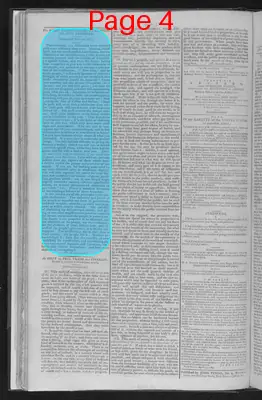
Literary
June 17, 1789
Gazette Of The United States
New York, New York County, New York
What is this article about?
This essay continuation analyzes a 371 BC Roman crisis, featuring Manlius's speech urging the people to reform the constitution by abolishing dictators and consuls, introducing a balanced government with a chief magistrate to check the senate and protect plebeians, echoing English constitutional principles.
Clipping
OCR Quality
98%
Excellent
Full Text
The RIGHT CONSTITUTION of a COMMONWEALTH
EXAMINED.
[Continued from our last.]
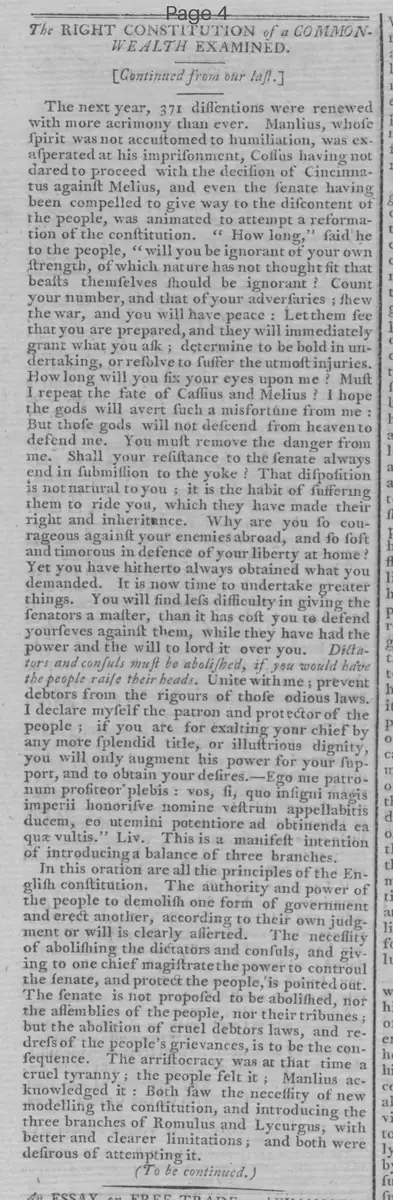
The next year, 371 dissensions were renewed with more acrimony than ever. Manlius, whose spirit was not accustomed to humiliation, was exasperated at his imprisonment, Cincinnatus having not dared to proceed with the decision of Cincinnatus against Melius, and even the senate having been compelled to give way to the discontent of the people, was animated to attempt a reformation of the constitution. "How long," said he to the people, "will you be ignorant of your own strength, of which nature has not thought fit that beasts themselves should be ignorant? Count your number, and that of your adversaries; shew the sword, and you will have peace: Let them see that you are prepared, and they will immediately grant what you ask; determine to be bold in undertaking, or resolve to suffer the utmost injuries. How long will you fix your eyes upon me? Must I repeat the fate of Cassius and Melius? I hope the gods will avert such a misfortune from me: But those gods will not descend from heaven to defend me. You must remove the danger from me. Shall your resistance to the senate always end in submission to the yoke? That disposition is not natural to you; it is the habit of suffering them to ride you, which they have made their right and inheritance. Why are you so courageous against your enemies abroad, and so soft and timorous in defence of your liberty at home? Yet you have hitherto always obtained what you demanded. It is now time to undertake greater things. You will find less difficulty in giving the senators a master, than it has cost you to defend yourselves against them, while they have had the power and the will to lord it over you. Dictators and consuls must be abolished, if you would have the people raise their heads. Unite with me; prevent debtors from the rigours of those odious laws. I declare myself the patron and protector of the people; if you are for exalting your chief by any more splendid title, or illustrious dignity, you will only augment his power for your support, and to obtain your desires.—Ego me patronum profiteor plebis: vos, si, quo inigni magis imperii honorisve nomine vestrum appellabitis ducem, eo utemini potentiore ad obtinenda ea quae vultis." Liv. This is a manifest intention of introducing a balance of three branches.
In this oration are all the principles of the English constitution. The authority and power of the people to demolish one form of government and erect another, according to their own judgment or will is clearly asserted. The necessity of abolishing the dictators and consuls, and giving to one chief magistrate the power to controul the senate, and protect the people, is pointed out. The senate is not proposed to be abolished, nor the assemblies of the people, nor their tribunes; but the abolition of cruel debtors laws, and redress of the people's grievances, is to be the consequence. The aristocracy was at that time a cruel tyranny; the people felt it; Manlius acknowledged it: Both saw the necessity of new modelling the constitution, and introducing the three branches of Romulus and Lycurgus, with better and clearer limitations; and both were desirous of attempting it.
(To be continued.)
EXAMINED.
[Continued from our last.]
The next year, 371 dissensions were renewed with more acrimony than ever. Manlius, whose spirit was not accustomed to humiliation, was exasperated at his imprisonment, Cincinnatus having not dared to proceed with the decision of Cincinnatus against Melius, and even the senate having been compelled to give way to the discontent of the people, was animated to attempt a reformation of the constitution. "How long," said he to the people, "will you be ignorant of your own strength, of which nature has not thought fit that beasts themselves should be ignorant? Count your number, and that of your adversaries; shew the sword, and you will have peace: Let them see that you are prepared, and they will immediately grant what you ask; determine to be bold in undertaking, or resolve to suffer the utmost injuries. How long will you fix your eyes upon me? Must I repeat the fate of Cassius and Melius? I hope the gods will avert such a misfortune from me: But those gods will not descend from heaven to defend me. You must remove the danger from me. Shall your resistance to the senate always end in submission to the yoke? That disposition is not natural to you; it is the habit of suffering them to ride you, which they have made their right and inheritance. Why are you so courageous against your enemies abroad, and so soft and timorous in defence of your liberty at home? Yet you have hitherto always obtained what you demanded. It is now time to undertake greater things. You will find less difficulty in giving the senators a master, than it has cost you to defend yourselves against them, while they have had the power and the will to lord it over you. Dictators and consuls must be abolished, if you would have the people raise their heads. Unite with me; prevent debtors from the rigours of those odious laws. I declare myself the patron and protector of the people; if you are for exalting your chief by any more splendid title, or illustrious dignity, you will only augment his power for your support, and to obtain your desires.—Ego me patronum profiteor plebis: vos, si, quo inigni magis imperii honorisve nomine vestrum appellabitis ducem, eo utemini potentiore ad obtinenda ea quae vultis." Liv. This is a manifest intention of introducing a balance of three branches.
In this oration are all the principles of the English constitution. The authority and power of the people to demolish one form of government and erect another, according to their own judgment or will is clearly asserted. The necessity of abolishing the dictators and consuls, and giving to one chief magistrate the power to controul the senate, and protect the people, is pointed out. The senate is not proposed to be abolished, nor the assemblies of the people, nor their tribunes; but the abolition of cruel debtors laws, and redress of the people's grievances, is to be the consequence. The aristocracy was at that time a cruel tyranny; the people felt it; Manlius acknowledged it: Both saw the necessity of new modelling the constitution, and introducing the three branches of Romulus and Lycurgus, with better and clearer limitations; and both were desirous of attempting it.
(To be continued.)
What sub-type of article is it?
Essay
What themes does it cover?
Political
Liberty Freedom
What keywords are associated?
Roman Constitution
Manlius Speech
Political Reform
English Principles
Constitutional Balance
Plebeian Rights
Literary Details
Title
The Right Constitution Of A Commonwealth Examined.
Key Lines
"How Long," Said He To The People, "Will You Be Ignorant Of Your Own Strength, Of Which Nature Has Not Thought Fit That Beasts Themselves Should Be Ignorant?"
"Dictators And Consuls Must Be Abolished, If You Would Have The People Raise Their Heads."
—Ego Me Patronum Profiteor Plebis: Vos, Si, Quo Inigni Magis Imperii Honorisve Nomine Vestrum Appellabitis Ducem, Eo Utemini Potentiore Ad Obtinenda Ea Quae Vultis." Liv.
In This Oration Are All The Principles Of The English Constitution.