Thank you for visiting SNEWPapers!
Sign up free
Editorial
August 25, 1867
The Carson Daily Appeal
Carson City, Ormsby County, Carson City County, Nevada
What is this article about?
This editorial counters exaggerations of the US public debt by Democratic politicians, estimating it at about $2,700 million ($77 per capita, or $100 including state and other debts), compares it favorably to England's higher per capita burden, and argues the US's higher wages and resources make it more able to pay than Britain, with future growth lightening the load further.
Clipping
OCR Quality
95%
Excellent
Full Text
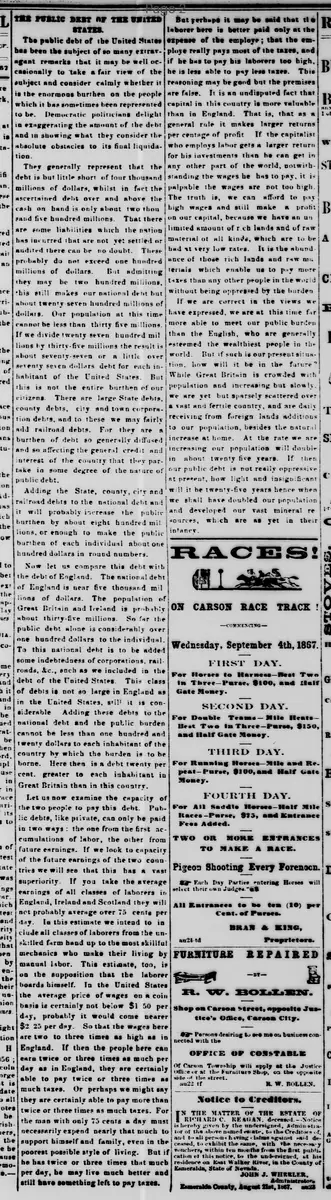
PUBLIC DEBT OF THE UNITED STATES.
The public debt of the United States has been the subject of so many extravagant remarks that it may be well occasionally to take a fair view of the subject and consider calmly whether it is the enormous burthen on the people which it has sometimes been represented to be. Democratic politicians delight in exaggerating the amount of the debt and in showing what they consider the absolute obstacles to its final liquidation.
They generally represent that the debt is but little short of four thousand millions of dollars, but in fact the ascertained debt over and above the cash on hand is only about two thousand five hundred millions. That there are some liabilities which the nation has incurred that are not yet settled or audited there can be no doubt. These probably do not exceed one hundred millions of dollars. But admitting they may be two hundred millions, this still makes our national debt but about twenty-seven hundred millions of dollars. Our population at this time cannot be less than thirty-five millions. If we divide twenty-seven hundred millions by thirty-five millions the result is about seventy-seven or a little over seventy-seven dollars debt for each inhabitant of the United States. But this is not the entire burthen of our citizens. There are large State debts, county debts, city and town corporation debts, and to these we may fairly add railroad debts. For they are a burthen of debt so generally diffused and so affecting the general credit and interest of the country that they partake in some degree of the nature of public debt.
Adding the State, county, city and railroad debts to the national debt and it will probably increase the public burthen by about eight hundred millions, or enough to make the public burthen of each individual about one hundred dollars in round numbers.
Now let us compare this debt with the debt of England. The national debt of England is near five thousand millions of dollars. The population of Great Britain and Ireland is probably about thirty-five millions. So far the public debt alone is considerably over one hundred dollars to the individual. To this parochial debt is to be added some indebtedness of corporations, railroads, &c., such as are included in the debt of the United States. This class of debts is not so large in England as in the United States, still it is considerable. Adding these debts to the national debt and the public burden cannot be less than one hundred and twenty dollars to each inhabitant of the country by which the burden is to be borne. Here then is a debt twenty per cent. greater to each inhabitant in Great Britain than in this country.
Let us now examine the capacity of the two people to pay this debt. Public debts, like private, can only be paid in two ways: the one from the first accumulations of labor, the other from future earnings. If we look to capacity of the future earnings of the two countries we will see that this has a vast superiority. If you take the average earnings of all classes of laborers in England, Ireland and Scotland they will not probably average over 75 cents per day. In this estimate we intend to include all classes of laborers from the unskilled farm hand up to the most skillful mechanics who make their living by manual labor. This estimate, too, is on the supposition that the laborer boards himself. In the United States the average price of wages on a coin basis is certainly not below $1.50 per day, probably it would come nearer $2.25 per day. So that the wages here are two to three times as high as in England. If then the people here can earn twice or three times as much per day as in England, they are certainly able to pay twice or three times as much taxes. Or perhaps we might say they are certainly able to pay more than twice or three times as much taxes. For the man with only 75 cents a day must necessarily expend nearly that much to support himself and family, even in the poorest possible style of living. But if he has twice or three times that much per day, he may live much better and still have something left to pay taxes.
But perhaps it may be said that the laborer here is better paid only at the expense of the employer; that the employer really pays most of the taxes, and if he has to pay his laborers too high, he is less able to pay less taxes. This reasoning may be good but the premises are false. It is an undisputed fact that capital in this country is more valuable than in England. That is, that as a general rule it makes larger returns percentage of profit. If the capitalist who employs labor gets a larger return for his investments than he can get in any other part of the world, notwithstanding the wages he has to pay, it is palpable the wages are not too high.
The truth is, we can afford to pay high wages and still make a profit on our capital, because we have an unlimited amount of rich lands and of raw material of all kinds, which are to be had at very low rates. It is the abundance of those rich lands and raw materials which enable us to pay more taxes than any other people in the world without being oppressed by the burden.
If we are correct in the views we have expressed, we are at this time far more able to meet our public burden than the English, who are generally esteemed the wealthiest people in the world. But if such is our present situation, how will it be in the future? While Great Britain is crowded with population and increasing but slowly, we are yet but sparsely scattered over a vast and fertile country, and are daily receiving from foreign lands additions to our population, besides the natural increase at home. At the rate we are increasing our population will double in about twenty-five years. If then our public debt is not really oppressive at present, how light and insignificant will it be twenty-five years hence when we shall have doubled our population and developed our vast mineral resources, which are as yet in their infancy.
The public debt of the United States has been the subject of so many extravagant remarks that it may be well occasionally to take a fair view of the subject and consider calmly whether it is the enormous burthen on the people which it has sometimes been represented to be. Democratic politicians delight in exaggerating the amount of the debt and in showing what they consider the absolute obstacles to its final liquidation.
They generally represent that the debt is but little short of four thousand millions of dollars, but in fact the ascertained debt over and above the cash on hand is only about two thousand five hundred millions. That there are some liabilities which the nation has incurred that are not yet settled or audited there can be no doubt. These probably do not exceed one hundred millions of dollars. But admitting they may be two hundred millions, this still makes our national debt but about twenty-seven hundred millions of dollars. Our population at this time cannot be less than thirty-five millions. If we divide twenty-seven hundred millions by thirty-five millions the result is about seventy-seven or a little over seventy-seven dollars debt for each inhabitant of the United States. But this is not the entire burthen of our citizens. There are large State debts, county debts, city and town corporation debts, and to these we may fairly add railroad debts. For they are a burthen of debt so generally diffused and so affecting the general credit and interest of the country that they partake in some degree of the nature of public debt.
Adding the State, county, city and railroad debts to the national debt and it will probably increase the public burthen by about eight hundred millions, or enough to make the public burthen of each individual about one hundred dollars in round numbers.
Now let us compare this debt with the debt of England. The national debt of England is near five thousand millions of dollars. The population of Great Britain and Ireland is probably about thirty-five millions. So far the public debt alone is considerably over one hundred dollars to the individual. To this parochial debt is to be added some indebtedness of corporations, railroads, &c., such as are included in the debt of the United States. This class of debts is not so large in England as in the United States, still it is considerable. Adding these debts to the national debt and the public burden cannot be less than one hundred and twenty dollars to each inhabitant of the country by which the burden is to be borne. Here then is a debt twenty per cent. greater to each inhabitant in Great Britain than in this country.
Let us now examine the capacity of the two people to pay this debt. Public debts, like private, can only be paid in two ways: the one from the first accumulations of labor, the other from future earnings. If we look to capacity of the future earnings of the two countries we will see that this has a vast superiority. If you take the average earnings of all classes of laborers in England, Ireland and Scotland they will not probably average over 75 cents per day. In this estimate we intend to include all classes of laborers from the unskilled farm hand up to the most skillful mechanics who make their living by manual labor. This estimate, too, is on the supposition that the laborer boards himself. In the United States the average price of wages on a coin basis is certainly not below $1.50 per day, probably it would come nearer $2.25 per day. So that the wages here are two to three times as high as in England. If then the people here can earn twice or three times as much per day as in England, they are certainly able to pay twice or three times as much taxes. Or perhaps we might say they are certainly able to pay more than twice or three times as much taxes. For the man with only 75 cents a day must necessarily expend nearly that much to support himself and family, even in the poorest possible style of living. But if he has twice or three times that much per day, he may live much better and still have something left to pay taxes.
But perhaps it may be said that the laborer here is better paid only at the expense of the employer; that the employer really pays most of the taxes, and if he has to pay his laborers too high, he is less able to pay less taxes. This reasoning may be good but the premises are false. It is an undisputed fact that capital in this country is more valuable than in England. That is, that as a general rule it makes larger returns percentage of profit. If the capitalist who employs labor gets a larger return for his investments than he can get in any other part of the world, notwithstanding the wages he has to pay, it is palpable the wages are not too high.
The truth is, we can afford to pay high wages and still make a profit on our capital, because we have an unlimited amount of rich lands and of raw material of all kinds, which are to be had at very low rates. It is the abundance of those rich lands and raw materials which enable us to pay more taxes than any other people in the world without being oppressed by the burden.
If we are correct in the views we have expressed, we are at this time far more able to meet our public burden than the English, who are generally esteemed the wealthiest people in the world. But if such is our present situation, how will it be in the future? While Great Britain is crowded with population and increasing but slowly, we are yet but sparsely scattered over a vast and fertile country, and are daily receiving from foreign lands additions to our population, besides the natural increase at home. At the rate we are increasing our population will double in about twenty-five years. If then our public debt is not really oppressive at present, how light and insignificant will it be twenty-five years hence when we shall have doubled our population and developed our vast mineral resources, which are as yet in their infancy.
What sub-type of article is it?
Economic Policy
Partisan Politics
What keywords are associated?
Public Debt
National Debt
Us Economy
Debt Comparison
Wages And Taxes
Fiscal Burden
What entities or persons were involved?
Democratic Politicians
United States
England
Great Britain
Editorial Details
Primary Topic
Manageability Of Us Public Debt Compared To England
Stance / Tone
Defensive And Optimistic About Us Fiscal Capacity
Key Figures
Democratic Politicians
United States
England
Great Britain
Key Arguments
Us National Debt Is About $2,700 Million, Not $4,000 Million As Exaggerated
Per Capita Us Debt Is $77, Or $100 Including State And Other Debts
England's Per Capita Debt Is 20% Higher At $120
Us Wages Are 2 3 Times Higher Than In Britain, Enabling Greater Tax Capacity
Abundant Resources And High Capital Returns Make Us Better Positioned To Pay Debts
Future Population Growth Will Make Current Debt Insignificant