Thank you for visiting SNEWPapers!
Sign up free
Gazette Of The United States
Philadelphia, Philadelphia County, Pennsylvania
What is this article about?
In No. XIV for the Gazette of the United States, Harrington counters claims from the New-York Minerva that Northern states secured independence for the South during the Revolution. He details Southern sufferings and battles fought primarily by local militias, citing historians, and urges unity to prevent Union dissolution. (248 characters)
Merged-components note: This is a continuation of the letter to the editor (No. XIV) spanning from page 2 to page 3; relabeled from 'story' to 'letter_to_editor' as it is a reader-submitted argumentative piece.
Clippings
1 of 2
OCR Quality
Full Text
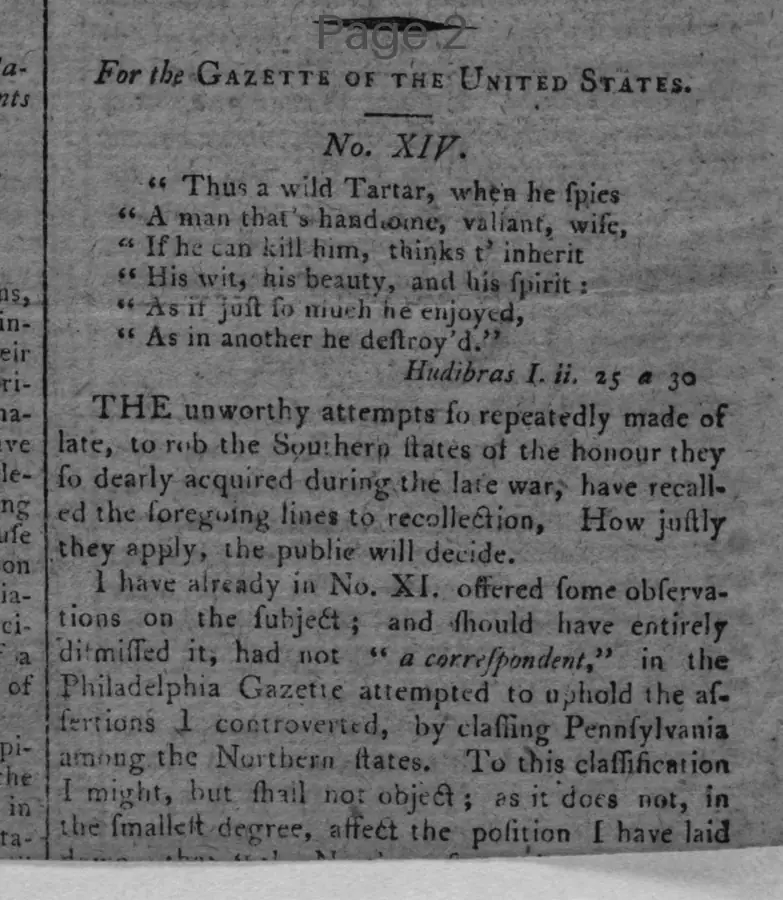
No. XIV.
"Thus a wild Tartar, when he spies
A man that's handsome, valiant, wise,
If he can kill him, thinks t' inherit
His wit, his beauty, and his spirit:
As if just so much he enjoyed.
As in another he destroy'd."
Hudibras I. ii. 25 to 30
THE unworthy attempts so repeatedly made of late, to rob the Southern states of the honour they so dearly acquired during the late war, have recalled the foregoing lines to recollection. How justly they apply, the public will decide.
I have already in No. XI. offered some observations on the subject; and should have entirely dismissed it, had not "a correspondent," in the Philadelphia Gazette attempted to uphold the assertions I controverted, by claiming Pennsylvania among the Northern states. To this classification I might, but shall not object; as it does not, in the smallest degree, affect the position I have laid down...
The paragraph which gave rise to this enquiry appeared on the 15th inst. in the New-York Minerva, published by Mr. Noah Webster, in the following words: "The Northern states fought the battles of the Southern during the late war. They fed, clothed, and supported the army. They secured independence."
It is extremely rare to meet so much falsehood in so small a compass. The writer, whoever he was, placed very great reliance on the credulity of his readers, when he ventured to depart so totally from truth respecting historical facts, particularly of so recent a date as those of the late war.
The Southern states, during the progress of the revolution, were exposed to all the ravages of a most destructive and desolating war. Ruthless generals spread ruin in every direction, far and near. (1)
The citizens were, for a considerable part of the time, entirely out of the protection of the general government, which, in the period of their greatest distress and difficulty, was unable to send them money or soldiers. (2) Many men were dragged from their houses, and compelled to take up arms against their country. (3) For fighting in defence of the common cause, several brave & distinguished characters were actually hanged like common felons. (4)
I have heard gentlemen of indubitable respectability affirm, that a fourth part of the inhabitants of Georgia perished during the war.
The havock in many parts of South-Carolina, (5) and in some parts of Virginia, was in as great a proportion. Trade, commerce, and even cultivation, were almost wholly suspended. And where cultivation was carried on, the produce of the soil lay on hands for want of shipping to transport it to suitable markets. Taking all these considerations together, it is not perhaps too much to suppose, that a single Southern state suffered as much by the war as all the New-England states united. South-Carolina, alone, lost 25,000 slaves. (6) At 75 dollars each these amount to 3,750,000 dollars. Virginia, tho' she did not probably lose so many, suffered immense. In this way. Yet these states are now threatened with being "shaken off the neck" of the northern ones, because they are opposed to a treaty, which has relinquished all claims to compensation for the negroes taken from them contrary to the treaty of peace. (7)
While the Southern states were in this dreadful situation, the Eastern and middle states, with some exceptions as to the state of New-Jersey, a part of New-York, Philadelphia and its vicinity, and some other parts at particular seasons, were, comparatively speaking, free from the din of arms. Internal trade suffered little check. The supplies for the army gave employment to the old branches of manufactures, and called new ones into existence: and if external commerce was suspended, numerous and successful privateers compensated for the interruption.
From almost all these advantages, the Southern states were partially or altogether debarred. If, therefore, as we are now told, "the Northern states had fought the battles of the Southern" -if they had "fed, clothed and supported the army," the contribution would not have been more severe than that of their Southern brethren; and, even in that case, they would not be entitled to reproach them with what they had done.
But the truth is, "that the Southern states fought their own battles." They contributed, to speak within very moderate bounds, at least as largely towards "securing independence" as the Northern. History bears them ample testimony, that if the revolution was really a criminal act, as would appear to be the opinion of many at present, they expiated their share of the guilt "to the utmost farthing." If it was meritorious and honourable, as I hope the world will long regard it, a very large proportion of the glory belongs to them.
The chief battles fought to the Southward, were at Camden, at Kingsmountain, at Cowpens, at Guilford Court-House, at Hobkirk's hill, near Camden, and at Eutaw. Let us enquire, were these "fought by the Northern states?".
At the battle of Camden, "the American army was formed in the following manner: the second Maryland brigade, commanded by brigadier-general Gist, flanked by a morass: the N. Carolina militia, commanded by major general Caswell, in the centre: and the Virginia militia, commanded by general Stevens, on the left, flanked by the N. Carolina militia light-infantry, and a morass. Major-general baron de Kalb commanded on the right of the line, and brigadier-general Smallwood commanded the first Maryland brigade, which was posted as a corps de reserve, two or three hundred yards in the rear." (8)
At the battle of Kingsmountain, in which major-general Ferguson was slain, the American army was composed exclusively of the militia of the Western parts of Virginia, and North and South-Carolina.
At the battle of Cowpens, that brilliant instance of bravery and good conduct, "General Morgan drew up his men in two lines. The whole of the North and South-Carolina militia present were put under the command of general Pickens, and formed the first line. The second consisted of the light-infantry under lieut. col. Howard, and the Virginia riflemen. Colonel Washington, with his cavalry, and about 45 militia, under colonel McCall, were drawn up in the rear of the whole." (10) The light-infantry were from Delaware, Maryland and Virginia-and the cavalry from Virginia, as may be seen by the list published by general Morgan. (11)
The American army, at Guilford Court-House, "consisted of Huger's brigade of Virginia continentals, 778 present, and fit for duty; of Williams's Maryland brigade and Delawares, 630, and of the infantry of Lee's partizan legion, 82; that of continental regulars, 1490: besides these, there were 1060 militia from North Carolina, and 1693 from Virginia. The whole army consisted of 4243 foot, and of 161 cavalry, including Washington's light dragoons, 86, and of Lee's legion 75 " (12)
The battle of Hobkirk's hill, near Camden, was fought about six weeks after the above, and by the same army. (13)
Of the battle of Eutaw, I have already given shall here repeat it. "The front consisted of the militia from North and South-Carolina, and was commanded by generals Marion and Pickens, & colonel de Malmedy. The second consisted of the continental troops from North Carolina, Virginia and Maryland, and was led on by general Sumner, lieut. col. Campbell, and colonel Williams. Lieut. col. Lee, with his legion, covered the right flank; lieut. col. Henderson, with the state troops, covered the left. Lieut. col. Washington, with his cavalry, and captain Kirkwood, with the Delaware troops, formed a corps de reserve."
To enter into details of all the brave and successful skirmishes, incursions, and surprises, in which Generals Morgan, Marion, Pickens, S. Sumter, Sumner, W. Washington, Lee, and various other distinguished officers of the Southern states, were concerned, though it would more fully establish the position I have laid down, would lead me too far.
I must therefore dismiss the subject, with referring the reader to the histories of Ramsay and Gordon, and to the journals of Congress, in which he will find ample testimonials to satisfy him, that "the Northern states did not fight the battles of the Southern."
It thus appears, that the charges so positively and barefacedly brought forward against the Southern states, are void of even a shadow of truth!- for so far from the Northern states having exclusively fought the battles of the Southern; it appears incontestible, that except at York-town, the Southern states were left, during the most dangerous periods of the war, to protect themselves almost wholly unaffisted! Still further to shew the total disregard of truth, which prevails with those who advance those bold assertions: it appears, from an examination of the accounts of the battles of Germantown and Brandywine, that there were probably more Southern soldiers engaged in them, than there were Northern soldiers in all the Southern battles together, Yorktown excepted.
Let us here make a most solemn pause. If we have not relinquished all cares beyond the sordid concerns of self-interest, here is ample matter for the most awful and painful reflections! Must we not shudder with affright, at the tremendous precipice, to which, with Syren arts, our incautious steps are so artfully drawn! To any foreign power, jealous of our prosperity, a rupture of the Union would be invaluable to Americans it would be the sign and seal of inevitable destruction!-- What, then, must be our abhorrence, our detestation of the motives which can lead any man who professes himself an American, to multiply, by such gross, such shameless, such palpable misrepresentation, the already too numerous sources of jealousy between the several members of our confederation! who lays a foundation of falsehood and deception, on which to erect the rightful superstructure of a dissolution of the Union! Are we not alarmed to find, that this idea is now thrown out with less concern, than was formerly felt at the idea of erecting a new state, a new county, or even the removal of a seat of Government! whatever may be their professions, can the men be federalists, who are thus endeavouring to destroy our federal Union? Are they friends to order, who are familiarizing us to the worst species of disorder and disorganization? Are they friends to the human race, who, as far as in them lies, are endeavouring to blast the hopes mankind entertained, of having here a lasting asylum against European persecution? Should we, for any of the heart burnings or discords of the present moment, dissolve the Union-fatal, accursed expression-little did I expect a few years back, you would be so familiar to my pen-should we, I say, be guilty of this stupendous folly, would we not devote ourselves to the execrations and maledictions of our cotemporaries and of the latest posterity?
HARRINGTON.
NOTES.
(1) See Ramsay and Gordon, passim.
(2) "Congress was unable to send either men or money for the defence of the Southern States." Ramsay's American Revolution, vol. ii. p. 229.
(3) Ramsay's South-Carolina, vol. ii, p. 115.
(4) Ibid. page 157--Remember Col. Hayne.
(5) "South-Carolina exhibited scenes of distress, which were shocking to humanity. The single district of Ninety-Six, which is only one of Six Districts into which South-Carolina is divided, has been computed to contain fourteen hundred widows and orphans, made so by the war."
Ibid. 275.
(6) Ibid. 384.
(7) Much disingenuous sophistry has been used to invalidate the claims of America on this head. The clause of the treaty of peace on this subject, states that the British troops should depart "without carrying any negroes or other property of the inhabitants." This, as has been already unanswerably observed, must mean either that the British troops should not take away the negroes then in their possession-or that they should not rob the inhabitants of negroes which had not been taken from them. The latter stipulation would be justly deemed an insult.-The former must therefore necessarily be the true one. Volumes of quibbles might perplex, but never could refute this explanation.
(8.) Ramsay's South Carolina, vol. ii. pp. 147, 8.
(9.) Ibid. 180, 181.-Gordon, vol. iii. p. 117.
(10.) Gordon's American Revolution, second New-York edition, vol. iii. pp. 160, 1.
(11.) Ramsay's South Carolina, ii. 472.
(12.) Gordon, iii. 173.
(13.) Ibid, 189. Ramsay's S. Carolina, ii. 230.
(14.) Ramsay's S. Carolina, ii. 252.
(15.) From the accounts of the battle of Brandywine, I have taken the following extracts: "Greene draws up his force, consisting of the Virginia troops, and a regiment of Pennsylvanians, commanded by col. Stewart, * * * * the tenth Virginia regiment, commanded by Lt. Col. A. Stephens, supports the attack of the British cannonade and musquetry, for fifteen minutes, though they have never before been engaged * ** *** Wayne and the North Carolinians, with the artillery and light troops, after their defeat by Knyphausen; pass the rear of it in their retreat. Gordon, vol. ii. pp. 225. 226.
What sub-type of article is it?
What themes does it cover?
What keywords are associated?
What entities or persons were involved?
Letter to Editor Details
Author
Harrington
Recipient
Gazette Of The United States
Main Argument
the letter refutes assertions that northern states fought the battles of and supported the southern states during the revolutionary war, emphasizing that southern states endured severe hardships, fought their own battles with significant contributions from local forces, and warns against misrepresentations that could lead to the dissolution of the union.
Notable Details