Thank you for visiting SNEWPapers!
Sign up free
The News & Observer
Raleigh, Wake County, North Carolina
What is this article about?
The University of North Carolina launches a graduate medical department in Raleigh in January 1902, building on its Chapel Hill preparatory program. The inaugural year succeeds with strong clinical resources, expert faculty, and graduates excelling in state exams, promising growth for future sessions.
Clipping
OCR Quality
Full Text
Success of the First Year's Work at Raleigh Bright Prospects for Coming Session. Abundant Clinical Material. Additions to Faculty.
When the Trustees of the University of North Carolina decided in January, 1902, to establish a graduate department of medicine at Raleigh, a distinct epoch was marked in the medical annals of the State. It was the first opportunity presented for students to complete their medical work in North Carolina in a thorough four years' course under the guidance of competent specialists and with all the advantages to be found in a city. The movement was of greater importance because the prestige, tradition and influence of the University were its own. And the reputation of three flourishing professional schools gave fair promise for the future to another, which was needed. Thirteen years ago a preparatory department of medicine was inaugurated at Chapel Hill. The high standard set from the beginning, the thoroughness of the work and the ability of its teachers soon gave this school a name second to none. Its certificate for advanced standing came to be accepted by leading medical colleges and if a man is known to have been prepared in medicine at the University of North Carolina, he is told at other institutions that he need have no fear for a successful issue. While the policy of that school has been to seek for good men rather than large numbers, yet the attendance has increased from a mere handful of students to classes of from 75 to 80.
AN IDEAL PLAN.
The success of the preparatory department and the want in the State of an advanced school which would carry the student further on the same line with the same methods, led the promoters of the graduate school at Raleigh to hope also for a just measure of the same prosperity. This hope has not been in vain. After a most auspicious first year abundant evidence proves the faith of those who conceived the plan and sets a high value upon the work of those who labored to execute it. The effort to dovetail the two courses—the preparatory and the graduate—shows that the arrangement is an ideal one. The two years at Chapel Hill lay the foundation, the two years at Raleigh build the superstructure; the one has to do with the theoretical branches and the other with the practical; the one with anatomy, chemistry, physiology, pathology and the other with medicine, surgery and all their allied branches. This plan cannot but have its benefits. No student of medicine should attempt to apply knowledge until he has mastered the details and theories on which it is founded. A first course man has no right in an operating room or hospital until he can understand what is being said and done. He will be tempted to minimize the theoretical and magnify the practical, neglecting the former and bungling the latter. But when the two courses are separated, though set on the same high plane and working harmoniously, every one of the fundamental branches must be mastered before permission is granted to apply this knowledge to actual experience. Again, taking heavy risks on the State Board examination or else they receive a diploma from a well-recognized local school which has been able to maintain a high standard. The latter alternative is much the safer. For the most part North Carolina young men of the class mentioned have been going to neighboring States where the conditions are no whit better and their chances sometimes not so good. There is no reason why North Carolinians should not receive a thorough medical education.
2. Clinical material in hospitals and dispensary has been unusually abundant. The objection has been raised against the school that not enough cases would be seen by the students during the year. The experience of one session has been sufficient to overrule such an objection. Just as much clinical work has been presented as the students could possibly digest. And when it is remembered that they are actually at the bedside of patients and treatment wards, new private rooms and a new operating room, with all modern improvements, are now being completed. In addition to these, by special arrangement, the city of Raleigh has allowed the establishment of a Free Dispensary at the College building, to which all the outdoor city patients are to come for treatment. Thus every possible case may be utilized as clinical material for students of the University. Here will be found unusual privileges of personal observation. At
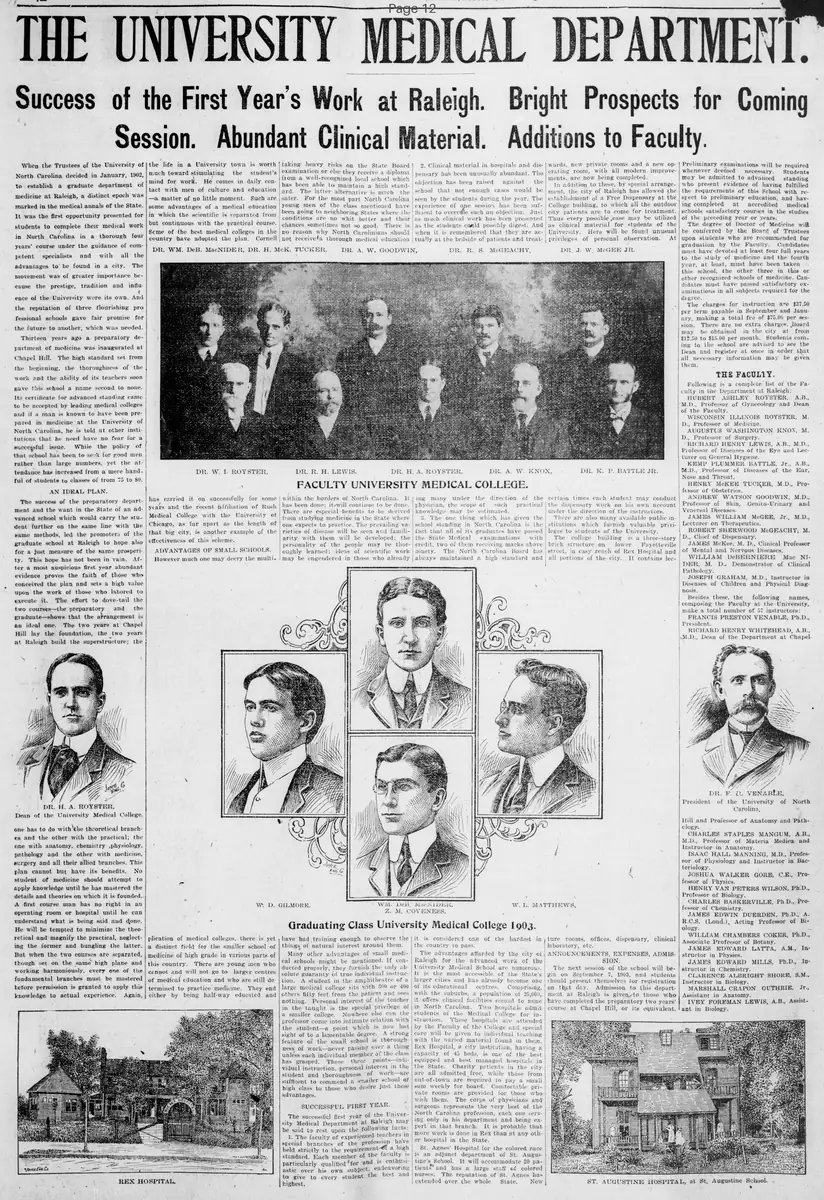
FACULTY UNIVERSITY MEDICAL COLLEGE.
has carried it on successfully for some years and the recent affiliation of Rush Medical College with the University of Chicago, as far apart as the length of that big city, is another example of the effectiveness of this scheme.
ADVANTAGES OF SMALL SCHOOLS,
However much one may decry the multiplication of medical colleges within the borders of North Carolina. It has been done: it will continue to be done. There are especial benefits to be derived from studying medicine in the State where one expects to practice. The prevailing varieties of disease will be seen and familiarity with them will be developed; the personality of the people may be thoroughly learned: ideas of scientific work may be engendered in those who already ing many under the direction of the physician, the scope of such practical knowledge may be estimated.
3. The one thing which has given the school standing in North Carolina is the fact that all of its graduates have passed the State Medical examinations with credit, two of them receiving marks above ninety. The North Carolina Board has always maintained a high standard and it is considered one of the hardest in the country to pass.
The advantages afforded by the city of Raleigh for the advanced work of the University Medical School are numerous. It is the most accessible of the State's larger cities and has already become one of its educational centres. Comprising, with the suburbs, a population of 25,000, it offers clinical facilities second to none in North Carolina. Two hospitals admit students of the Medical College for instruction. These hospitals are attended by the Faculty of the College and special care will be given to individual teaching with the varied material found in them. Rex Hospital, a city institution, having a capacity of 45 beds, is one of the best equipped and best managed hospitals in the State. Charity patients in the city are all admitted free, while those from out-of-town are required to pay a small sum weekly for board. Comfortable private rooms are provided for those who wish them. The corps of physicians and surgeons represents the very best of the North Carolina profession, each one serving only in his department and being expert in that branch. It is probable that more work is done in Rex than at any other hospital in the State. St. Agnes' Hospital for the colored race is an adjunct department of St. Augustine's School. It will accommodate 20 patients and has a large staff of colored nurses. The reputation of St. Agnes has extended over the whole State. New
lecture rooms, offices, dispensary, clinical laboratory, etc.
ANNOUNCEMENTS, EXPENSES, ADMISSION.
The next session of the school will begin on September 7, 1903, and students should present themselves for registration on that day. Admission to this department at Raleigh is given to those who have completed the preparatory two years' course at Chapel Hill, or its equivalent. Preliminary examinations will be required whenever deemed necessary. Students may be admitted to advanced standing who present evidence of having fulfilled the requirements of this School with respect to preliminary education, and having completed at accredited medical schools satisfactory courses in the studies of the preceding year or years. The degree of Doctor of Medicine will be conferred by the Board of Trustees upon students who are recommended for graduation by the Faculty. Candidates must have devoted at least four full years to the study of medicine and the fourth year, at least, must have been taken this school, the other three in this or other recognized schools of medicine. Candidates must have passed satisfactory examinations in all subjects required for the degree.
The charges for instruction are $37.50 per term payable in September and January, making a total fee of $75.00 per session. There are no extra charges. Board may be obtained in the city at from $12.50 to $15.00 per month. Students coming to the school are advised to see the Dean and register at once in order that all necessary information may be given them.
THE FACULTY.
Following is a complete list of the Faculty in the Department at Raleigh:
HUBERT ASHLEY ROYSTER, A.B., M.D., Professor of Gynecology and Dean of the Faculty.
WISCONSIN ILLINOIS ROYSTER, M.D., Professor of Medicine.
AUGUSTUS WASHINGTON KNOX, M.D., Professor of Surgery.
RICHARD HENRY LEWIS, A.B., M.D., Professor of Diseases of the Eye and Lecturer on General Hygiene.
KEMP PLUMMER BATTLE, Jr., A.B., M.D., Professor of Diseases of the Ear, Nose and Throat.
HENRY McKEE TUCKER, M.D., Professor of Obstetrics.
ANDREW WATSON GOODWIN, M.D., Professor of Skin, Genito-Urinary and Venereal Diseases.
JAMES WILLIAM McGEE, Jr., M.D., Lecturer on Therapeutics.
ROBERT SHERWOOD McGEACHY, M.D., Chief of Dispensary.
JAMES McKEE, M.D., Clinical Professor of Mental and Nervous Diseases.
WILLIAM DeBERNIERE MacNIDER, M.D., Demonstrator of Clinical Pathology.
JOSEPH GRAHAM, M.D., Instructor in Diseases of Children and Physical Diagnosis.
Besides these, the following names, composing the Faculty at the University, make a total number of 51 instructors:
FRANCIS PRESTON VENABLE, Ph.D., President.
RICHARD HENRY WHITEHEAD, A.B., M.D., Dean of the Department at Chapel Hill and Professor of Anatomy and Pathology.
CHARLES STAPLES MANGUM, A.B., M.D., Professor of Materia Medica and Instructor in Anatomy.
ISAAC HALL MANNING, M.D., Professor of Physiology and Instructor in Bacteriology.
JOSHUA WALKER GORE, C.E., Professor of Physics.
HENRY VAN PETERS WILSON, Ph.D., Professor of Biology.
CHARLES BASKERVILLE, Ph.D., Professor of Chemistry.
JAMES EDWIN DUERDEN, Ph.D., A.R.C.S. (Lond.), Acting Professor of Biology.
WILLIAM CHAMBERS COKER, Ph.D., Associate Professor of Botany.
JAMES EDWARD LATTA, A.M., Instructor in Physics.
JAMES EDWARD MILLS, Ph.D., Instructor in Chemistry.
CLARENCE ALBRIGHT SHORE, S.M., Instructor in Biology.
MARSHALL CRAPO GUTHRIE, Jr., Assistant in Anatomy.
IVEY FOREMAN LEWIS, A.B., Assistant in Biology.
DR. F. P. VENABLE.
President of the University of North Carolina.
What sub-type of article is it?
What themes does it cover?
What keywords are associated?
What entities or persons were involved?
Where did it happen?
Story Details
Key Persons
Location
Raleigh, North Carolina; Chapel Hill, North Carolina
Event Date
January 1902
Story Details
The University of North Carolina establishes a graduate medical department in Raleigh in 1902, following a successful preparatory program at Chapel Hill. The first year proves successful with abundant clinical material, high faculty standards, and all graduates passing state exams with credit. Prospects for the next session are bright, with additions to facilities and faculty listed.