Thank you for visiting SNEWPapers!
Sign up free
Virginia Argus
Richmond, Virginia
What is this article about?
A letter to freeholders in Henrico's congressional district warns against electing General Marshall, inferring from his statements that he views the Alien and Sedition Acts as constitutional despite local opposition seeing them as violations of press freedom and liberties, potentially strengthening executive power.
Clipping
OCR Quality
Full Text
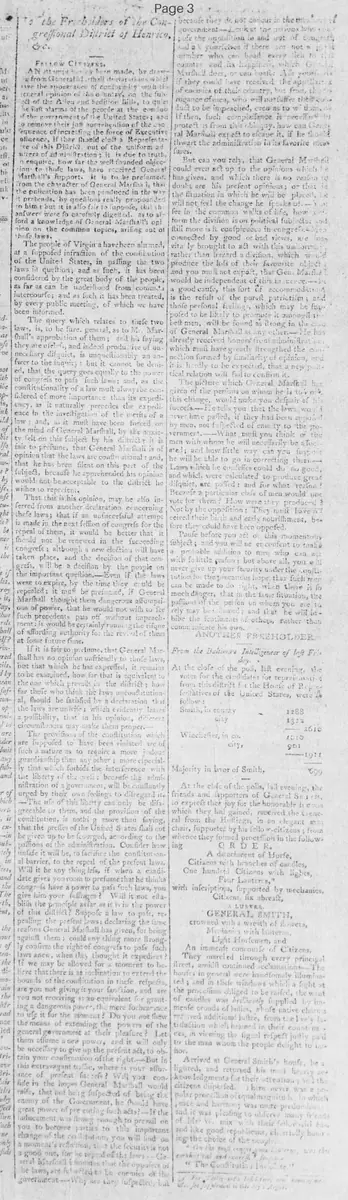
FELLOW CITIZENS,
An attempt having been made, by drawing from General Marshall certain declarations supposed to be at variance with the general opinion of the country, on the subject of the Alien and Sedition Bills, to enlist the ignorance of the people against the conduct of the government of the United States; and to remove their just apprehension of the consequence of increasing the force of Executive influence, if they should elect a Representative of this District, out of the uniform admirers of administration: it is due to truth, and to enquire, how far the well founded objection to those laws, have received General Marshall's support. It is to be presumed, from the character of General Marshall, that the publication has been produced in the way it pretends, by questions really propounded to him: but it is also fair to suppose, that the answers were so carefully digested, as to afford a knowledge of General Marshall's opinion on the common topics, arising out of those laws.
The people of Virginia have been alarmed, at a supposed infraction of the constitution of the United States, in passing the two laws in question; and as such, it has been considered by the great body of the people, as far as can be understood from common intercourse; and as such it has been treated, by every public meeting, of which we have been informed.
The query which relates to these two laws, is, to be sure, general, as to Mr. Marshall's approbation of them; and his saying they are useless, and indeed productive of unnecessary disquiet, is unquestionably an answer to the inquiry: but it cannot be denied, that the query goes equally to the power of congress to pass such laws; and, as the constitutionality of a law must always be considered of more importance than its expediency, as it naturally precedes the expediency in the investigation of the merits of a law; and, as it must have been forced on the mind of General Marshall, by the anxiety felt on this subject by his district; it is fair to presume, that General Marshall is of opinion that the laws are constitutional: and, that he has been silent on this part of the subject, because he apprehended his opinion would not be acceptable to the district he wishes to represent.
That this is his opinion, may be also inferred from another declaration concerning these laws; that if an unsuccessful attempt is made in the next session of congress for the repeal of them, it would be better that it should not be renewed in the succeeding congress; although a new election will have taken place, and the decision of that congress, will be a decision by the people on the important question.--Even if the laws were to expire, by the time they could be repealed; it must be presumed, if General Marshall thought them dangerous assumptions of power, that he would not wish to see such precedents pass off without impeachment: it would be certainly running the risque of affording authority for the revival of them at some future time.
If it is fair to presume, that General Marshall has no opinion unfriendly to those laws, but that which he has expressed, it remains to be examined, how far that is equivalent to the one which prevails in the district; how far those who think the laws unconstitutional, should be satisfied by a declaration that the laws are unwise: which evidently leaves a possibility, that in his opinion, different circumstances may make them proper.
The provisions of the constitution which are supposed to have been violated are of such a nature as to require a more jealous guardianship than any other; more especially that which forbids the interference with the liberty of the press: because the administration of a government, will be constantly urged by their own feelings to disregard it. The use of this liberty can only be disagreeable to them, and the provision of the constitution, is nothing more than saying, that the press of the United States shall not be given up to be scourged, according to the passions of the administration. Consider how unsafe it will be, to sacrifice the constitutional barrier, to the repeal of the present laws. Will it be any thing less, if when a candidate gives you room to presume that he thinks congress have a power to pass such laws, you give him your suffrages? Will it not establish the principle as far as it is in the power of this district? Suppose a law to pass, repealing the present Laws; declaring the same reasons General Marshall has given, for being against them: could any thing more strongly confirm the right of congress to pass such laws anew, when they thought it expedient?
If we may be allowed for a moment to believe that there is an inclination to extend the bounds of the constitution in these respects, are you not giving it your sanction, and are you not receiving as an equivalent for granting a dangerous power, the mere forbearance to use it for the moment? Do you not show the means of extending the power of the general government at their pleasure? Let them assume a new power, and it will only be necessary to give up the present act, to obtain your confirmation of the right.--But in this extravagant trade, where is your assurance of present use? Will you confide in the hope General Marshall would raise, that not he is suspected of being the enemy of the Government, he should have great power of preventing such acts?--If the inducement was strong enough to prevail on you to become parties to this important change of the constitution, you will find on a moment's reflection, that the security is not a good one, for the repeal of the laws --General Marshall intimates that the opposers of the laws, are hushed to be enemies of the government--Why Are they suspected, but because they do not concur in the measure.
Reflect--Look at yourselves if there are not a number who can boast every wish to their country and its happiness, which General Marshall does, or can boast: Ask yourselves if they would have received the reply he has given, as from enemies of their country, but from the arrogance of men, who will suffer their conduct to be impeached, even as to with regard. If then, such complaisance is necessary to protect us from this obloquy, how can General Marshall expect to escape it, if he should thwart the administration in its favorite measures.
But can you rely, that General Marshall could even act up to the opinions which he has given, and which there is no reason to doubt are his present opinions: or that in the situation in which he will be placed, he will not feel the change he speaks of.--We see in the common walks of life, how firm the division is on political subjects. . . and still more is it conspicuous in congress.--Men connected by good or bad views, are inevitably brought to act with this uniformity: rather than hazard a division. which would produce the loss of their favorite object . and you must not expect, that Gen. Marshall would be independent of this influence.--) In a good cause, this sort of accommodation is the result of the purest patriotism; and those personal feelings, which may be supposed to be likely to promote it among worst men, will be found as strong in the case of General Marshall as any other.--He has already received honors from the administration, which must have greatly strengthened the connection formed by similarity of opinion, and it is hardly to be expected, that a new political relation will fail to confirm it.
The picture which General Marshall has given of the persons on whom he is to vote on this change, would make you despair of his success.--He tells you that the laws was never have passed, if they had been opposed by men, not suspected of enmity to the government.--What, must you think of the men with whom he will necessarily be associated; and how little way can you suppose: he will be able to go in correcting them-- Laws which he confesses could do no good, and which were calculated to produce great disquiet, are passed: and For what reason? Because a particular class of men would not vote for them? How were they produced? Not by the opposition: They must have received their birth and early nourishment, before they could have been opposed.
Pause before you act on this momentous subject; and you will never consent to make a probable addition to men who can act with so little reason ; but above all, you will never give up your security under the constitution for the precarious hope, that such men can be made to do right, when there is so much danger, that in the same situation, the passions of the person on whom you are to rely may be seduced; and that he will imbibe the sentiments of others, rather than communicate his own.
ANOTHER FREEHOLDER
What sub-type of article is it?
What themes does it cover?
What keywords are associated?
What entities or persons were involved?
Letter to Editor Details
Author
Another Freeholder
Recipient
To The Freeholders Of The Congressional District Of Henrico, &C.
Main Argument
general marshall's statements imply he believes the alien and sedition acts are constitutional, despite their unpopularity in the district as violations of the constitution; electing him would endorse this view and risk expanding executive power over press freedom and liberties.
Notable Details