Thank you for visiting SNEWPapers!
Sign up free
Story
September 7, 1864
Daily National Republican
Washington, District Of Columbia
What is this article about?
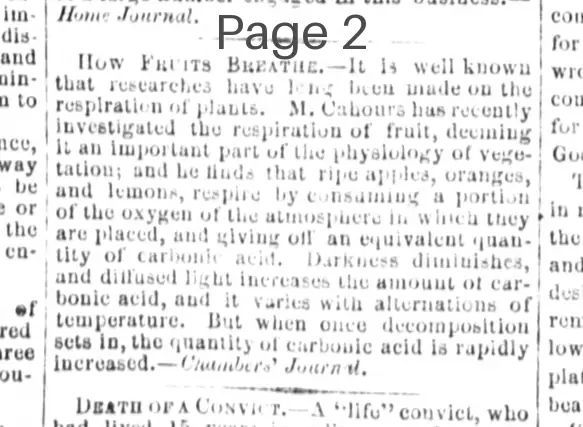
M. Calours's research reveals that ripe fruits like apples, oranges, and lemons respire by absorbing oxygen and releasing carbonic acid, with rates affected by light, darkness, temperature, and decomposition. (From Chambers' Journal.)
Clipping
OCR Quality
95%
Excellent
Full Text
How Fruits Breathe.—It is well known that researches have been made on the respiration of plants. M. Calours has recently investigated the respiration of fruit, deeming it an important part of the physiology of vegetation; and he finds that ripe apples, oranges, and lemons, respire by consuming a portion of the oxygen of the atmosphere in which they are placed, and giving off an equivalent quantity of carbonic acid. Darkness diminishes, and diffused light increases the amount of carbonic acid, and it varies with alternations of temperature. But when once decomposition sets in, the quantity of carbonic acid is rapidly increased.—Chambers' Journal.
What sub-type of article is it?
Curiosity
What themes does it cover?
Nature
What keywords are associated?
Fruit Respiration
Plant Physiology
Oxygen Consumption
Carbonic Acid Emission
What entities or persons were involved?
M. Calours
Story Details
Key Persons
M. Calours
Story Details
M. Calours investigated the respiration of ripe apples, oranges, and lemons, finding they consume oxygen from the atmosphere and emit an equivalent quantity of carbonic acid. Darkness diminishes and light increases the amount, varying with temperature; decomposition rapidly increases it.