Thank you for visiting SNEWPapers!
Sign up free
Virginia Argus
Richmond, Virginia
What is this article about?
A U.S. Navy Court of Inquiry in Boston Harbor investigated the September 1814 capture of schooners Scorpion and Tigress on Lake Huron by superior British forces. Lieutenant Daniel Turner and crew defended spiritedly; Turner wounded, Champlin and others killed. Court cleared Turner of blame, citing ship deficiencies and enemy surprise.
Merged-components note: Continuation of the court of inquiry report on the loss of U.S. schooners Scorpion and Tigress.
Clippings
1 of 2
OCR Quality
Full Text
NAVAL.
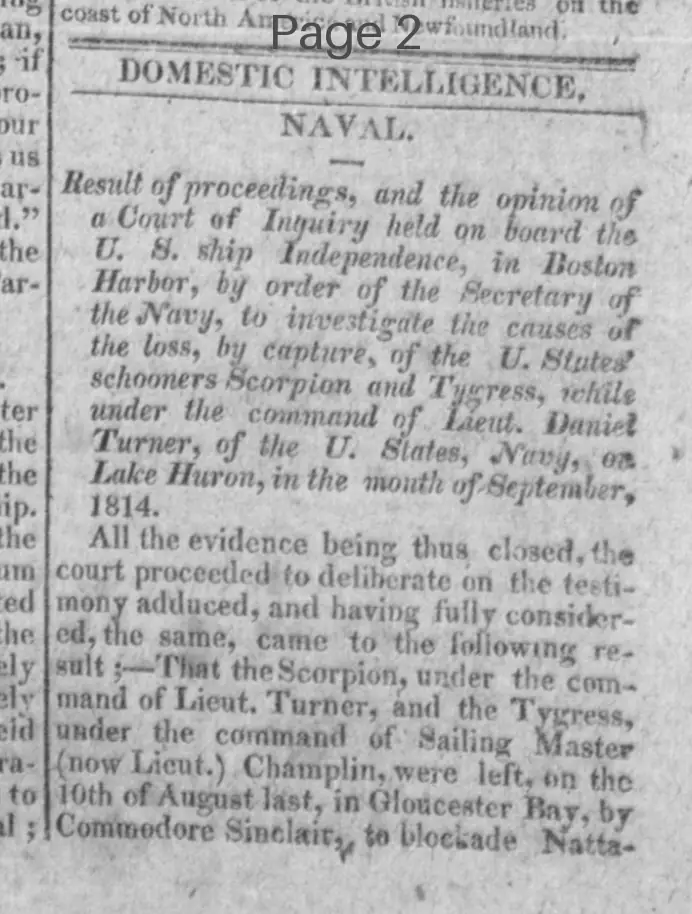
Result of proceedings, and the opinion of a Court of Inquiry held on board the U. S. ship Independence, in Boston Harbor, by order of the Secretary of the Navy, to investigate the causes of the loss, by capture, of the United States schooners Scorpion and Tigress, while under the command of Lieut. Daniel Turner, of the United States Navy, on Lake Huron, in the month of September, 1814.
All the evidence being thus closed, the court proceeded to deliberate on the testimony adduced, and having fully considered the same, came to the following result:—That the Scorpion, under the command of Lieut. Turner, and the Tigress, under the command of Sailing Master (now Lieut.) Champlin, were sent, on the 10th of August last, in Gloucester Bay, by Commodore Sinclair, to blockade Mackinac, and to intercept the communication between that place and the mainland; that they continued to perform this service until the 3d of September, when they were both captured by a greatly superior force of the enemy, after a spirited defence, in which Lieut. Turner was wounded, and Mr. Champlin and several others killed.
Nattawasaga river: that the Scorpion had thirty men, including her officers, and mounted one 18 pounder: and although there was a twelve pounder on board, its carriage had been so much disabled as to render it useless, and that Lieut. Turner had not the means of repairing it. It is in evidence, and is fully proved, that the Scorpion had no boarding netting, and that she was deficient in spare cordage; that she had no signals, and that her crew was composed of men of the most ordinary class.
The court find that the Tigress had twenty-eight men, officers included, and mounted one 24 pounder; that she had neither boarding nettings nor signals, and was deficient in cordage.
It does not, however, appear that the armament of these schooners was deficient, except in pistols.
The court are of opinion, that, inasmuch as no anchorage was found in Gloucester Bay, and it having become dangerous to remain there any longer, from the severity of the gales, which were daily increasing, Lieutenant Turner was perfectly justified in raising the blockade of Nottawasaga river and proceeding to St. Josephs: that the position taken by him while at St. Josephs, and in the neighborhood of French river, were well calculated to annoy the enemy in his line of communication with Mackinaw.
The court find that, after Lieut. Turner had proceeded to cruize off French river, on the night of the 3d of September last, the Tigress was attacked by the enemy in five large boats, (one of them mounting a 6 pounder, and the other a 3 pounder,) and by nineteen canoes, carrying about three hundred sailors, soldiers, and Indians, under the command of an English naval officer: that owing to the extreme darkness of the night, the enemy were not perceived until they were close on board: nor were they then discovered but by the sound of their oars.
After they were discovered, every exertion was made by Lieut. Champlin, his officers and men, to defend his schooner, that bravery and skill could suggest; and not until all the officers were cut down, did the overwhelming numbers of the enemy prevail. The enemy having thus captured the Tigress, and having mounted on her their 6 and 3 pounders, and placed on board a complement from seventy to one hundred of picked men, remained at St. Joseph's until the 5th of September. On the evening of that day the court find, that the Scorpion returned from cruizing off French river, and came to anchor within five miles of the Tigress, without any information having been received, or suspicion entertained by Lieut. Turner, of her capture. At the dawn of the next day, it appears that the gunner having charge of the watch, passed word to the sailing-master, that the Tigress was bearing down under American colours. In a few minutes after, she ran alongside of the Scorpion, fired, boarded, and carried her.
It appears to the court, that the loss of the Scorpion is, in a great measure, to be attributed to the want of signals; and owing to this deficiency, no suspicions were excited as to the real character of the Tigress; and from some of the English officers and men on board of her being dressed in the clothes of her former officers and men, and the residue of the enemy's crew being concealed, a surprise was effected, which precluded the possibility of defence.
The court are, therefore, of opinion, from the whole testimony before them, that the conduct of Lieut. Turner was that of a discreet and vigilant officer.
JOHN SHAW, President.
Wm. C. Aylwin,
Judge Advocate.
Approved,
B. W. CROWNINSHIELD.
What sub-type of article is it?
What keywords are associated?
What entities or persons were involved?
Where did it happen?
Domestic News Details
Primary Location
Lake Huron
Event Date
September 1814
Key Persons
Outcome
lieut. turner wounded; mr. champlin and several others killed; both schooners captured by superior enemy force; court cleared turner of blame, attributing loss to ship deficiencies and surprise attack.
Event Details
U.S. schooners Scorpion and Tigress, blockading Mackinac, were captured on September 3, 1814, by British forces in five boats and nineteen canoes with 300 men. Tigress attacked first in darkness; after capture, used to surprise and take Scorpion on September 6. Court of Inquiry in Boston Harbor found officers' conduct proper.