Thank you for visiting SNEWPapers!
Sign up free
Editorial
May 30, 1943
Atlanta Daily World
Atlanta, Fulton County, Georgia
What is this article about?
Editorial by Elmer Anderson Carter argues that money can mitigate racial discrimination faced by Negroes in America, illustrated by a theater anecdote, and urges acquiring skills, pooling resources, and seizing post-war global economic opportunities for empowerment.
Clipping
OCR Quality
100%
Excellent
Full Text
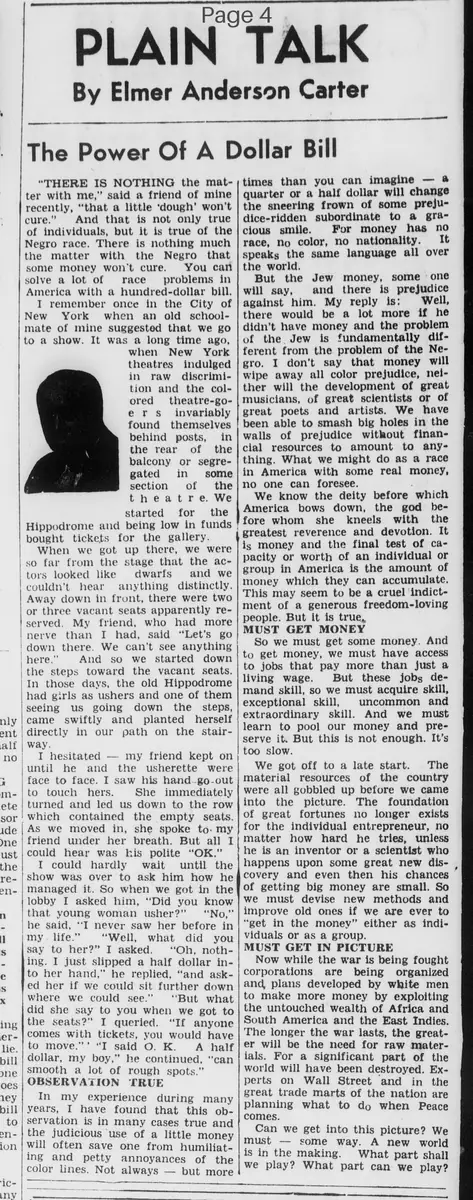
PLAIN TALK
By Elmer Anderson Carter
The Power Of A Dollar Bill
"THERE IS NOTHING the matter with me," said a friend of mine recently, "that a little 'dough' won't cure.
And that is not only true of individuals, but it is true of the Negro race. There is nothing much the matter with the Negro that some money won't cure.
You can solve a lot of race problems in America with a hundred-dollar bill.
I remember once in the City of New York when an old school-mate of mine suggested that we go to a show. It was a long time ago, when New York theatres indulged in raw discrimination and the colored theatre-goers invariably found themselves behind posts, in the rear of the balcony or segregated in some section of the theatre.
We started for the Hippodrome and being low in funds bought tickets for the gallery. When we got up there, we were so far from the stage that the actors looked like dwarfs and we couldn't hear anything distinctly.
Away down in front, there were two or three vacant seats apparently reserved. My friend, who had more nerve than I had, said "Let's go down there. We can't see anything here."
And so we started down the steps toward the vacant seats. In those days, the old Hippodrome had girls as ushers and one of them seeing us going down the steps, came swiftly and planted herself directly in our path on the stairway.
I hesitated - my friend kept on until he and the usherette were face to face. I saw his hand go-out to touch hers. She immediately turned and led us down to the row which contained the empty seats.
As we moved in, she spoke to. my friend under her breath. But all I could hear was his polite "OK."
I could hardly wait until the show was over to ask him how he managed it. So when we got in the lobby I asked him, "Did you know that young woman usher?" "No." he said, "I never saw her before in my life."
"Well, what did you say to her?" I asked. "Oh, noth- ing. I just slipped a half dollar into her hand," he replied, "and asked her if we could sit further down where we could see."
"But what did she say to you when we got to the seats?" I queried. "If anyone comes with tickets, you would have to move." "I said O. K. A half dollar, my boy," he continued, "can smooth a lot of rough spots."
OBSERVATION TRUE
In my experience during many years, I have found that this observation is in many cases true and the judicious use of a little money will often save one from humiliating and petty annoyances of the color lines. Not always - but more times than you can imagine - a quarter or a half dollar will change the sneering frown of some prejudice-ridden subordinate to a gracious smile.
For money has no race, no color, no nationality. It speaks the same language all over the world.
But the Jew money, some one will say, and there is prejudice against him. My reply is: Well, there would be a lot more if he didn't have money and the problem of the Jew is fundamentally different from the problem of the Negro. I don't say that money will wipe away all color prejudice, neither will the development of great musicians, of great scientists or of great poets and artists. We have been able to smash big holes in the walls of prejudice without financial resources to amount to anything. What we might do as a race in America with some real money, no one can foresee.
We know the deity before which America bows down, the god before whom she kneels with the greatest reverence and devotion. It is money and the final test of capacity or worth of an individual or group in America is the amount of money which they can accumulate.
This may seem to be a cruel indictment of a generous freedom-loving people. But it is true.
MUST GET MONEY
So we must get some money. And to get money, we must have access to jobs that pay more than just a living wage. But these jobs demand skill, so we must acquire skill, exceptional skill, uncommon and extraordinary skill. And we must learn to pool our money and preserve it. But this is not enough. It's too slow.
We got off to a late start. The material resources of the country were all gobbled up before we came into the picture. The foundation of great fortunes no longer exists for the individual entrepreneur, no matter how hard he tries, unless he is an inventor or a scientist who happens upon some great new discovery and even then his chances of getting big money are small. So we must devise new methods and improve old ones if we are ever to "get in the money" either as individuals or as a group.
MUST GET IN PICTURE
Now while the war is being fought corporations are being organized and plans developed by white men to make more money by exploiting the untouched wealth of Africa and South America and the East Indies.
The longer the war lasts, the greater will be the need for raw materials. For a significant part of the world will have been destroyed. Experts on Wall Street and in the great trade marts of the nation are planning what to do when Peace comes.
Can we get into this picture? We must - some way. A new world is in the making. What part shall we play? What part can we play?
By Elmer Anderson Carter
The Power Of A Dollar Bill
"THERE IS NOTHING the matter with me," said a friend of mine recently, "that a little 'dough' won't cure.
And that is not only true of individuals, but it is true of the Negro race. There is nothing much the matter with the Negro that some money won't cure.
You can solve a lot of race problems in America with a hundred-dollar bill.
I remember once in the City of New York when an old school-mate of mine suggested that we go to a show. It was a long time ago, when New York theatres indulged in raw discrimination and the colored theatre-goers invariably found themselves behind posts, in the rear of the balcony or segregated in some section of the theatre.
We started for the Hippodrome and being low in funds bought tickets for the gallery. When we got up there, we were so far from the stage that the actors looked like dwarfs and we couldn't hear anything distinctly.
Away down in front, there were two or three vacant seats apparently reserved. My friend, who had more nerve than I had, said "Let's go down there. We can't see anything here."
And so we started down the steps toward the vacant seats. In those days, the old Hippodrome had girls as ushers and one of them seeing us going down the steps, came swiftly and planted herself directly in our path on the stairway.
I hesitated - my friend kept on until he and the usherette were face to face. I saw his hand go-out to touch hers. She immediately turned and led us down to the row which contained the empty seats.
As we moved in, she spoke to. my friend under her breath. But all I could hear was his polite "OK."
I could hardly wait until the show was over to ask him how he managed it. So when we got in the lobby I asked him, "Did you know that young woman usher?" "No." he said, "I never saw her before in my life."
"Well, what did you say to her?" I asked. "Oh, noth- ing. I just slipped a half dollar into her hand," he replied, "and asked her if we could sit further down where we could see."
"But what did she say to you when we got to the seats?" I queried. "If anyone comes with tickets, you would have to move." "I said O. K. A half dollar, my boy," he continued, "can smooth a lot of rough spots."
OBSERVATION TRUE
In my experience during many years, I have found that this observation is in many cases true and the judicious use of a little money will often save one from humiliating and petty annoyances of the color lines. Not always - but more times than you can imagine - a quarter or a half dollar will change the sneering frown of some prejudice-ridden subordinate to a gracious smile.
For money has no race, no color, no nationality. It speaks the same language all over the world.
But the Jew money, some one will say, and there is prejudice against him. My reply is: Well, there would be a lot more if he didn't have money and the problem of the Jew is fundamentally different from the problem of the Negro. I don't say that money will wipe away all color prejudice, neither will the development of great musicians, of great scientists or of great poets and artists. We have been able to smash big holes in the walls of prejudice without financial resources to amount to anything. What we might do as a race in America with some real money, no one can foresee.
We know the deity before which America bows down, the god before whom she kneels with the greatest reverence and devotion. It is money and the final test of capacity or worth of an individual or group in America is the amount of money which they can accumulate.
This may seem to be a cruel indictment of a generous freedom-loving people. But it is true.
MUST GET MONEY
So we must get some money. And to get money, we must have access to jobs that pay more than just a living wage. But these jobs demand skill, so we must acquire skill, exceptional skill, uncommon and extraordinary skill. And we must learn to pool our money and preserve it. But this is not enough. It's too slow.
We got off to a late start. The material resources of the country were all gobbled up before we came into the picture. The foundation of great fortunes no longer exists for the individual entrepreneur, no matter how hard he tries, unless he is an inventor or a scientist who happens upon some great new discovery and even then his chances of getting big money are small. So we must devise new methods and improve old ones if we are ever to "get in the money" either as individuals or as a group.
MUST GET IN PICTURE
Now while the war is being fought corporations are being organized and plans developed by white men to make more money by exploiting the untouched wealth of Africa and South America and the East Indies.
The longer the war lasts, the greater will be the need for raw materials. For a significant part of the world will have been destroyed. Experts on Wall Street and in the great trade marts of the nation are planning what to do when Peace comes.
Can we get into this picture? We must - some way. A new world is in the making. What part shall we play? What part can we play?
What sub-type of article is it?
Economic Policy
Social Reform
What keywords are associated?
Racial Prejudice
Economic Empowerment
Money Power
Negro Race
Post War Opportunities
Job Skills
Discrimination Anecdote
What entities or persons were involved?
Negro Race
Elmer Anderson Carter
Editorial Details
Primary Topic
Power Of Money To Overcome Racial Prejudice
Stance / Tone
Advocacy For Economic Empowerment
Key Figures
Negro Race
Elmer Anderson Carter
Key Arguments
Money Can Solve Many Problems For Individuals And The Negro Race
A Hundred Dollar Bill Can Resolve Race Problems In America
Anecdote Of Using A Half Dollar To Bypass Theater Discrimination
Money Has No Race, Color, Or Nationality
America Values Individuals And Groups By Their Wealth
Negroes Must Acquire Skills For Better Jobs And Pool Resources
Need To Participate In Post War Economic Opportunities In Africa, South America, And East Indies