Thank you for visiting SNEWPapers!
Sign up free
Editorial
May 11, 1827
The National Republican And Ohio Political Register
Cincinnati, Hamilton County, Ohio
What is this article about?
An editorial from the Providence Journal complains about the undervalued labor of printers and editors, public misconceptions of newspaper production, demanding customers, and the lack of appreciation for the printing trade.
Clipping
OCR Quality
98%
Excellent
Full Text
MISERIES OF PRINTERS
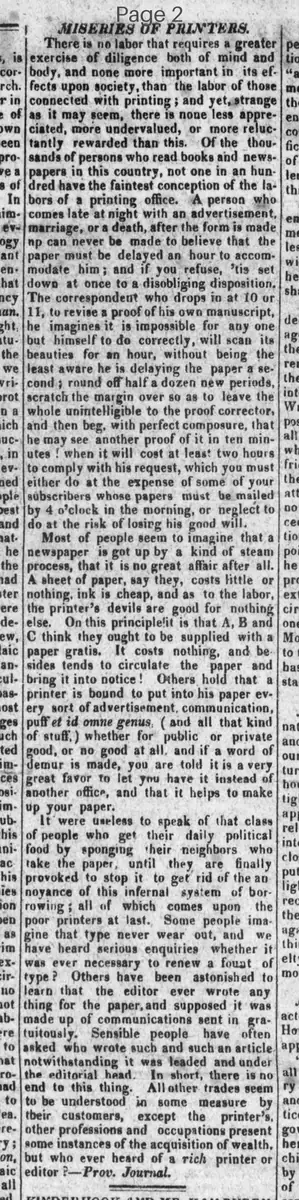
There is no labor that requires a greater exercise of diligence both of mind and body, and none more important in its effects upon society, than the labor of those connected with printing; and yet, strange as it may seem, there is none less appreciated, more undervalued, or more reluctantly rewarded than this. Of the thousands of persons who read books and newspapers in this country, not one in a hundred have the faintest conception of the labors of a printing office. A person who comes late at night with an advertisement, marriage, or a death, after the form is made up can never be made to believe that the paper must be delayed an hour to accommodate him; and if you refuse, tis set down at once to a disobliging disposition. The correspondent who drops in at 10 or 11, to revise a proof of his own manuscript, he imagines it is impossible for any one but himself to do correctly, will scan its beauties for an hour, without being the least aware he is delaying the paper a second; round off half a dozen new periods, scratch the margin over so as to leave the whole unintelligible to the proof corrector, and then beg, with perfect composure, that he may see another proof of it in ten minutes! when it will cost at least two hours to comply with his request, which you must either do at the expense of some of your subscribers whose papers must be mailed by 4 o'clock in the morning, or neglect to do at the risk of losing his good will. Most of people seem to imagine that a newspaper is got up by a kind of steam process, that it is no great affair after all. A sheet of paper, say they, costs little or nothing, ink is cheap, and as to the labor, the printer's devils are good for nothing else. On this principle it is that A, B and C think they ought to be supplied with a paper gratis. It costs nothing, and besides tends to circulate the paper and bring it into notice! Others hold that a printer is bound to put into his paper every sort of advertisement, communication, puff et id omne genus. (and all that kind of stuff.) whether for public or private good, or no good at all, and if a word of demur is made, you are told it is a very great favor to let you have it instead of another office, and that it helps to make up your paper. It were useless to speak of that class of people who get their daily political food by sponging their neighbors who take the paper, until they are finally provoked to stop it to get rid of the annoyance of this infernal system of borrowing; all of which comes upon the poor printers at last. Some people imagine that type never wear out, and we have heard serious enquiries whether it was ever necessary to renew a fount of type? Others have been astonished to learn that the editor ever wrote anything for the paper, and supposed it was made up of communications sent in gratuitously. Sensible people have often asked who wrote such and such an article notwithstanding it was leaded and under the editorial head. In short, there is no end to this thing. All other trades seem to be understood in some measure by their customers, except the printer's. Other professions and occupations present some instances of the acquisition of wealth. But who ever heard of a rich printer or editor? -Prov. Journal.
There is no labor that requires a greater exercise of diligence both of mind and body, and none more important in its effects upon society, than the labor of those connected with printing; and yet, strange as it may seem, there is none less appreciated, more undervalued, or more reluctantly rewarded than this. Of the thousands of persons who read books and newspapers in this country, not one in a hundred have the faintest conception of the labors of a printing office. A person who comes late at night with an advertisement, marriage, or a death, after the form is made up can never be made to believe that the paper must be delayed an hour to accommodate him; and if you refuse, tis set down at once to a disobliging disposition. The correspondent who drops in at 10 or 11, to revise a proof of his own manuscript, he imagines it is impossible for any one but himself to do correctly, will scan its beauties for an hour, without being the least aware he is delaying the paper a second; round off half a dozen new periods, scratch the margin over so as to leave the whole unintelligible to the proof corrector, and then beg, with perfect composure, that he may see another proof of it in ten minutes! when it will cost at least two hours to comply with his request, which you must either do at the expense of some of your subscribers whose papers must be mailed by 4 o'clock in the morning, or neglect to do at the risk of losing his good will. Most of people seem to imagine that a newspaper is got up by a kind of steam process, that it is no great affair after all. A sheet of paper, say they, costs little or nothing, ink is cheap, and as to the labor, the printer's devils are good for nothing else. On this principle it is that A, B and C think they ought to be supplied with a paper gratis. It costs nothing, and besides tends to circulate the paper and bring it into notice! Others hold that a printer is bound to put into his paper every sort of advertisement, communication, puff et id omne genus. (and all that kind of stuff.) whether for public or private good, or no good at all, and if a word of demur is made, you are told it is a very great favor to let you have it instead of another office, and that it helps to make up your paper. It were useless to speak of that class of people who get their daily political food by sponging their neighbors who take the paper, until they are finally provoked to stop it to get rid of the annoyance of this infernal system of borrowing; all of which comes upon the poor printers at last. Some people imagine that type never wear out, and we have heard serious enquiries whether it was ever necessary to renew a fount of type? Others have been astonished to learn that the editor ever wrote anything for the paper, and supposed it was made up of communications sent in gratuitously. Sensible people have often asked who wrote such and such an article notwithstanding it was leaded and under the editorial head. In short, there is no end to this thing. All other trades seem to be understood in some measure by their customers, except the printer's. Other professions and occupations present some instances of the acquisition of wealth. But who ever heard of a rich printer or editor? -Prov. Journal.
What sub-type of article is it?
Labor
Press Freedom
Satire
What keywords are associated?
Printers Labor
Newspaper Production
Public Misconceptions
Printing Office Challenges
Editor Undervaluation
Advertisement Delays
Free Papers Expectation
What entities or persons were involved?
Printers
Editors
Public
Prov. Journal
Editorial Details
Primary Topic
Miseries And Undervaluation Of Printers' Labor
Stance / Tone
Frustrated And Satirical Lament
Key Figures
Printers
Editors
Public
Prov. Journal
Key Arguments
Printing Requires Great Diligence Of Mind And Body But Is Undervalued
Public Lacks Conception Of Printing Office Labors
Late Advertisements And Demanding Correspondents Delay Production
Misconception That Newspapers Are Cheap And Easy To Produce
Expectations Of Free Papers Or Mandatory Inclusion Of All Ads
Borrowing Papers Annoys Subscribers And Burdens Printers
Ignorance About Type Renewal And Editorial Writing
Printers Unlike Other Trades, Rarely Become Wealthy