Thank you for visiting SNEWPapers!
Sign up free
Story
February 22, 1881
The Daily Gazette
Wilmington, New Castle County, Delaware
What is this article about?
Washington report on February 21, 1881, discusses debates over Treasury notes in the funding bill, their limitations as currency, bank concerns with the Refunding bill, potential congressional changes, and optimistic views on market for 3% bonds due to secure investment demand.
Clipping
OCR Quality
95%
Excellent
Full Text
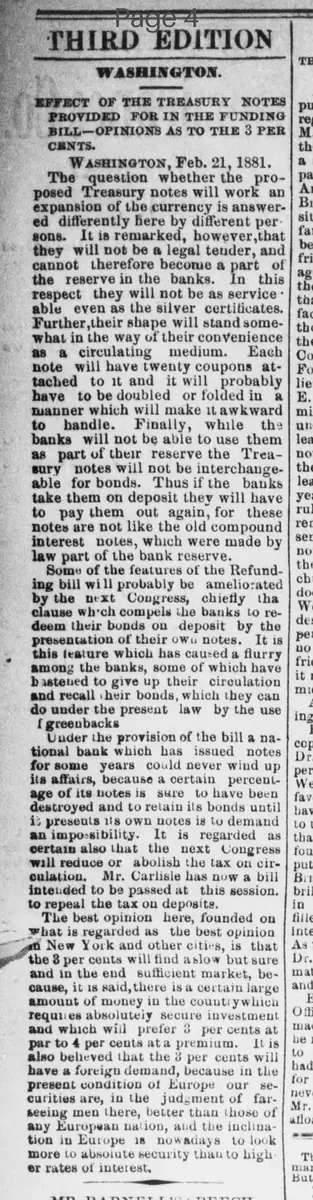
THIRD EDITION
WASHINGTON.
EFFECT OF THE TREASURY NOTES PROVIDED FOR IN THE FUNDING BILL—OPINIONS AS TO THE 3 PER CENTS.
WASHINGTON, Feb. 21, 1881.
The question whether the proposed Treasury notes will work an expansion of the currency is answered differently here by different persons. It is remarked, however, that they will not be a legal tender, and cannot therefore become a part of the reserve in the banks. In this respect they will not be as serviceable even as the silver certificates. Further, their shape will stand somewhat in the way of their convenience as a circulating medium. Each note will have twenty coupons attached to it and it will probably have to be doubled or folded in a manner which will make it awkward to handle. Finally, while the banks will not be able to use them as part of their reserve the Treasury notes will not be interchangeable for bonds. Thus if the banks take them on deposit they will have to pay them out again, for these notes are not like the old compound interest notes, which were made by law part of the bank reserve. Some of the features of the Refunding bill will probably be ameliorated by the next Congress, chiefly that clause which compels the banks to redeem their bonds on deposit by the presentation of their own notes. It is this feature which has caused a flurry among the banks, some of which have hastened to give up their circulation and recall their bonds, which they can do under the present law by the use of greenbacks. Under the provision of the bill a national bank which has issued notes for some years could never wind up its affairs, because a certain percentage of its notes is sure to have been destroyed and to retain its bonds until it presents its own notes is to demand an impossibility. It is regarded as certain also that the next Congress will reduce or abolish the tax on circulation. Mr. Carlisle has now a bill intended to be passed at this session to repeal the tax on deposits.
The best opinion here, founded on that is regarded as the best opinion New York and other cities, is that the 3 per cents will find a slow but sure and in the end sufficient market, because, it is said, there is a certain large amount of money in the country which requires absolutely secure investment and which will prefer 3 per cents at par to 4 per cents at a premium. It is also believed that the 3 per cents will have a foreign demand, because in the present condition of Europe our securities are, in the judgment of far-seeing men there, better than those of any European nation, and the inclination in Europe is nowadays to look more to absolute security than to high rates of interest.
WASHINGTON.
EFFECT OF THE TREASURY NOTES PROVIDED FOR IN THE FUNDING BILL—OPINIONS AS TO THE 3 PER CENTS.
WASHINGTON, Feb. 21, 1881.
The question whether the proposed Treasury notes will work an expansion of the currency is answered differently here by different persons. It is remarked, however, that they will not be a legal tender, and cannot therefore become a part of the reserve in the banks. In this respect they will not be as serviceable even as the silver certificates. Further, their shape will stand somewhat in the way of their convenience as a circulating medium. Each note will have twenty coupons attached to it and it will probably have to be doubled or folded in a manner which will make it awkward to handle. Finally, while the banks will not be able to use them as part of their reserve the Treasury notes will not be interchangeable for bonds. Thus if the banks take them on deposit they will have to pay them out again, for these notes are not like the old compound interest notes, which were made by law part of the bank reserve. Some of the features of the Refunding bill will probably be ameliorated by the next Congress, chiefly that clause which compels the banks to redeem their bonds on deposit by the presentation of their own notes. It is this feature which has caused a flurry among the banks, some of which have hastened to give up their circulation and recall their bonds, which they can do under the present law by the use of greenbacks. Under the provision of the bill a national bank which has issued notes for some years could never wind up its affairs, because a certain percentage of its notes is sure to have been destroyed and to retain its bonds until it presents its own notes is to demand an impossibility. It is regarded as certain also that the next Congress will reduce or abolish the tax on circulation. Mr. Carlisle has now a bill intended to be passed at this session to repeal the tax on deposits.
The best opinion here, founded on that is regarded as the best opinion New York and other cities, is that the 3 per cents will find a slow but sure and in the end sufficient market, because, it is said, there is a certain large amount of money in the country which requires absolutely secure investment and which will prefer 3 per cents at par to 4 per cents at a premium. It is also believed that the 3 per cents will have a foreign demand, because in the present condition of Europe our securities are, in the judgment of far-seeing men there, better than those of any European nation, and the inclination in Europe is nowadays to look more to absolute security than to high rates of interest.
What sub-type of article is it?
Historical Event
What themes does it cover?
Fortune Reversal
What keywords are associated?
Treasury Notes
Funding Bill
Refunding Bill
3 Per Cents
Bank Reserves
Currency Expansion
What entities or persons were involved?
Mr. Carlisle
Where did it happen?
Washington
Story Details
Key Persons
Mr. Carlisle
Location
Washington
Event Date
Feb. 21, 1881
Story Details
Debates on Treasury notes' impact on currency, their limitations, bank concerns over Refunding bill provisions, anticipated congressional amendments, and positive market outlook for 3% bonds.