Thank you for visiting SNEWPapers!
Sign up free
Morning Republican
Little Rock, Pulaski County, Arkansas
What is this article about?
George Francis Train claims the book 'Prison Life of Jefferson Davis,' attributed to Dr. Craven, was actually written in nine days by General C.G. Halpine using minimal facts from Craven. The hoax book stirred emotions and sympathies for Davis post-imprisonment, benefiting him and earning Halpine $7,000.
Clipping
OCR Quality
Full Text
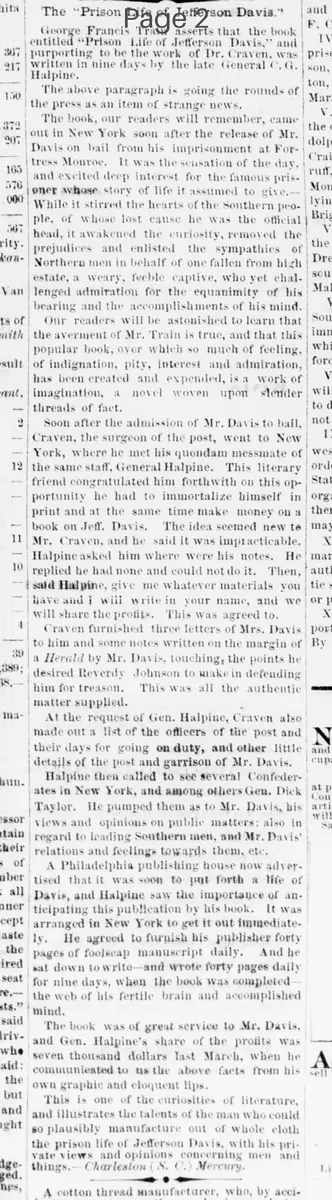
The above paragraph is going the rounds of the press as an item of strange news. The book, our readers will remember, came out in New York soon after the release of Mr. Davis on bail from his imprisonment at Fortress Monroe. It was the sensation of the day, and excited every interest for the famous prisoner's story of life it assumed to give. While it stirred the hearts of the Southern people, of whom just cause he was the official head, it awakened the curiosity, removed the prejudices and enlisted the sympathies of Northern men in behalf of one fallen from high estate, a wars, foiled captive, who yet challenged admiration for the equanimity of his bearing and the accomplishments of his mind.
Our readers will be astonished to learn that the averment of Mr. Train is true, and that this popular book, over which so much of feeling, of indignation, pity, interest and admiration, has been created and expended, is a work of imagination, a mound woven upon slender threads of fact.
Soon after the admission of Mr. Davis to bail, Craven, the surgeon of the post, went to New York, where he met his quondam messmate of the same staff, General Halpine. This literary friend congratulated him forthwith on this opportunity he had to immortalize himself in print and at the same time make money on a book on Jeff. Davis. The idea seemed new to Mr. Craven, and he said it was impracticable. Halpine asked him where were his notes. He replied he had none and could not do it. Then, said Halpine, give me whatever materials you have and I will write in your name, and we will share the profits. This was agreed to.
Craven furnished three letters of Mrs. Davis to him and some notes written on the margin of a Herald by Mr. Davis, touching the points he desired Reverdy Johnson to make in defending him for treason. This was all the authentic matter supplied.
At the request of Gen. Halpine, Craven also made out a list of the officers of the post and their days for going on duty, and other little details of the post and garrison of Mr. Davis.
Halpine then called to see several Confederates in New York, and among others Gen. Dick Taylor. He pumped them as to Mr. Davis, his views and opinions on public matters: also in regard to leading Southern men, and Mr. Davis' relations and feelings towards them, etc.
A Philadelphia publishing house now advertised that it was soon to put forth a life of Davis, and Halpine saw the importance of anticipating this publication by his book. It was arranged in New York to get it out immediately. He agreed to furnish his publisher forty pages of foolscap manuscript daily. And he sat down to write—and wrote forty pages daily for nine days, when the book was completed—the web of his fertile brain and accomplished mind.
The book was of great service to Mr. Davis, and Gen. Halpine's share of the profits was seven thousand dollars last March, when he communicated to us the above facts from his own graphic and eloquent lips.
This is one of the curiosities of literature, and illustrates the talents of the man who could so plausibly manufacture out of whole cloth the prison life of Jefferson Davis, with his private views and opinions concerning men and things. Charleston (S. C.) Mercury.
What sub-type of article is it?
What themes does it cover?
What keywords are associated?
What entities or persons were involved?
Where did it happen?
Story Details
Key Persons
Location
New York, Fortress Monroe
Event Date
Soon After The Release Of Mr. Davis On Bail From His Imprisonment At Fortress Monroe
Story Details
Dr. Craven provided minimal materials to General Halpine, who wrote the entire book 'Prison Life of Jefferson Davis' in nine days under Craven's name, using imagination to fabricate Davis's prison experiences, earning profits and aiding Davis's public image.