Thank you for visiting SNEWPapers!
Sign up free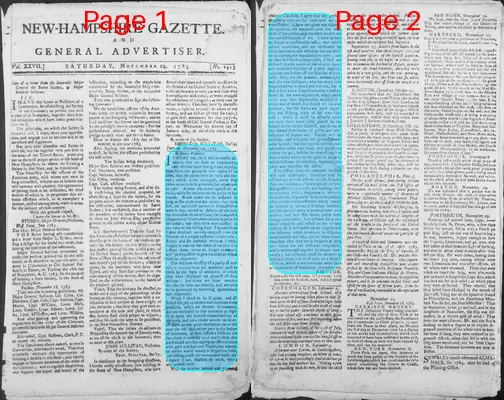
The New Hampshire Gazette And General Advertiser
Portsmouth, Exeter, Rockingham County, New Hampshire
What is this article about?
In a letter dated November 19, 1783, from Durham, 'AMATOR' argues that societal strength relies on moral purity, citing the falls of Athens and Rome due to corruption. He defends his prior criticisms of common corrupting practices against critic 'Candidus' and urges reform of customs leading to disgrace and ruin.
Merged-components note: This is a single continuous letter to the editor spanning across pages 1 and 2, as indicated by the sequential reading order and the text flow from the end of the first part to the beginning of the second.
Clippings
1 of 2
OCR Quality
Full Text
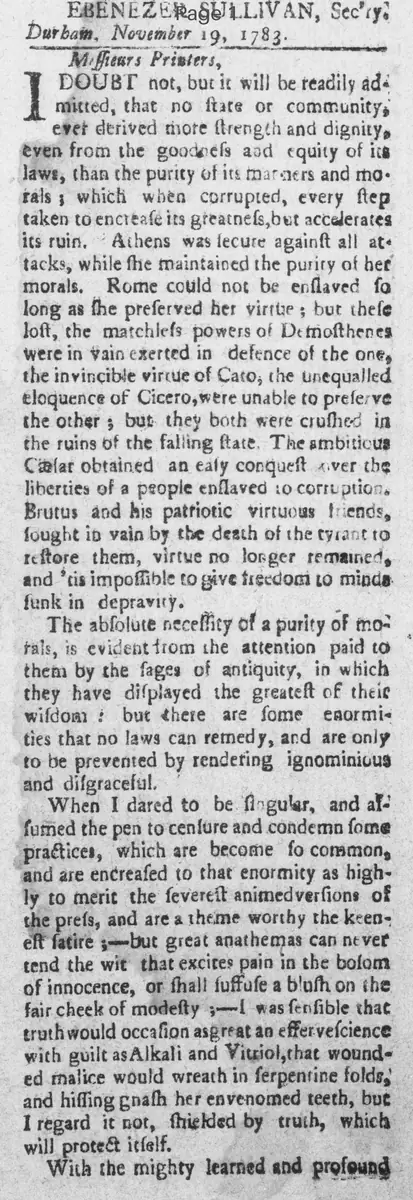
Messrs. Printers,
DOUBT not, but it will be readily admitted, that no state or community ever derived more strength and dignity, even from the goodness and equity of its laws, than the purity of its manners and morals; which when corrupted, every step taken to increase its greatness, but accelerates its ruin. Athens was secure against all attacks, while she maintained the purity of her morals. Rome could not be enslaved so long as she preserved her virtue; but these lost, the matchless powers of Demosthenes were in vain exerted in defence of the one, the invincible virtue of Cato, the unequalled eloquence of Cicero, were unable to preserve the other: but they both were crushed in the ruins of the falling state. The ambitious Caesar obtained an easy conquest over the liberties of a people enslaved to corruption. Brutus and his patriotic virtuous friends, fought in vain by the death of the tyrant to restore them, virtue no longer remained, and 'tis impossible to give freedom to minds sunk in depravity.
The absolute necessity of a purity of morals, is evident from the attention paid to them by the sages of antiquity, in which they have displayed the greatest of their wisdom: but there are some enormities that no laws can remedy, and are only to be prevented by rendering ignominious and disgraceful.
When I dared to be singular, and assumed the pen to censure and condemn some practices, which are become so common, and are increased to that enormity as highly to merit the severest animadversions of the press, and are a theme worthy the keenest satire;--but great anathemas can never tend the wit that excites pain in the bosom of innocence, or shall suffuse a blush on the fair cheek of modesty;--I was sensible that truth would occasion as great an effervescence with guilt as Alkali and Vitriol, that wounded malice would wreath in serpentine folds, and hissing gnash her envenomed teeth, but I regard it not, shielded by truth, which will protect itself.
With the mighty learned and profound
Reasoner Candidus, I agree that my performances as they are the truth only are extraordinary. I have not given out disputable opinions, nor wandered over the wide field of peculation, and therefore needed not the embellishments of wit. I have spoken to simple unquestionable facts; with which all are conversant, and are confirmed by daily experience, and which he had not ability to confute, nor impudence to deny: and as they still stand unimpeached, I shall not descend to take notice of the virulent sneers and wretched sophisms of a petit logician, who has not shaken off the shackles of scholastic folly, nor the pedantic, awkward stiffness of a raw Collegian, who has made little improvements in Mode and Figure, but is still in barbarous implicit; who is best refuted by his own arguments, which recoil with two fold impetuosity on himself every line of which is a sketch of his own portrait; but the Italics are most expressive and striking traits of his own likeness; which it must be allowed could not have been more justly placed by the famed Italian master himself, and shows to the eternal humiliation of pride, and mortification of human wit. Nature will be absolute, and will paint her greatest simplicities herself: but the capitals are the characteristics of his own head, and peculiarly denote the ass; besides the clearest truth in such a mind would be like gold in an acid, which destroys the cohesion, separates the parts and tarnishes the lustre.
If to dissent from the common method will raise admiration, Candidus may be assured my address will not be less singular than my writings;--'tis my opinion, the present practice in that case, is a standing insult to common sense; dangerous to virtue in its tendency, disgraceful in its consequences, often creates embarrassments which cannot be relieved by the most assiduous industry, and has pierced many a parental heart with anxiety, and will still more, unless some change takes place. Let wisdom for a moment attend to and reflect on the present custom, & it will rather excite surprise that the instances which terminate in disgrace, wretchedness and ruin, are not more numerous than that they are so frequent as they are: virtue has not sufficient temptation, and is not enough exposed to danger naturally; but invention must be tortured to multiply them,--it must truly be a miracle of virtue, which is not overcome under such a combination of hazardous circumstances.
AMATOR.
What sub-type of article is it?
What themes does it cover?
What keywords are associated?
What entities or persons were involved?
Letter to Editor Details
Author
Amator.
Recipient
Messrs. Printers
Main Argument
societal strength and dignity derive from pure morals rather than laws alone; corrupting practices must be censured to prevent ruin, as historical examples like athens and rome demonstrate, and the author defends his truthful criticisms against detractors.
Notable Details