Thank you for visiting SNEWPapers!
Sign up free
Editorial
May 30, 1789
Gazette Of The United States
New York, New York County, New York
What is this article about?
This editorial argues that public opinion is not always a reliable test of justice, especially regarding revenue laws and taxes. Through anecdotes on partial honesty in trade, gaming, and society, it urges citizens to pay taxes dutifully and governments to administer fairly without oppression.
Clipping
OCR Quality
95%
Excellent
Full Text
THE TABLET. NO. XIV.
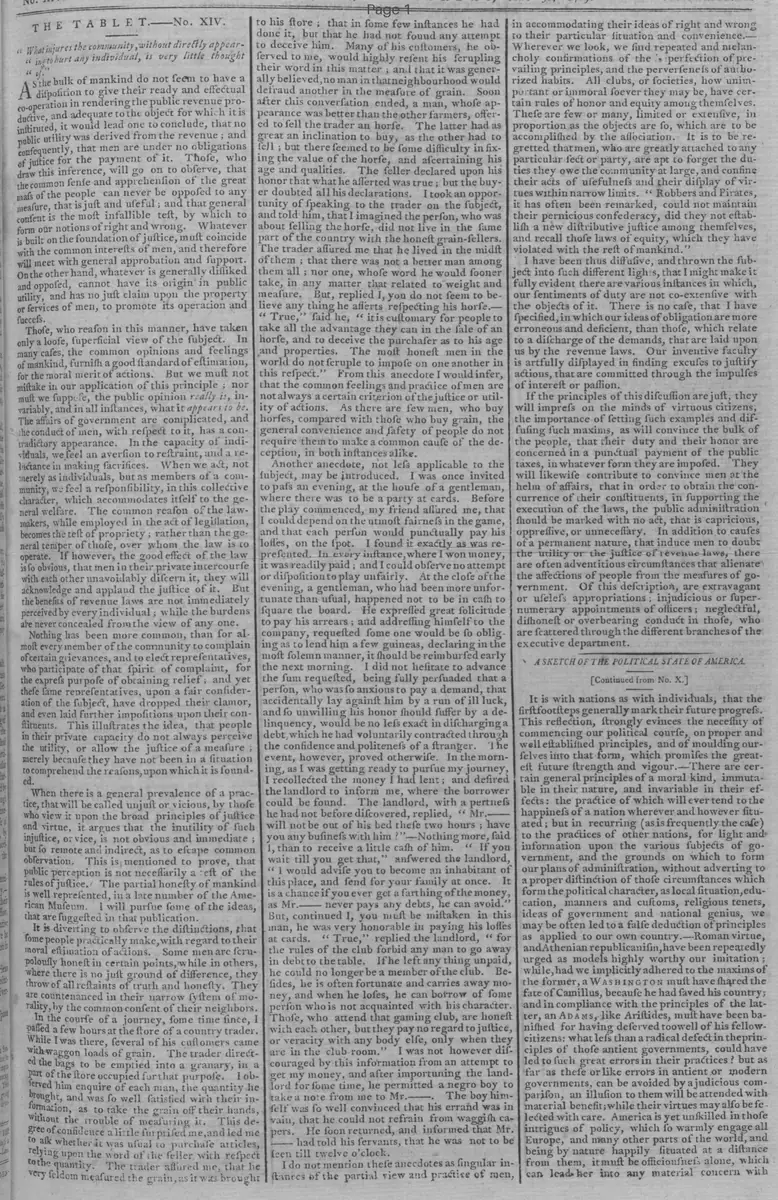
"What injures the community, without directly appearing to hurt any individual, is very little thought of. As the bulk of mankind do not seem to have a sense of co-operation in rendering the public revenue productive, and adequate to the object for which it is instituted, it would lead one to conclude, that no public utility was derived from the revenue; and consequently, that men are under no obligations of justice for the payment of it. Those, who draw this inference, will go on to observe, that the common sense and apprehension of the great mass of the people can never be opposed to any measure, that is just and useful; and that general consent is the most infallible test, by which to form our notions of right and wrong. Whatever is built on the foundation of justice, must coincide with the common interests of men, and therefore will meet with general approbation and support.
On the other hand, whatever is generally disliked and opposed, cannot have its origin in public utility, and has no just claim upon the property or services of men, to promote its operation and success.
Those, who reason in this manner, have taken only a loose, superficial view of the subject. In many cases, the common opinions and feelings of mankind, furnish a good standard of estimation, for the moral merit of actions. But we must not mistake in our application of this principle; nor must we suppose, the public opinion really is, invariably, and in all instances, what it appears to be.
The affairs of government are complicated, and the conduct of men, with respect to it, has a contradictory appearance. In the capacity of individuals, we feel an aversion to restraint, and a reluctance in making sacrifices. When we act, not merely as individuals, but as members of a community, we feel a responsibility, in this collective character, which accommodates itself to the general welfare. The common reason of the law-makers, while employed in the act of legislation, becomes the test of propriety; rather than the general temper of those, over whom the law is to operate. If however, the good effect of the law is so obvious, that men in their private intercourse with each other unavoidably discern it, they will acknowledge and applaud the justice of it. But the benefits of revenue laws are not immediately perceived by every individual; while the burdens are never concealed from the view of any one.
Nothing has been more common, than for almost every member of the community to complain of certain grievances, and to elect representatives, who participate of that spirit of complaint, for the express purpose of obtaining relief; and yet these same representatives, upon a fair consideration of the subject, have dropped their clamor, and even laid further impositions upon their constituents. This illustrates the idea, that people in their private capacity do not always perceive the utility, or allow the justice of a measure; merely because they have not been in a situation to comprehend the reasons, upon which it is founded.
When there is a general prevalence of a practice, that will be called unjust or vicious, by those who view it upon the broad principles of justice and virtue, it argues that the inutility of such injustice, or vice, is not obvious and immediate; but so remote and indirect, as to escape common observation. This is mentioned to prove, that public perception is not necessarily a test of the rules of justice. The partial honesty of mankind is well represented, in a late number of the American Museum. I will pursue some of the ideas, that are suggested in that publication.
It is diverting to observe the distinctions, that some people practically make, with regard to their moral estimation of actions. Some men are scrupulously honest in certain points, while in others, where there is no just ground of difference, they throw off all restraints of truth and honesty. They are countenanced in their narrow system of morality, by the common consent of their neighbors.
In the course of a journey, some time since, I passed a few hours at the store of a country trader. While I was there, several of his customers came with wagon loads of grain. The trader directed the bags to be emptied into a granary, in a part of the store occupied for that purpose. I observed him enquire of each man, the quantity he brought, and was so well satisfied with their information, as to take the grain off their hands, without the trouble of measuring it. This degree of confidence a little surprised me, and led me to ask whether it was usual to purchase articles, relying upon the word of the seller with respect to the quantity. The trader assured me, that he very seldom measured the grain, as it was brought to his store; that in some few instances he had done it, but that he had not found any attempt to deceive him. Many of his customers, he observed to me, would highly resent his scruppling their word in this matter; and that it was generally believed, no man in that neighbourhood would defraud another in the measure of grain. Soon after this conversation ended, a man, whose appearance was better than the other farmers, offered to sell the trader a horse. The latter had as great an inclination to buy, as the other had to sell; but there seemed to be some difficulty in fixing the value of the horse, and ascertaining his age and qualities. The seller declared upon his honor that what he asserted was true; but the buyer doubted all his declarations. I took an opportunity of speaking to the trader on the subject, and told him, that I imagined the person, who was about selling the horse, did not live in the same part of the country with the honest grain-sellers. The trader assured me that he lived in the midst of them; that there was not a better man among them all; nor one, whose word he would sooner take, in any matter that related to weight and measure. But, replied I, you do not seem to believe any thing he asserts respecting his horse.— "True," said he, "it is customary for people to take all the advantage they can in the sale of a horse, and to deceive the purchaser as to his age and properties. The most honest men in the world do not scruple to impose on one another in this respect." From this anecdote I would infer, that the common feelings and practice of men are not always a certain criterion of the justice or utility of actions. As there are few men, who buy horses, compared with those who buy grain, the general convenience and safety of people do not require them to make a common cause of the deception, in both instances alike.
Another anecdote, not less applicable to the subject, may be introduced. I was once invited to pass an evening, at the house of a gentleman, where there was to be a party at cards. Before the play commenced, my friend assured me, that I could depend on the utmost fairness in the game, and that each person would punctually pay his losses, on the spot. I found it exactly as was represented. In every instance, where I won money, it was readily paid; and I could observe no attempt or disposition to play unfairly. At the close of the evening, a gentleman, who had been more unfortunate than usual, happened not to be in cash to square the board. He expressed great solicitude to pay his arrears; and addressing himself to the company, requested some one would be so obliging as to lend him a few guineas, declaring in the most solemn manner, it should be reimbursed early the next morning. I did not hesitate to advance the sum requested, being fully persuaded that a person, who was so anxious to pay a demand, that accidentally lay against him by a run of ill luck, and so unwilling his honor should suffer by a delinquency, would be no less exact in discharging a debt, which he had voluntarily contracted through the confidence and politeness of a stranger. The event, however, proved otherwise. In the morning, as I was getting ready to pursue my journey, I recollected the money I had lent; and desired the landlord to inform me, where the borrower could be found. The landlord, with a pertness he had not before discovered, replied, "Mr. — will not be out of his bed these two hours; have you any business with him?"—Nothing more, said I, than to receive a little cash of him. "If you wait till you get that," answered the landlord, "I would advise you to become an inhabitant of this place, and send for your family at once. It is a chance if you ever get a farthing of the money, as Mr. — never pays any debts, he can avoid." But, continued I, you must be mistaken in this man, he was very honorable in paying his losses at cards. "True," replied the landlord, "for the rules of the club forbid any man to go away in debt to the table. If he left any thing unpaid, he could no longer be a member of the club. Besides, he is often fortunate and carries away money, and when he loses, he can borrow of some person who is not acquainted with his character. Those, who attend that gaming club, are honest with each other, but they pay no regard to justice, or veracity with any body else, only when they are in the club room." I was not however discouraged by this information from an attempt to get my money, and after importuning the landlord for some time, he permitted a negro boy to take a note from me to Mr. —. The boy himself was so well convinced that his errand was in vain, that he could not refrain from waggish capers. He soon returned, and informed that Mr. — had told his servants, that he was not to be seen till twelve o'clock.
I do not mention these anecdotes as singular instances of the partial view and practice of men in accommodating their ideas of right and wrong to their particular situation and convenience.— Wherever we look, we find repeated and melancholy confirmations of the perfection of prevailing principles, and the perverseness of authorized habits. All clubs, or societies, how unimportant or immoral soever they may be, have certain rules of honor and equity among themselves. These are few or many, limited or extensive, in proportion as the objects are so, which are to be accomplished by the association. It is to be regretted that men, who are greatly attached to any particular sect or party, are apt to forget the duties they owe the community at large, and confine their acts of usefulness and their display of virtues within narrow limits. "Robbers and Pirates, it has often been remarked, could not maintain their pernicious confederacy, did they not establish a new distributive justice among themselves, and recall those laws of equity, which they have violated with the rest of mankind."
I have been thus diffusive, and thrown the subject into such different lights, that I might make it fully evident there are various instances in which, our sentiments of duty are not co-extensive with the objects of it. There is no case, that I have specified, in which our ideas of obligation are more erroneous and deficient, than those, which relate to a discharge of the demands, that are laid upon us by the revenue laws. Our inventive faculty is artfully displayed in finding excuses to justify actions, that are committed through the impulse of interest or passion.
If the principles of this discussion are just, they will impress on the minds of virtuous citizens, the importance of setting such examples and diffusing such maxims, as will convince the bulk of the people, that their duty and their honor are concerned in a punctual payment of the public taxes, in whatever form they are imposed. They will likewise contribute to convince men at the helm of affairs, that in order to obtain the concurrence of their constituents, in supporting the execution of the laws, the public administration should be marked with no act, that is capricious, oppressive, or unnecessary. In addition to causes of a permanent nature, that induce men to doubt the utility or the justice of revenue laws, there are often adventitious circumstances that alienate the affections of people from the measures of government. Of this description, are extravagant or useless appropriations; injudicious or supernumerary appointments of officers; neglectful, dishonest or overbearing conduct in those, who are scattered through the different branches of the executive department.
"What injures the community, without directly appearing to hurt any individual, is very little thought of. As the bulk of mankind do not seem to have a sense of co-operation in rendering the public revenue productive, and adequate to the object for which it is instituted, it would lead one to conclude, that no public utility was derived from the revenue; and consequently, that men are under no obligations of justice for the payment of it. Those, who draw this inference, will go on to observe, that the common sense and apprehension of the great mass of the people can never be opposed to any measure, that is just and useful; and that general consent is the most infallible test, by which to form our notions of right and wrong. Whatever is built on the foundation of justice, must coincide with the common interests of men, and therefore will meet with general approbation and support.
On the other hand, whatever is generally disliked and opposed, cannot have its origin in public utility, and has no just claim upon the property or services of men, to promote its operation and success.
Those, who reason in this manner, have taken only a loose, superficial view of the subject. In many cases, the common opinions and feelings of mankind, furnish a good standard of estimation, for the moral merit of actions. But we must not mistake in our application of this principle; nor must we suppose, the public opinion really is, invariably, and in all instances, what it appears to be.
The affairs of government are complicated, and the conduct of men, with respect to it, has a contradictory appearance. In the capacity of individuals, we feel an aversion to restraint, and a reluctance in making sacrifices. When we act, not merely as individuals, but as members of a community, we feel a responsibility, in this collective character, which accommodates itself to the general welfare. The common reason of the law-makers, while employed in the act of legislation, becomes the test of propriety; rather than the general temper of those, over whom the law is to operate. If however, the good effect of the law is so obvious, that men in their private intercourse with each other unavoidably discern it, they will acknowledge and applaud the justice of it. But the benefits of revenue laws are not immediately perceived by every individual; while the burdens are never concealed from the view of any one.
Nothing has been more common, than for almost every member of the community to complain of certain grievances, and to elect representatives, who participate of that spirit of complaint, for the express purpose of obtaining relief; and yet these same representatives, upon a fair consideration of the subject, have dropped their clamor, and even laid further impositions upon their constituents. This illustrates the idea, that people in their private capacity do not always perceive the utility, or allow the justice of a measure; merely because they have not been in a situation to comprehend the reasons, upon which it is founded.
When there is a general prevalence of a practice, that will be called unjust or vicious, by those who view it upon the broad principles of justice and virtue, it argues that the inutility of such injustice, or vice, is not obvious and immediate; but so remote and indirect, as to escape common observation. This is mentioned to prove, that public perception is not necessarily a test of the rules of justice. The partial honesty of mankind is well represented, in a late number of the American Museum. I will pursue some of the ideas, that are suggested in that publication.
It is diverting to observe the distinctions, that some people practically make, with regard to their moral estimation of actions. Some men are scrupulously honest in certain points, while in others, where there is no just ground of difference, they throw off all restraints of truth and honesty. They are countenanced in their narrow system of morality, by the common consent of their neighbors.
In the course of a journey, some time since, I passed a few hours at the store of a country trader. While I was there, several of his customers came with wagon loads of grain. The trader directed the bags to be emptied into a granary, in a part of the store occupied for that purpose. I observed him enquire of each man, the quantity he brought, and was so well satisfied with their information, as to take the grain off their hands, without the trouble of measuring it. This degree of confidence a little surprised me, and led me to ask whether it was usual to purchase articles, relying upon the word of the seller with respect to the quantity. The trader assured me, that he very seldom measured the grain, as it was brought to his store; that in some few instances he had done it, but that he had not found any attempt to deceive him. Many of his customers, he observed to me, would highly resent his scruppling their word in this matter; and that it was generally believed, no man in that neighbourhood would defraud another in the measure of grain. Soon after this conversation ended, a man, whose appearance was better than the other farmers, offered to sell the trader a horse. The latter had as great an inclination to buy, as the other had to sell; but there seemed to be some difficulty in fixing the value of the horse, and ascertaining his age and qualities. The seller declared upon his honor that what he asserted was true; but the buyer doubted all his declarations. I took an opportunity of speaking to the trader on the subject, and told him, that I imagined the person, who was about selling the horse, did not live in the same part of the country with the honest grain-sellers. The trader assured me that he lived in the midst of them; that there was not a better man among them all; nor one, whose word he would sooner take, in any matter that related to weight and measure. But, replied I, you do not seem to believe any thing he asserts respecting his horse.— "True," said he, "it is customary for people to take all the advantage they can in the sale of a horse, and to deceive the purchaser as to his age and properties. The most honest men in the world do not scruple to impose on one another in this respect." From this anecdote I would infer, that the common feelings and practice of men are not always a certain criterion of the justice or utility of actions. As there are few men, who buy horses, compared with those who buy grain, the general convenience and safety of people do not require them to make a common cause of the deception, in both instances alike.
Another anecdote, not less applicable to the subject, may be introduced. I was once invited to pass an evening, at the house of a gentleman, where there was to be a party at cards. Before the play commenced, my friend assured me, that I could depend on the utmost fairness in the game, and that each person would punctually pay his losses, on the spot. I found it exactly as was represented. In every instance, where I won money, it was readily paid; and I could observe no attempt or disposition to play unfairly. At the close of the evening, a gentleman, who had been more unfortunate than usual, happened not to be in cash to square the board. He expressed great solicitude to pay his arrears; and addressing himself to the company, requested some one would be so obliging as to lend him a few guineas, declaring in the most solemn manner, it should be reimbursed early the next morning. I did not hesitate to advance the sum requested, being fully persuaded that a person, who was so anxious to pay a demand, that accidentally lay against him by a run of ill luck, and so unwilling his honor should suffer by a delinquency, would be no less exact in discharging a debt, which he had voluntarily contracted through the confidence and politeness of a stranger. The event, however, proved otherwise. In the morning, as I was getting ready to pursue my journey, I recollected the money I had lent; and desired the landlord to inform me, where the borrower could be found. The landlord, with a pertness he had not before discovered, replied, "Mr. — will not be out of his bed these two hours; have you any business with him?"—Nothing more, said I, than to receive a little cash of him. "If you wait till you get that," answered the landlord, "I would advise you to become an inhabitant of this place, and send for your family at once. It is a chance if you ever get a farthing of the money, as Mr. — never pays any debts, he can avoid." But, continued I, you must be mistaken in this man, he was very honorable in paying his losses at cards. "True," replied the landlord, "for the rules of the club forbid any man to go away in debt to the table. If he left any thing unpaid, he could no longer be a member of the club. Besides, he is often fortunate and carries away money, and when he loses, he can borrow of some person who is not acquainted with his character. Those, who attend that gaming club, are honest with each other, but they pay no regard to justice, or veracity with any body else, only when they are in the club room." I was not however discouraged by this information from an attempt to get my money, and after importuning the landlord for some time, he permitted a negro boy to take a note from me to Mr. —. The boy himself was so well convinced that his errand was in vain, that he could not refrain from waggish capers. He soon returned, and informed that Mr. — had told his servants, that he was not to be seen till twelve o'clock.
I do not mention these anecdotes as singular instances of the partial view and practice of men in accommodating their ideas of right and wrong to their particular situation and convenience.— Wherever we look, we find repeated and melancholy confirmations of the perfection of prevailing principles, and the perverseness of authorized habits. All clubs, or societies, how unimportant or immoral soever they may be, have certain rules of honor and equity among themselves. These are few or many, limited or extensive, in proportion as the objects are so, which are to be accomplished by the association. It is to be regretted that men, who are greatly attached to any particular sect or party, are apt to forget the duties they owe the community at large, and confine their acts of usefulness and their display of virtues within narrow limits. "Robbers and Pirates, it has often been remarked, could not maintain their pernicious confederacy, did they not establish a new distributive justice among themselves, and recall those laws of equity, which they have violated with the rest of mankind."
I have been thus diffusive, and thrown the subject into such different lights, that I might make it fully evident there are various instances in which, our sentiments of duty are not co-extensive with the objects of it. There is no case, that I have specified, in which our ideas of obligation are more erroneous and deficient, than those, which relate to a discharge of the demands, that are laid upon us by the revenue laws. Our inventive faculty is artfully displayed in finding excuses to justify actions, that are committed through the impulse of interest or passion.
If the principles of this discussion are just, they will impress on the minds of virtuous citizens, the importance of setting such examples and diffusing such maxims, as will convince the bulk of the people, that their duty and their honor are concerned in a punctual payment of the public taxes, in whatever form they are imposed. They will likewise contribute to convince men at the helm of affairs, that in order to obtain the concurrence of their constituents, in supporting the execution of the laws, the public administration should be marked with no act, that is capricious, oppressive, or unnecessary. In addition to causes of a permanent nature, that induce men to doubt the utility or the justice of revenue laws, there are often adventitious circumstances that alienate the affections of people from the measures of government. Of this description, are extravagant or useless appropriations; injudicious or supernumerary appointments of officers; neglectful, dishonest or overbearing conduct in those, who are scattered through the different branches of the executive department.
What sub-type of article is it?
Taxation
Moral Or Religious
Economic Policy
What keywords are associated?
Public Revenue
Tax Payment
Partial Honesty
Moral Duty
Government Administration
Revenue Laws
Civic Responsibility
Justice Perception
What entities or persons were involved?
Government
Revenue Laws
Citizens
Representatives
Editorial Details
Primary Topic
Duty To Pay Public Taxes Despite Public Opinion
Stance / Tone
Advocacy For Civic Duty In Taxation And Just Governance
Key Figures
Government
Revenue Laws
Citizens
Representatives
Key Arguments
Public Opinion Is Not Always A Reliable Test Of Justice, Especially For Complex Government Matters
Benefits Of Revenue Laws Are Not Immediately Perceived, While Burdens Are Obvious
People Complain About Taxes But Elect Representatives Who Later Impose Them After Consideration
Partial Honesty Prevails: Scrupulous In Some Dealings (E.G., Grain Measure) But Deceptive In Others (E.G., Horse Sales)
Gaming Clubs Enforce Internal Honor But Members Disregard It Outside
Societies And Clubs Limit Virtues To Their Members, Forgetting Broader Community Duties
Citizens Should Pay Taxes Punctually As A Matter Of Duty And Honor
Governments Must Avoid Capricious, Oppressive, Or Unnecessary Acts To Gain Public Support