Thank you for visiting SNEWPapers!
Sign up free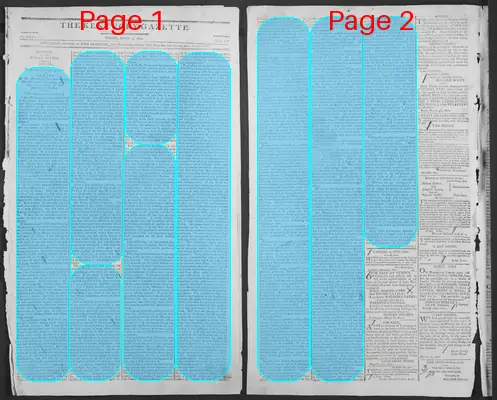
The Kentucky Gazette
Lexington, Fayette County, Kentucky
What is this article about?
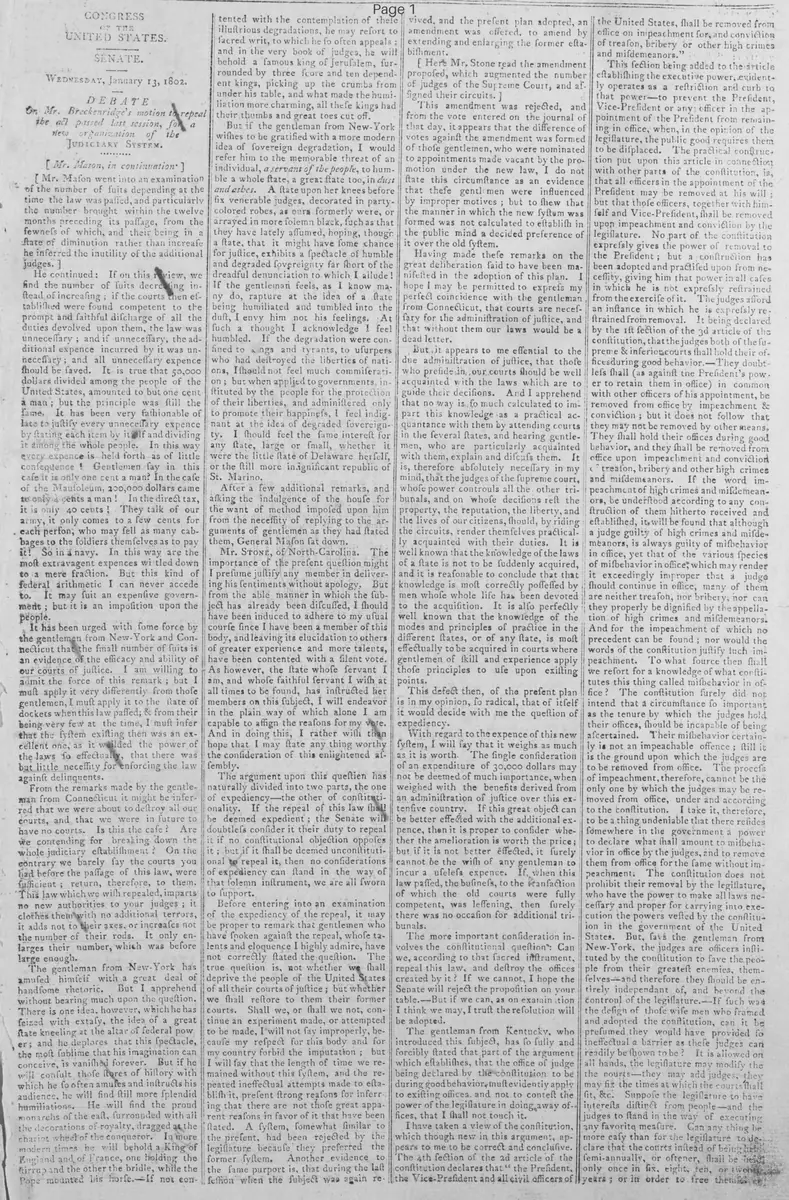
U.S. Senate debate on January 13, 1802, regarding Mr. Breckenridge's motion to repeal the Judiciary Act of 1801 reorganizing the federal courts. Speakers including Mason (Virginia), Stone (North Carolina), Olcott (New Hampshire), Cocke (Tennessee), and Morris argue on expediency, cost, court sufficiency, and constitutional power to repeal, emphasizing judicial independence and public protection.
Merged-components note: Continuation of the congressional debate on the judiciary system across pages 1 and 2, as indicated by seamless text flow and '(TO BE CONTINUED.)' at the end.
Clippings
1 of 2
OCR Quality
Full Text
DEBATE
On Mr. Breckenridge's motion to repeal
the act passed last session, for
a
new organization of the
JUDICIARY SYSTEM.
[ Mr. Mason, in continuation ]
Mr. Mason went into an examination
of the number of suits depending at the
time the law was passed, and particularly
the number brought within the twelve
months preceding its passage, from the
fewness of which, and their being in a
state of diminution rather than increase
he inferred the inutility of the additional
judges.
He continued: If on this review, we
find the number of suits decreasing in-
stead of increasing; if the courts then es-
tablished were found competent to the
prompt and faithful discharge of all the
duties devolved upon them, the law was
unnecessary; and if unnecessary, the ad-
ditional expense incurred by it was un-
necessary; and all unnecessary expense
should be saved. It is true that $50,000
dollars divided among the people of the
United States, amounted to but one cent
a man: but the principle was still the
same. It has been very fashionable of
late to justify every unnecessary expense
by stating each item by itself and dividing
it among the whole people. In this way
every expense is held forth as of little
consequence! Gentlemen say in this
case it is only one cent a man? In the case
of the Mausoleum, $200,000 dollars came
to only 4 cents a man! In the direct tax,
it is only 40 cents! They talk of our
army, it only comes to a few cents for
each person, who may sell as many cab-
bages to the soldiers themselves as to pay
it! So in navy. In this way are the
most extravagant expenses whittled down
to a mere fraction. But this kind of
federal arithmetic I can never accede
to. It may suit an expensive govern-
ment; but it is an imposition upon the
people.
It has been urged with some force by
the gentlemen from New-York and Con-
necticut that the small number of suits is
an evidence of the efficacy and ability of
our courts of justice. I am willing to
admit the force of this remark; but I
must apply it very differently from those
gentlemen, I must apply it to the state of
dockets when this law passed; & from their
being very few at the time, I must infer
that the system existing then was an ex-
cellent one, as it wielded the power of
the laws so effectually, that there was
but little necessity for enforcing the law
against delinquents.
From the remarks made by the gentle-
man from Connecticut it might be infer-
red that we were about to destroy all our
courts, and that we were in future to
have no courts. Is this the case? Are
we contending for breaking down the
whole judiciary establishment? On the
contrary we barely say the courts you
had before the passage of this law, were
sufficient; return, therefore, to them.
This law which we wish repealed, imparts
no new authorities to your judges; it
clothes them with no additional terrors,
it adds not to their axes, or increases not
the number of their rods. It only en-
larges their number, which was before
large enough.
The gentleman from New-York has
amused himself with a great deal of
handsome rhetoric. But I apprehend
without bearing much upon the question.
There is one idea, however, which he has
seized with ecstasy, the idea of a great
state kneeling at the altar of federal pow
er; and he deplores that this spectacle,
the most sublime that his imagination can
conceive, is vanished forever. But if he
will consult those stores of history with
which he so often amuses and instructs his
audience, he will find still more splendid
humiliations. He will find the proud
monarchs of the east, surrounded with all
the decorations of royalty, dragged at the
chariot wheel of the conqueror. In more
modern times he will behold a King of
England and of France, one holding the
stirrup and the other the bridle, while the
Pope mounted his horse. If not con-
tented with the contemplation of these
illustrious degradations, he may resort to
sacred writ, to which he so often appeals;
and in the very book of judges, he will
behold a famous king of Jerusalem, sur-
rounded by three score and ten depend-
ent kings, picking up the crumbs from
under his table, and what made the humi-
liation more charming, all these kings had
their thumbs and great toes cut off.
But if the gentleman from New-York
wishes to be gratified with a more modern
idea of sovereign degradation, I would
refer him to the memorable threat of an
individual, a servant of the people, to hum-
ble a whole state, a great state too, in dust
and ashes. A state upon her knees before
six venerable judges, decorated in party-
colored robes, as ours formerly were, or
arrayed in more solemn black, such as that
they have lately assumed, hoping, though
a state, that it might have some chance
for justice, exhibits a spectacle of humble
and degraded sovereignty far short of the
dreadful denunciation to which I allude!
If the gentleman feels, as I know ma-
ny do, rapture at the idea of a state
being humiliated and tumbled into the
dust, I envy him not his feelings. At
such a thought I acknowledge I feel
humbled. If the degradation were con-
fined to kings and tyrants, to usurpers
who had destroyed the liberties of nati-
ons, I should not feel much commiserati-
on; but when applied to governments, in-
stituted by the people for the protection
of their liberties, and administered only
to promote their happiness, I feel indig-
nant at the idea of degraded sovereign-
ty. I should feel the same interest for
any state, large or small, whether it
were the little state of Delaware herself,
or the still more insignificant republic of
St. Marino.
After a few additional remarks, and
asking the indulgence of the house for
the want of method imposed upon him
from the necessity of replying to the ar-
guments of gentlemen as they had stated
them, General Mason sat down.
Mr. Stone, of North-Carolina. The
importance of the present question might
I presume justify any member in deliver-
ing his sentiments without apology. But
from the able manner in which the sub-
ject has already been discussed, I should
have been induced to adhere to my usual
course since I have been a member of this
body, and leaving its elucidation to others
of greater experience and more talents,
have been contented with a silent vote.
As however, the state whose servant I
am, and whose faithful servant I wish at
all times to be found, has instructed her
members on this subject, I will endeavor
in the plain way of which alone I am
capable to assign the reasons for my vote.
And in doing this, I rather wish than
hope that I may state any thing worthy
the consideration of this enlightened as-
sembly.
The argument upon this question has
naturally divided into two parts, the one
of expediency-the other of constitutionality. If the repeal of this law shall
be deemed expedient: the Senate will
doubtless consider it their duty to repeal
it if no constitutional objection opposes
it : but if it shall be deemed unconstitutional to repeal it, then no considerations
of expediency can stand in the way of
that solemn instrument, we are all sworn
to support.
Before entering into an examination
of the expediency of the repeal, it may
be proper to remark that gentlemen who
have spoken against the repeal, whose ta-
lents and eloquence I highly admire, have
not correctly stated the question. The
true question is, not whether we shall
depelve the people of the United States
of all their courts of justice; but whether
we shall restore to them their former
courts. Shall we, or shall we not, con-
tinue an experiment made, or attempted
to be made, I will not say improperly, be-
cause my respect for this body and for
my country forbid the imputation; but
I will say that the length of time we re-
mained without this system, and the re-
peated ineffectual attempts made to esta-
bish it, present strong reasons for inferr-
ing that there are not those great appa-
rent reasons in favor of it that have been
stated. A system, somewhat similar to
the present, had been rejected by the
legislature because they preferred the
former system. Another evidence to
the same purport is, that during the last
election when the subject was again re-
vived, and the present plan adopted, an
amendment was offered, to amend by
extending and enlarging the former esta-
bishment.
[Here Mr. Stone read the amendment
proposed, which augmented the number
of judges of the Supreme Court, and as-
signed their circuits.]
This amendment was rejected, and
from the vote entered on the journal of
that day, it appears that the difference of
votes against the amendment was formed
of those gentlemen, who were nominated
to appointments made vacant by the pro-
motion under the new law, I do not
state this circumstance as an evidence
that these gentlemen were influenced
by improper motives; but to show that
the manner in which the new system was
formed was not calculated to establish in
the public mind a decided preference of
it over the old system.
Having made these remarks on the
great deliberation said to have been ma-
nifested in the adoption of this plan. I
hope I may be permitted to express my
perfect coincidence with the gentleman
from Connecticut, that courts are neces-
sary for the administration of justice, and
that without them our laws would be a
dead letter.
But it appears to me essential to the
due administration of justice, that those
who preside in our courts should be well
acquainted with the laws which are to
guide their decisions. And I apprehend
that no way is so much calculated to im-
part this knowledge -as a practical ac-
quaintance with them by attending courts
in the several states, and hearing gentle-
men, who are particularly acquainted
with them, explain and discuss them. It
is, therefore absolutely necessary in my
mind, that the judges of the supreme court,
whose power controuls all the other tri-
bunals, and on whose decisions rest the
property, the reputation, the liberty, and
the lives of our citizens, should, by riding
the circuits, render themselves practically
acquainted with their duties. It is
well known that the knowledge of the laws
of a state is not to be suddenly acquired,
and it is reasonable to conclude that that
knowledge is most correctly possessed by
men whose whole life has been devoted
to the acquisition. It is also perfectly
well known that the knowledge of the
modes and principles of practice in the
different states, or of any state, is most
effectually to be acquired in courts where
gentlemen of skill and experience apply
those principles to use upon existing
points.
This defect then, of the present plan
is in my opinion, so radical, that of itself
it would decide with me the question of
expediency.
With regard to the expense of this new
system, I will say that it weighs as much
as it is worth. The single consideration
of an expenditure of $30,000 dollars may
not be deemed of much importance, when
weighed with the benefits derived from
an administration of justice over this ex-
tensive country. If this great object can
be better effected with the additional ex-
pense, then it is proper to consider whe-
ther the amelioration is worth the price;
but if it is not better effected, it surely
cannot be the wish of any gentleman to
incur a useless expense. If, when this
law passed, the business, to the transaction
of which the old courts were fully
competent, was lessening, then surely
there was no occasion for additional tri-
bunals.
The more important consideration in-
volves the constitutional question: Can
we, according to that sacred instrument,
repeal this law, and destroy the offices
created by it? If we cannot, I hope the
Senate will reject the proposition on your
table.--But if we can, as on examination
I think we may, I trust the resolution will
be adopted.
The gentleman from Kentucky, who
introduced this subject, has so fully and
forcibly stated that part of the argument
which establishes, that the office of judge
being declared by the constitution to be
during good behavior, must evidently apply
to existing offices. and not to contest the
power of the legislature in doing away of-
fices, that I shall not touch it.
I have taken a view of the constitution,
which though new in this argument, ap-
pears to me to be correct and conclusive.
The 4th section of the 2d article of the
constitution declares that "the President,
the Vice-President and all civil officers of
the United States, shall be removed from
office on impeachment for, and conviction
of treason, bribery or other high crimes
and misdemeanors.
This section being added to the article
establishing the executive power, evident-
ly operates as a restriction and curb to
that power~-to prevent the President.
Vice-President or any officer in the ap-
pointment of the President from remain-
ing in office, when, in the opinion of the
legislature, the public good requires them
to be displaced. The practical construc-
tion put upon this article in connection
with other parts of the constitution, is,
that all officers in the appointment of the
President may be removed at his will;
but that those officers, together with him-
self and Vice-President, shall be removed
upon impeachment and conviction by the
legislature. No part of the constitution
expressly gives the power of removal to
the President; but a construction has
been adopted and practised upon from ne-
cessity, giving him that power in all cases
in which he is not expressly restrained
from the exercise of it. The judges afford
an instance in which he is expressly re.
strained from removal. It being declared
by the 1st section of the 3d article of the
constitution, that the judges both of the su-
preme & inferior courts shall hold their of.
fices during good behavior.-They doubt-
less shall (as against the President's pow.
er to retain them in office) in common
with other officers of his appointment, be
removed from office by impeachment &
conviction; but it does not follow that
they may not be removed by other means,
They shall hold their offices during good
behavior, and they shall be removed from
office upon impeachment and conviction
of treason, bribery and other high crimes
and misdemeanors. If the word im-
peachment of high crimes and misdeam-
ors, be understood according to any con-
struction of them hitherto received and
established, it will be found that although
a judge guilty of high crimes and misde-
meanors, is always guilty of misbehavior
in office, yet that of the various species
of misbehavior in office; which may render
it exceedingly improper that a judge
should continue in office, many of them
are neither treason, nor bribery, nor can
they properly be dignified by the appellation of high crimes and misdemeanors.
And for the impeachment of which no
precedent can be found; nor would the
words of the constitution justify such im-
peachment. To what source then shall
we resort for a knowledge of what con sti-
tutes this thing called misbehavior in of-
fice? The constitution surely did not
intend that a circumstance so important
as the tenure by which the judges hold
their offices, should be incapable of being
ascertained. Their misbehavior certain-
ly is not an impeachable offence; still it
is the ground upon which the judges are
to be removed from office. The process
of impeachment, therefore, cannot be the
only one by which the judges may be re-
moved from office, under and according
to the constitution. I take it, therefore,
to be a thing undeniable that there resides
somewhere in the government a power
to declare what shall amount to misbehavior in office by the judges, and to remove
them from office for the same without im-
peachment: The constitution does not
prohibit their removal by the legislature,
who have the power to make all laws ne-
cessary and proper for carrying into exe-
cution the powers vested by the constitu-
tion in the government of the United
States. But, as the gentleman from
New-York, the judges are officers insti-
tuted by the constitution to save the peo
ple from their greatest enemies, them-
selves--and therefore they should be en-
tirely independent of, and beyond the
controul of the legislature.--If such was
the design of those wise men who framed
and adopted the constitution, can it be
presumed they would have provided so
ineffectual a barrier as these judges can
readily be shown to be? It is allowed on
all hands, the legislature may modify the
the courts-they may add judges, they
may fix the times at which the courts shall
sit, &c. Suppose the legislature to have
interests distinct from people-and the
judges to stand in the way of executing
any favorite measure. Can any thing be
more easy than for the legislature to de-
clare that the courts instead of being held
semi-annually, or oftener, shall be tried
only once in six, eight, ten, or twelve
years; or in order to free themselves
From the opposition of the present Supreme Court to declare, that court shall hereafter be held by thirteen judges. An understanding between the President and the Senate would make it practicable to fill the new offices with men of different views and opinions from those now in office--And what, in either case, would become of this boasted protection of the people against themselves. I cannot conceive the constitution intended so feeble a barrier--a barrier so easily evaded.
What danger is there to the people from the legislature which the courts can control? The means of oppression nearest at hand to the legislature, and which afford the strongest temptation to their use, are, the raising extravagant and unnecessary sums of money, and the embodying large and useless armies.--Can the courts oppose effectual checks to these powers? I presume not. The constitution permits their exercise to any extent within the discretion of the legislature.
The objects of courts of law, as I understand them, are, to settle questions of right between suitors--to enforce obedience to the laws--and to protect the citizens against the oppressive use of power in the executive officers.--Not to protect them against the legislature; for that I think I have shown to be impossible with the powers which the legislature may safely use and exercise; and because the people have retained in their own hands the power of controlling and directing the legislature, by their immediate and mediate elections of President, Senate and House of Representatives.
It is not alone the sixteen rank and file, which the gentleman from New-York has so ludicrously depicted, that I apprehend immediate danger from, but it is the principle which converts the office of judge into an hospital of incurables, and declares that an expiring faction after having lost the public confidence, may add to those 16 until they become 1600, or 16,000; and that the restored good sense of the legislature, the whole government and constitution retains no means of casting them off, but by destroying itself and resorting to revolutionary principles.--The legislature may repeal unnecessary taxes, may disband useless and expensive armies, may declare they will no longer be bound by the stipulations of an oppressive treaty; and if war should follow the constitution is still safe. But if the construction which gentlemen contend for be correct, a band of drones to any amount in number under denomination of the judges, may prey upon the substance of the people, and the government retains not the power to remove them but by destroying the constitution itself.
I beseech this enlightened assembly to pause before they adopt a construction capable of producing so great mischief, and so ineffectual to the ends proposed.
The question is not now, as it would seem from the arguments of gentlemen, they understand it to be; whether we shall abolish offices without compensating the officers for the sacrifices they may have made. If a proposal to compensate them shall be brought forward, the legislature will surely do what honor and justice shall require.
If I possessed equal powers of speech with the gentleman from Connecticut, I might be tempted to make as impressive an address to the feelings of the Senate. Sure I am, I feel as deep an interest in, and solicitude for the constitution, as that gentleman. I view it with him as the bond of our union and the foundation of our safety. But it must be supported on reasonable and practical grounds. My understanding is incapable of seeing how the absurdities and evils of the construction contended for, can be avoided. I hope therefore that the power of the legislature to put down as well as to build up, courts of justice, as the public good may require, will be established.
Not having accustomed myself to deliver my sentiments in this or the other branch of the legislature, I may not have comprised them in so short a compass, nor in such orderly shape, as would be proper in submitting them to this enlightened assembly. If, however, I have succeeded in stating intelligibly the grounds of my conviction, I am satisfied. If my remarks have contributed to elucidate the subject to others, I shall rejoice; but if failing in this, they also are mixed with error, I trust gentlemen will set them right.
Mr. OLCOTT, of New-Hampshire, said this subject was of the most important kind, and though many able arguments had been already offered, he could not pass it over with a negative vote.
It has been suggested that the act, now proposed to be repealed, came in on the influx of passion, and that the influx of reason should sweep it away.--He did not know that this was the case. Some gentlemen contend that it was adopted with great deliberation.
He thought the reasons for a repeal of this law insufficient. It is not said, that if the constitution vests a right to office in the judges, that we can affect them. He thought the constitution did vest the right, and he held it to be sacred.
The provisions of the constitution appeared to him so plain, that they scarcely admitted of illustration. He who undertakes to explain the text must find more explicit terms than those contained in it. He could not find any.
After dwelling upon the different provisions of the constitution, Mr. Olcott went upon the question of expediency at some length, and concluded that a repeal was as inexpedient as unconstitutional.
Mr. COCKE, of Tennessee, followed Mr. Olcott: He said he was sorry gentlemen attempted to make quack doctors of them, by saying we may give a wound, but cannot heal it. He wished the Senate to enquire whether the law now proposed to be repealed was constitutional or not. If it was not, we should act like honest men, acknowledge that we have violated the constitution, and restore it to its purity by repealing the law. Let us recur to the Journals of 1799, and see what was the understanding of these champions of our liberties, and whether they have not since changed. The Journals would prove that the judges were to mix with the legislature, were to be locked up in a closet, and to declare who was to be our executive magistrate.
[Mr. Cocke went into an examination of the arguments on the constitutional point.]
We have been told that the nation is to look up to these immaculate judges to protect their liberties--to protect the people against themselves. This was novel, and what result did it lead to? He shuddered to think of it. Were there none of these judges ready to plunge their swords in the American heart? He did not think it proper to be alarmed by the terrors held out. He wished to know no man; to take things as they are. But if gentlemen will attack, they must expect a reply.
Mr. Cocke then dilated upon the several points of the discussion and concluded with the expression of the hope that the legislature would repeal the law, and that they would not give way to the ideas of gentleman that the government was made for a chosen few--for the judges to whom we are to look up for every thing.
MR. MORRIS.--Mr. President, I had fostered the hope that some gentleman who thinks with me, would have taken upon himself the task of replying to the observations made yesterday, and this morning, in favor of the motion on your table. But since no gentleman has gone so fully into the subject as it seems to require, I am compelled to request your attention.
We were told yesterday, by the honorable member from Virginia, that our objections were calculated for the bye standers, and made with a view to produce effect upon the people at large. I know not for whom this charge is intended. I certainly recollect no such observations. As I was personally charged with making a play upon words, it may have been intended for me. But surely, sir, it will be recollected that I declined that paltry game, and declared that I considered the verbal criticism which had been relied on, as irrelevant. If I can recollect what I said from recollecting well what I thought and meant to say, I am that I uttered nothing in the style of an appeal to the people.--I hope no member of this house has so poor a sense of its dignity as to make such an appeal. As to myself it is now near thirty years since I was called into public office. During that period I have frequently been the servant of the people, always their friend; but at no one moment of my life their flatterer, and God forbid that I ever should be. When the honorable gentleman considers the course we have taken, he must see that the observation he has thus pointed can light on no object. I trust that it did not flow from a consciousness of his own intentions. He, I hope had no view of this sort. If he had he was much, very much mistaken. Had he looked round upon those who honor us with their attendance, he would have seen that the splendid flashes of his wit excited no approbatory smile. The countenances of those by whom we were surrounded presented a different spectacle. They were impressed with the dignity of this house; they perceived in it the dignity of the American people, and felt with high and manly sentiment their own participation.
We have been told, sir, by the honorable gentleman from Virginia, that there is no independent part of this government. That in popular governments the form of every department, as well as the government itself, must depend upon popular opinion. And the honorable member from North-Carolina has informed us that there is no check for the overbearing powers of the legislature but public opinion; and he has been pleased to notice a sentiment I had uttered. A sentiment which not only fell from my lips, but which flowed from my heart. It has, however, been misunderstood and misapplied. After reminding the house of the dangers to which popular governments are exposed from the influence of designing demagogues upon popular passion, I took the liberty to say, that we, we the Senate of the United States, are assembled here to save the people from their most dangerous enemy, to save them from themselves; to guard them against the baneful effects of their own precipitation, their passion, their misguided zeal.
'Tis for these purposes that all our constitutional checks are devised. If this be not the language of the constitution, the constitution is all nonsense. For why are the Senators chosen by communities, and the representatives directly by the people? Why are the one chosen for a longer term than the other? Why give one branch of the legislature a negative upon the acts of the other? Why give the President a right to arrest the proceedings of both till two thirds of each should concur? Why all these multiplied precautions, unless to check and control that iniquitous spirit, that headlong torrent of opinion, which has swept away every popular government that ever existed?
With most respectful attention I heard the declaration of the gentleman from Virginia, of his own sentiment. "Whatever" said he, "may be my opinion of the constitution, I hold myself bound to respect it." He disdained, sir, to profess an affection he did not feel, and I accept his candor as a pledge for the performance of his duty.--But he will admit this necessary inference from that frank confession, that although he will struggle (against his inclination) to support the constitution, even to the last moment, yet, when in spite of all his efforts it shall fall, he will rejoice in its destruction.
Far different are my feelings.--It is possible that we are both prejudiced; and that in taking the ground on which we respectively stand our judgements are influenced by the sentiments which glow in our hearts. I, sir, wish to support this constitution because I love it. And I love it because I consider it as the bond of our union; because in my soul I believe that on it depends our harmony and our peace; that without it we should soon be plunged in all the horrors of civil war; that this country would be deluged with the blood of its inhabitants; and a brother's hand be raised against the bosom of a brother.
After these preliminary remarks, I hope I shall be indulged while I consider the subject in reference to the two points which have been taken, the expediency and constitutionality of the repeal.
(TO BE CONTINUED.)
What sub-type of article is it?
What themes does it cover?
What keywords are associated?
What entities or persons were involved?
Where did it happen?
Story Details
Key Persons
Location
United States Senate
Event Date
Wednesday, January 13, 1802
Story Details
Senate debate on motion to repeal the Judiciary Act reorganizing federal courts; speakers argue that prior system was sufficient, new act unnecessary and expensive, and Congress has constitutional power to repeal it by abolishing offices held during good behavior only for existing judges.