Thank you for visiting SNEWPapers!
Sign up free
The Enquirer
Richmond, Henrico County, Virginia
What is this article about?
The Philadelphia Chamber of Commerce presents a memorial to the U.S. Congress opposing a bill regulating the clearance of armed merchant vessels, arguing it would harm trade to the West Indies, Africa, and Pacific amid privateer threats, and urges clearer restrictions without severe penalties.
Clipping
OCR Quality
Full Text
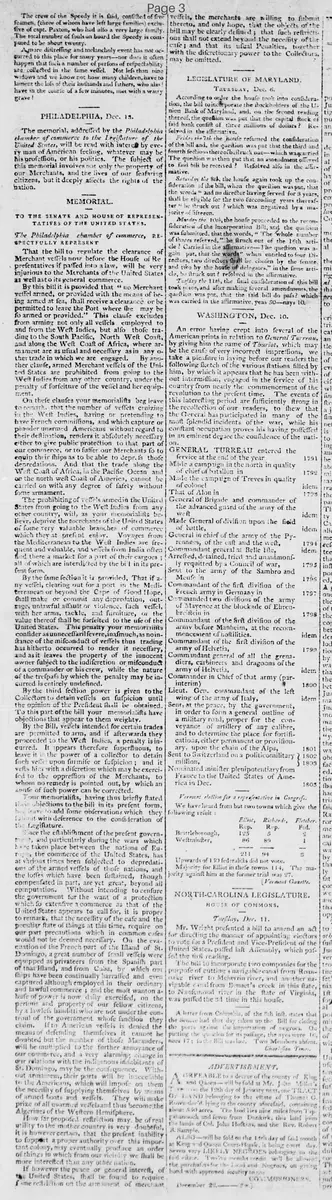
The memorial, addressed by the Philadelphia chamber of commerce to the Legislature of the United States, will be read with interest by every man of American feeling, whatever may be his profession, or his politics. The subject of this memorial involves not only the property of our Merchants, and the lives of our seafaring citizens, but it deeply affects the rights of the nation.
MEMORIAL.
TO THE SENATE AND HOUSE OF REPRESENTATIVES OF THE UNITED STATES.
The Philadelphia chamber of commerce, respectfully represent,
That the bill to regulate the clearance of Merchant vessels now before the House of Representatives if passed into a law, will be very injurious to the Merchants of the United States as well as to its general commerce.
By this bill it is provided that "no Merchant vessel armed, or provided with the means of being armed at sea, shall receive a clearance or be permitted to leave the Port where they may be so armed or provided." This clause excludes from arming not only all vessels employed to and from the West Indies, but also those trading to the South Pacific, North West Coast, and along the West Coast of Africa, where armaments are as usual and necessary as in any other trade in which we are engaged. By another clause, armed Merchant vessels of the United States are prohibited from going to the West Indies from any other country, under the penalty of forfeiture of the vessel and her equipment.
On these clauses your memorialists beg leave to remark, that the number of vessels cruising in the West Indies, having or pretending to have French commissions, and which capture or plunder unarmed Americans without regard to their destination, renders it absolutely necessary either to give public protection to that part of our commerce, or to suffer our Merchants so to equip their ships as to be able to defend themselves against those depredations. And that the trade along the West Coast of Africa, in the Pacific Ocean and on the north west Coast of America, cannot be carried on with any degree of safety without some armament.
The prohibiting of vessels armed in the United States from going to the West Indies from any other country, will, as your memorialists believe, deprive the merchants of the United States of some very valuable branches of commerce which they at present enjoy. Voyages from the Mediterranean to the West Indies are frequent and valuable, and vessels from India often find there a market for a part of their cargoes; all of which are interdicted by the bill in its present form.
By the same section it is provided, That if any vessel, clearing out for a port in the Mediterranean or beyond the Cape of Good Hope, shall make or commit any depredation, outrage, unlawful assault or violence, such vessel, with her arms, tackle, and furniture, or the value thereof shall be forfeited to the use of the United States. This penalty your memorialists consider as unnecessarily severe, inasmuch as no instance of the misconduct of vessels thus trading has hitherto occurred to render it necessary, and as it leaves the property of the innocent owner subject to the indiscretion or misconduct of a commander or his crew, while the nature of the trespass by which the penalty may be incurred is entirely undefined.
By the third section power is given to the Collectors to detain vessels on suspicion until the opinion of the President shall be obtained. To this part of the bill your memorialists have objections that appear to them weighty.
By the Bill, vessels intended for certain trades are permitted to arm, and if afterwards they proceeded to the West Indies, a penalty is incurred. It appears therefore superfluous, to leave it in the power of a collector to detain such vessels upon surmise or suspicion; and it vests him with a discretion which may be exercised to the oppression of the Merchants, to whom no remedy is pointed out, by which an abuse of such power can be corrected.
Your memorialists, having thus briefly stated their objections to the bill in its present form, beg leave to add some observations which they submit with deference to the consideration of the Legislature.
Since the establishment of the present government, and particularly during the wars which have taken place between the nations of Europe, the commerce of the United States, has at various times been subjected to depredations of the armed vessels of those nations, and the losses which have been sustained, though compensated in part, are yet great, beyond all computation. Without intending to censure the government for the want of a protection which so extensive a commerce as that of the United States appears to call for, it is proper to remark, that the necessity of the case and the peculiar state of things at this time, require on our part precautions which in common cases would not be deemed necessary. On the evacuation of the French part of the Island of St. Domingo, a great number of small vessels were equipped as privateers from the Spanish part of that Island, and from Cuba, by which our ships have been continually harassed and even captured although employed in their ordinary and lawful commerce : and the most wanton abuse of power is now daily exercised, on the persons and property of our fellow citizens, by a lawless banditti who are not under the control of the government whose sanction they claim. If to American vessels is denied the means of defending themselves it cannot be doubted but the number of those Marauders, will be multiplied to the further annoyance of our commerce, and a very alarming change in our relations with the indigenous inhabitants of St. Domingo, may be the consequence. Without armament, their ports will be inaccessible to the Americans, which will impose on them the necessity of supplying themselves by means of armed boats and vessels. They will make prize of all unarmed vessels and thus become the Algerines of the Western Hemisphere.
How far proposed restriction may be of real utility to the mother country is very doubtful, it is however certain, that the present inability to support a proper authority over this important colony, may eventually produce an order of things in which from our vicinity we shall be more interested than any other nation.
If however the peace or general interest, of the United States, shall be found to require some restriction on the armament of merchant vessels, the merchants are willing to submit thereto, and only hope, that the objects of the bill may be clearly defined: that such restrictions shall not extend beyond the necessity of the case; and that its usual Penalties, together with the discretionary power to the Collectors, may be omitted.
What sub-type of article is it?
What keywords are associated?
What entities or persons were involved?
Where did it happen?
Domestic News Details
Primary Location
Philadelphia
Event Date
Dec. 13.
Key Persons
Outcome
memorial submitted with objections to the bill; no specific outcomes reported.
Event Details
The Philadelphia Chamber of Commerce addresses a memorial to the U.S. Senate and House opposing a bill regulating clearance of armed merchant vessels, highlighting risks to trade from privateers in the West Indies, Africa, and Pacific, severe penalties, and discretionary powers to collectors.