Thank you for visiting SNEWPapers!
Sign up free
Gazette Of The United States, & Philadelphia Daily Advertiser
Philadelphia, Philadelphia County, Pennsylvania
What is this article about?
Reports from St. Domingo describe negro insurrections at Port-au-Prince and Grande Riviere, including burning of habitations, killing of chief Ganges, and refusal to work; proclamation requisitions citizens for defense; contrasting letter claims tranquility in some areas under Toussaint Louverture (Aug. 1796).
Clipping
OCR Quality
Full Text
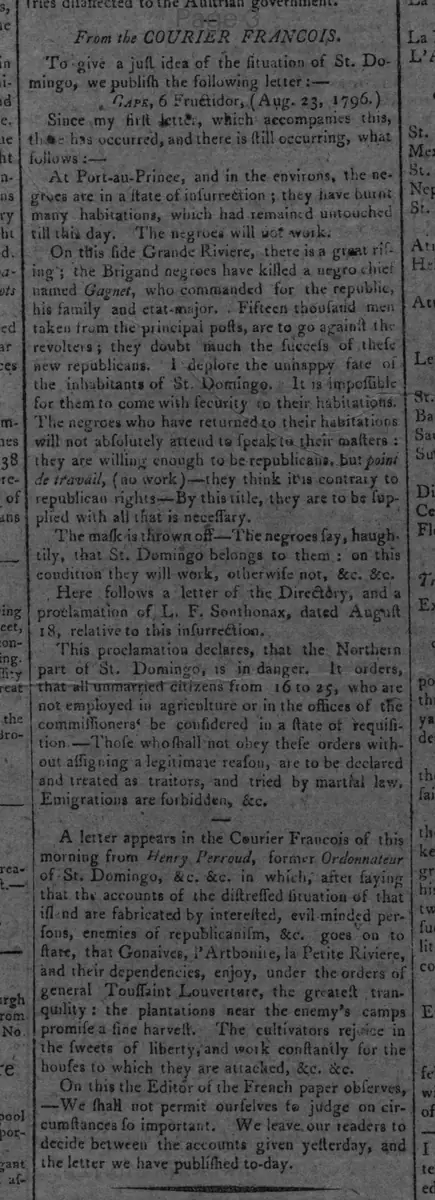
To give a just idea of the situation of St. Domingo, we publish the following letter:-
Cape, 6 Fructidor, (Aug. 23, 1796.)
Since my first letter, which accompanies this, nothing has occurred, and there is still occurring, what follows:--
At Port-au-Prince, and in the environs, the negroes are in a state of insurrection; they have burnt many habitations, which had remained untouched till this day. The negroes will not work.
On this side Grande Riviere, there is a great rising; the Brigand negroes have killed a negro chief named Ganges, who commanded for the republic, his family and etat-major. Fifteen thousand men taken from the principal posts, are to go against the revolters; they doubt much the success of these new republicans. I deplore the unhappy fate of the inhabitants of St. Domingo. It is impossible for them to come with security to their habitations. The negroes who have returned to their habitations will not absolutely attend to speak to their masters: they are willing enough to be republicans, but point de travail, (no work)—they think it contrary to republican rights—By this title, they are to be supplied with all that is necessary.
The mask is thrown off—The negroes say, haughtily, that St. Domingo belongs to them: on this condition they will work, otherwise not, &c. &c.
Here follows a letter of the Directory, and a proclamation of L. F. Sonthonax, dated August 18. relative to this insurrection.
This proclamation declares, that the Northern part of St. Domingo, is in danger. It orders, that all unmarried citizens from 16 to 25, who are not employed in agriculture or in the offices of the commissioners' be considered in a state of requisition—Those who shall not obey these orders without assigning a legitimate reason, are to be declared and treated as traitors, and tried by martial law.
Emigrations are forbidden, &c.
A letter appears in the Courier Francois of this morning from Henry Perroud, former Ordonnateur of St. Domingo, &c. &c. in which, after saying that the accounts of the distressed situation of that island are fabricated by interested, evil-minded persons, enemies of republicanism, &c. goes on to state, that Gonaives, L'Artibonite, la Petite Riviere, and their dependencies, enjoy, under the orders of general Toussaint Louverture, the greatest tranquility: the plantations near the enemy's camps promise a fine harvest. The cultivators rejoice in the sweets of liberty, and work constantly for the houses to which they are attached, &c. &c.
On this the Editor of the French paper observes,
-We shall not permit ourselves to judge on circumstances so important. We leave our readers to decide between the accounts given yesterday, and the letter we have published to-day.
What sub-type of article is it?
What keywords are associated?
What entities or persons were involved?
Where did it happen?
Foreign News Details
Primary Location
St. Domingo
Event Date
6 Fructidor (Aug. 23, 1796)
Key Persons
Outcome
brigand negroes killed negro chief ganges, his family and etat-major; doubt success of 15,000 men against revolters; some areas like gonaives enjoy tranquility
Event Details
Letter from Cape reports insurrection at Port-au-Prince with negroes burning habitations and refusing work; rising at Grande Riviere where brigand negroes killed Ganges; negroes claim St. Domingo belongs to them and refuse work unless supplied; proclamation by Sonthonax dated August 18 requisitions unmarried citizens 16-25 for defense, forbids emigrations, treats non-compliers as traitors; Perroud's letter claims tranquility in Gonaives, L'Artibonite, la Petite Riviere under Toussaint Louverture with good harvests; editor leaves judgment to readers