Thank you for visiting SNEWPapers!
Sign up free
Letter to Editor
December 2, 1859
Union County Star And Lewisburg Chronicle
Lewisburg, Union County, Pennsylvania
What is this article about?
A student in Europe writes from Frankfort-on-Main, Germany, on Nov. 3, 1859, describing its military occupation, historical sites like the Romer and Cathedral, Jewish quarter, and Sunday social customs.
Clipping
OCR Quality
95%
Excellent
Full Text
Correspondence of the Star & Chronicle.
From a Student in Europe—No. 4.
In Germany, Nov. 3, 1859.
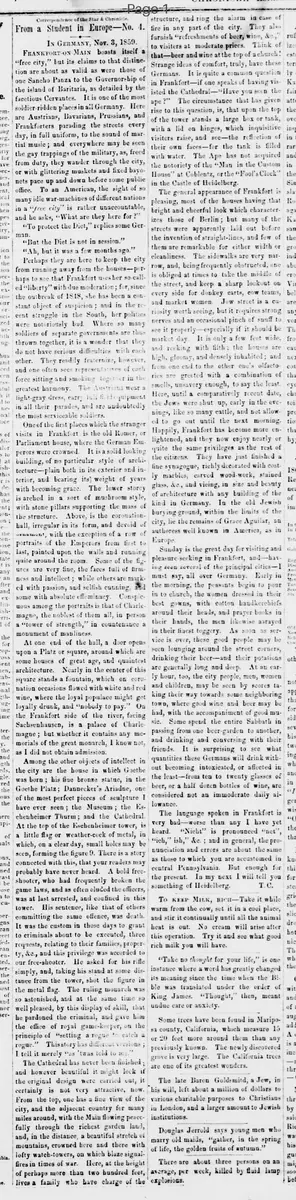
FRANKFORT-ON-MAIN boasts itself a "free city," but its claims to that distinction are about as valid as were those of one Sancho Panza to the Governorship of the island of Barataria, as detailed by the facetious Cervantes. It is one of the most soldier-ridden places in all Germany. Here are Austrians, Bavarians, Prussians, and Frankforters parading the streets every day, in full uniform, to the sound of martial music; and everywhere may be seen the gay trappings of the military, as, freed from duty, they wander through the city, or with glittering muskets and fixed bayonets pace up and down before some public office. To an American, the sight of so many idle war-machines of different nations in a "free city" is rather unaccountable, and he asks, "What are they here for?"
"To protect the Diet," replies some German.
"But the Diet is not in session."
"Ah, but it was a few months ago."
Perhaps they are here to keep the city from running away from the houses—perhaps to see that Frankfort uses her so-called "liberty" with due moderation; for, since the outbreak of 1848, she has been a constant object of suspicion; and in the recent struggle in the South, her politics were notoriously bad. Where so many soldiers of separate governments are thus thrown together, it is a wonder that they do not have serious difficulties with each other. They readily fraternize, however, and one often sees representatives of each force sitting and smoking together in the greatest harmony. The Austrians wear a light-gray dress, carry full equipment in all their parades, and are undoubtedly the most serviceable soldiers.
One of the first places which the stranger visits in Frankfort is the old Romer, or Parliament house, where the German Emperors were crowned. It is a solid looking building, of no particular style of architecture—plain both in its exterior and interior, and bearing its weight of years with becoming grace. The lower story is arched in a sort of mushroom style, with stone pillars supporting the mass of the structure. Above, is the coronation-hall, irregular in its form, and devoid of ornament, with the exception of a row of portraits of the Emperors from first to last, painted upon the walls and running quite around the room. Some of the figures are very fine, the faces full of firmness and intellect; while others are marked with passion, and selfish cunning, and some with absolute effeminacy. Conspicuous among the portraits is that of Charlemagne, the noblest of them all, in person a "tower of strength," in countenance a monument of manliness.
At one end of the hall, a door opens upon a Platz or square, around which are some houses of great age, and quaintest architecture. Nearly in the center of this square stands a fountain, which on coronation occasions flowed with white and red wine, where the loyal populace might get loyally drunk, and "nobody to pay." On the Frankfort side of the river, facing Sachsenhausen, is a palace of Charlemagne; but whether it contains any memorials of the great monarch, I know not as I did not obtain admission.
Among the other objects of interest in the city are the house in which Goethe was born; his fine bronze statue, in the Goethe Platz; Dannecker's Ariadne, one of the most perfect pieces of sculpture I have ever seen; the Museum; the Eschenheimer Thurm; and the Cathedral.
At the top of the Eschenheimer tower, is a little flag or weather-cock of metal, in which, on a clear day, small holes may be seen, forming the figure O. There is a story connected with this, that your readers may probably have never heard. A bold free-shooter, who had frequently broken the game laws, and as often eluded the officers, was at last arrested, and confined in this tower. His sentence, like that of others committing the same offence, was death. It was the custom in those days to grant to criminals about to be executed, three requests, relating to their families, property, &c., and this privilege was accorded to our free-shooter. He asked for his rifle simply, and, taking his stand at some distance from the tower, shot the figure in the metal flag. The ruling monarch was so astonished, and at the same time so well pleased, by this display of skill, that he pardoned the criminal, and gave him the office of royal game-keeper, on the principle of "setting a rogue to catch a rogue."
This story has different versions; I tell it merely "as 'twas told to me."
The Cathedral has never been finished, and however beautiful it might look if the original design were carried out, it certainly is not very attractive, now. From the top, one has a fine view of the city, and the adjacent country for many miles around, with the Main flowing peacefully through the richest garden land, and, in the distance, a beautiful stretch of mountains, crowned here and there with lofty watch-towers, on which blaze signal-fires in times of war. Here, at the height of perhaps more than two hundred feet, lives a family who have charge of the structure, and ring the alarm in case of fire in any part of the city. They also furnish "refreshments of beer, wine, &c.," to visitors at moderate prices. Think of that—beer and wine at the top of a church: Strange ideas of comfort, truly, have these Germans. It is quite a common question in Frankfort—if one speaks of having visited the Cathedral—"Have you seen the ape?" The circumstance that has given rise to this question, is, that upon the top of the tower stands a large box or tank, with a lid on hinges, which inquisitive visitors raise, and see—the reflection of their own faces—for the tank is filled with water. The Ape has not acquired the notoriety of the "Man in the Custom House" at Coblentz, or the "Fool's Clock" in the Castle of Heidelberg.
The general appearance of Frankfort is pleasing, most of the houses having that bright and cheerful look which characterizes those of Berlin: but many of the streets were apparently laid out before the invention of straight-lines, and few of them are remarkable for either width or cleanliness. The sidewalks are very narrow, and, being frequently obstructed, one is obliged at times to take the middle of the street, and keep a sharp lookout on every side for donkey carts, cow teams, and market women. Jew street is a curiosity worth seeing, but it requires strong nerves and an occasional pinch of snuff to see it properly—especially if it should be market day. It is only a few feet wide, and reeking with filth; the houses are high, gloomy, and densely inhabited; and from one end to the other one's olfactories are greeted with a combination of smells, unsavory enough, to say the least. Here, until a comparatively recent date, the Jews were shut up, early in the evenings, like so many cattle, and not allowed to go out until the next morning. Happily, Frankfort has become more enlightened, and they now enjoy nearly or quite the same privileges as the rest of the citizens. They have just finished a fine synagogue, richly decorated with costly marbles, carved wood-work, stained glass, &c., and vying, in size and beauty of architecture with any building of the kind in Germany. In the old Jewish burying ground, within the limits of the city, lie the remains of Grace Aguilar, an authoress well known in America, as in Europe.
Sunday is the great day for visiting and pleasure seeking in Frankfort, and—having seen several of the principal cities—I must say, all over Germany. Early in the morning, the peasants begin to pour in to church, the women dressed in their best gowns, with cotton handkerchiefs around their heads, and prayer books in their hands, the men likewise arrayed in their finest toggery. As soon as service is over, these good people may be seen lounging around the street corners, drinking their beer—and their potations are generally long and deep. At an early hour, too, the city people, men, women and children, may be seen by scores taking their way towards some neighboring town, where good wine and beer may be had, with the accompaniment of good music. Some spend the entire Sabbath in passing from one beer-garden to another, and drinking and conversing with their friends. It is surprising to see what quantities these Germans will drink without becoming intoxicated, or affected in the least—from ten to twenty glasses of beer, or a half dozen bottles of wine, are considered not an immoderate daily allowance.
The language spoken in Frankfort is very bad—worse than any I have yet heard. "Nicht" is pronounced "net", "ich," "ish," &c.; and in general, the pronunciation and errors are about the same as those to which you are accustomed in central Pennsylvania. But enough for the present. In my next I will tell you something of Heidelberg.
T. C.
From a Student in Europe—No. 4.
In Germany, Nov. 3, 1859.
FRANKFORT-ON-MAIN boasts itself a "free city," but its claims to that distinction are about as valid as were those of one Sancho Panza to the Governorship of the island of Barataria, as detailed by the facetious Cervantes. It is one of the most soldier-ridden places in all Germany. Here are Austrians, Bavarians, Prussians, and Frankforters parading the streets every day, in full uniform, to the sound of martial music; and everywhere may be seen the gay trappings of the military, as, freed from duty, they wander through the city, or with glittering muskets and fixed bayonets pace up and down before some public office. To an American, the sight of so many idle war-machines of different nations in a "free city" is rather unaccountable, and he asks, "What are they here for?"
"To protect the Diet," replies some German.
"But the Diet is not in session."
"Ah, but it was a few months ago."
Perhaps they are here to keep the city from running away from the houses—perhaps to see that Frankfort uses her so-called "liberty" with due moderation; for, since the outbreak of 1848, she has been a constant object of suspicion; and in the recent struggle in the South, her politics were notoriously bad. Where so many soldiers of separate governments are thus thrown together, it is a wonder that they do not have serious difficulties with each other. They readily fraternize, however, and one often sees representatives of each force sitting and smoking together in the greatest harmony. The Austrians wear a light-gray dress, carry full equipment in all their parades, and are undoubtedly the most serviceable soldiers.
One of the first places which the stranger visits in Frankfort is the old Romer, or Parliament house, where the German Emperors were crowned. It is a solid looking building, of no particular style of architecture—plain both in its exterior and interior, and bearing its weight of years with becoming grace. The lower story is arched in a sort of mushroom style, with stone pillars supporting the mass of the structure. Above, is the coronation-hall, irregular in its form, and devoid of ornament, with the exception of a row of portraits of the Emperors from first to last, painted upon the walls and running quite around the room. Some of the figures are very fine, the faces full of firmness and intellect; while others are marked with passion, and selfish cunning, and some with absolute effeminacy. Conspicuous among the portraits is that of Charlemagne, the noblest of them all, in person a "tower of strength," in countenance a monument of manliness.
At one end of the hall, a door opens upon a Platz or square, around which are some houses of great age, and quaintest architecture. Nearly in the center of this square stands a fountain, which on coronation occasions flowed with white and red wine, where the loyal populace might get loyally drunk, and "nobody to pay." On the Frankfort side of the river, facing Sachsenhausen, is a palace of Charlemagne; but whether it contains any memorials of the great monarch, I know not as I did not obtain admission.
Among the other objects of interest in the city are the house in which Goethe was born; his fine bronze statue, in the Goethe Platz; Dannecker's Ariadne, one of the most perfect pieces of sculpture I have ever seen; the Museum; the Eschenheimer Thurm; and the Cathedral.
At the top of the Eschenheimer tower, is a little flag or weather-cock of metal, in which, on a clear day, small holes may be seen, forming the figure O. There is a story connected with this, that your readers may probably have never heard. A bold free-shooter, who had frequently broken the game laws, and as often eluded the officers, was at last arrested, and confined in this tower. His sentence, like that of others committing the same offence, was death. It was the custom in those days to grant to criminals about to be executed, three requests, relating to their families, property, &c., and this privilege was accorded to our free-shooter. He asked for his rifle simply, and, taking his stand at some distance from the tower, shot the figure in the metal flag. The ruling monarch was so astonished, and at the same time so well pleased, by this display of skill, that he pardoned the criminal, and gave him the office of royal game-keeper, on the principle of "setting a rogue to catch a rogue."
This story has different versions; I tell it merely "as 'twas told to me."
The Cathedral has never been finished, and however beautiful it might look if the original design were carried out, it certainly is not very attractive, now. From the top, one has a fine view of the city, and the adjacent country for many miles around, with the Main flowing peacefully through the richest garden land, and, in the distance, a beautiful stretch of mountains, crowned here and there with lofty watch-towers, on which blaze signal-fires in times of war. Here, at the height of perhaps more than two hundred feet, lives a family who have charge of the structure, and ring the alarm in case of fire in any part of the city. They also furnish "refreshments of beer, wine, &c.," to visitors at moderate prices. Think of that—beer and wine at the top of a church: Strange ideas of comfort, truly, have these Germans. It is quite a common question in Frankfort—if one speaks of having visited the Cathedral—"Have you seen the ape?" The circumstance that has given rise to this question, is, that upon the top of the tower stands a large box or tank, with a lid on hinges, which inquisitive visitors raise, and see—the reflection of their own faces—for the tank is filled with water. The Ape has not acquired the notoriety of the "Man in the Custom House" at Coblentz, or the "Fool's Clock" in the Castle of Heidelberg.
The general appearance of Frankfort is pleasing, most of the houses having that bright and cheerful look which characterizes those of Berlin: but many of the streets were apparently laid out before the invention of straight-lines, and few of them are remarkable for either width or cleanliness. The sidewalks are very narrow, and, being frequently obstructed, one is obliged at times to take the middle of the street, and keep a sharp lookout on every side for donkey carts, cow teams, and market women. Jew street is a curiosity worth seeing, but it requires strong nerves and an occasional pinch of snuff to see it properly—especially if it should be market day. It is only a few feet wide, and reeking with filth; the houses are high, gloomy, and densely inhabited; and from one end to the other one's olfactories are greeted with a combination of smells, unsavory enough, to say the least. Here, until a comparatively recent date, the Jews were shut up, early in the evenings, like so many cattle, and not allowed to go out until the next morning. Happily, Frankfort has become more enlightened, and they now enjoy nearly or quite the same privileges as the rest of the citizens. They have just finished a fine synagogue, richly decorated with costly marbles, carved wood-work, stained glass, &c., and vying, in size and beauty of architecture with any building of the kind in Germany. In the old Jewish burying ground, within the limits of the city, lie the remains of Grace Aguilar, an authoress well known in America, as in Europe.
Sunday is the great day for visiting and pleasure seeking in Frankfort, and—having seen several of the principal cities—I must say, all over Germany. Early in the morning, the peasants begin to pour in to church, the women dressed in their best gowns, with cotton handkerchiefs around their heads, and prayer books in their hands, the men likewise arrayed in their finest toggery. As soon as service is over, these good people may be seen lounging around the street corners, drinking their beer—and their potations are generally long and deep. At an early hour, too, the city people, men, women and children, may be seen by scores taking their way towards some neighboring town, where good wine and beer may be had, with the accompaniment of good music. Some spend the entire Sabbath in passing from one beer-garden to another, and drinking and conversing with their friends. It is surprising to see what quantities these Germans will drink without becoming intoxicated, or affected in the least—from ten to twenty glasses of beer, or a half dozen bottles of wine, are considered not an immoderate daily allowance.
The language spoken in Frankfort is very bad—worse than any I have yet heard. "Nicht" is pronounced "net", "ich," "ish," &c.; and in general, the pronunciation and errors are about the same as those to which you are accustomed in central Pennsylvania. But enough for the present. In my next I will tell you something of Heidelberg.
T. C.
What sub-type of article is it?
Informative
Historical
Reflective
What themes does it cover?
Social Issues
Religion
Politics
What keywords are associated?
Frankfort On Main
Germany 1859
Military Occupation
Historical Sites
Jewish Quarter
Sunday Customs
Goethe House
Charlemagne Portrait
What entities or persons were involved?
T. C.
Star & Chronicle
Letter to Editor Details
Author
T. C.
Recipient
Star & Chronicle
Main Argument
describes the military presence, historical landmarks, jewish community, and sunday customs in frankfort-on-main from an american perspective.
Notable Details
Comparison To Sancho Panza
Portraits Of German Emperors Including Charlemagne
Story Of The Free Shooter And The Eschenheimer Tower
Grace Aguilar Buried In Jewish Cemetery
Beer And Wine Sold At The Top Of The Cathedral