Thank you for visiting SNEWPapers!
Sign up free
Literary
October 29, 1762
The New Hampshire Gazette
Portsmouth, Rockingham County, New Hampshire
What is this article about?
Continuation of Portuguese history describing Chaves as a frontier town with Roman origins; detailed account of Coimbra's geography, university founded in 1553, architecture, religious sites, and aqueduct; excursion to ancient ruins; Mount Stella's lake; and Covilhao's history linked to the 714 Moorish invasion and rebuilding in 1186.
Clipping
OCR Quality
98%
Excellent
Full Text
Continuation of the History of PORTUGAL.
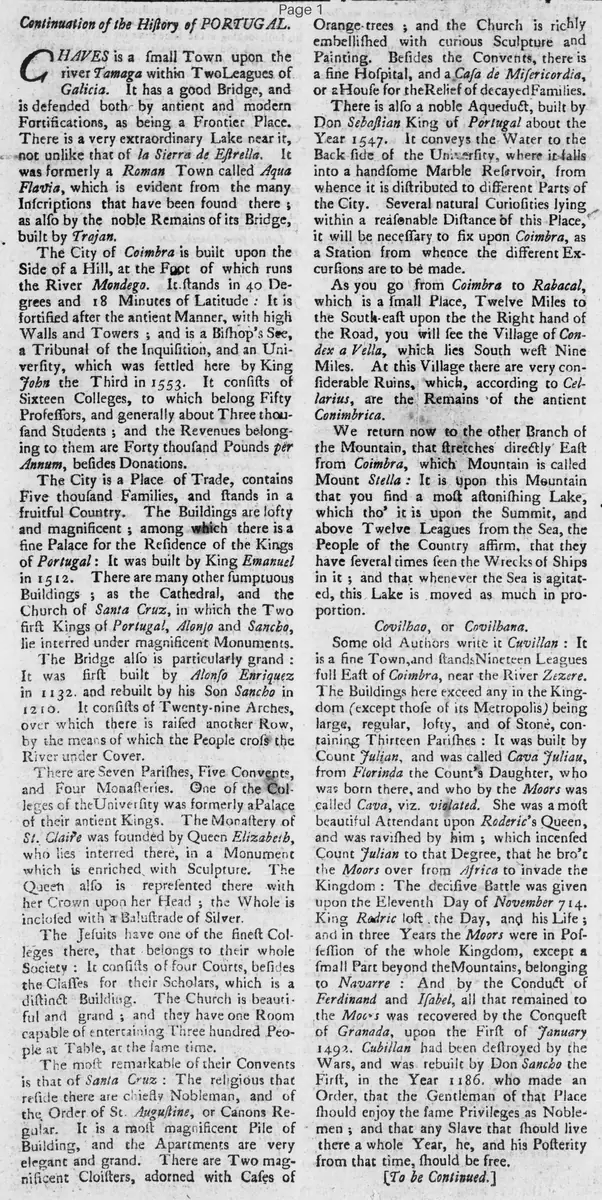
Chaves is a small Town upon the river Tamaga within Two Leagues of Galicia. It has a good Bridge, and is defended both by antient and modern Fortifications, as being a Frontier Place. There is a very extraordinary Lake near it, not unlike that of la Sierra de Estrella. It was formerly a Roman Town called Aqua Flavia, which is evident from the many Inscriptions that have been found there; as also by the noble Remains of its Bridge, built by Trajan.
The City of Coimbra is built upon the Side of a Hill, at the Foot of which runs the River Mondego. It stands in 40 Degrees and 18 Minutes of Latitude: It is fortified after the antient Manner, with high Walls and Towers; and is a Bishop's See, a Tribunal of the Inquisition, and an University, which was settled here by King John the Third in 1553. It consists of Sixteen Colleges, to which belong Fifty Professors, and generally about Three thousand Students: and the Revenues belonging to them are Forty thousand Pounds per Annum, besides Donations.
The City is a Place of Trade, contains Five thousand Families, and stands in a fruitful Country. The Buildings are lofty and magnificent; among which there is a fine Palace for the Residence of the Kings of Portugal: It was built by King Emanuel in 1512. There are many other sumptuous Buildings; as the Cathedral, and the Church of Santa Cruz, in which the Two first Kings of Portugal, Alonso and Sancho, lie interred under magnificent Monuments. The Bridge also is particularly grand: It was first built by Alono Enriguez in 1132. and rebuilt by his Son Sancho in 1210. It consists of Twenty-nine Arches, over which there is raised another Row, by the means of which the People cross the River under Cover.
There are Seven Parishes, Five Convents, and Four Monasteries. One of the Colleges of the University was formerly a Palace of their antient Kings. The Monastery of St. Claire was founded by Queen Elizabeth, who lies interred there, in a Monument which is enriched with Sculpture. The Queen also is represented there with her Crown upon her Head; the Whole is enclosed with a Balustrade of Silver.
The Jesuits have one of the finest Colleges there, that belongs to their whole Society: It consists of four Courts, besides the Classes for their Scholars, which is a distinct Building. The Church is beautiful and grand; and they have one Room capable of entertaining Three hundred People at Table, at the same time.
The most remarkable of their Convents is that of Santa Cruz: The religious that reside there are chiefly Noblemen, and of the Order of St. Augustine, or Canons Regular. It is a most magnificent Pile of Building, and the Apartments are very elegant and grand. There are Two magnificent Cloisters, adorned with Cases of Orange-trees; and the Church is richly embellished with curious Sculpture and Painting. Besides the Convents, there is a fine Hospital, and a Casa de Misericordia, or a House for the Relief of decayed Families.
There is also a noble Aqueduct, built by Don Sebastian King of Portugal about the Year 1567. It conveys the Water to the Back side of the University, where it falls into a handsome Marble Reservoir, from whence it is distributed to different Parts of the City. Several natural Curiosities lying within a reasonable Distance of this Place, it will be necessary to fix upon Coimbra, as a Station from whence the different Excursions are to be made.
As you go from Coimbra to Rabacal, which is a small Place, Twelve Miles to the South-east upon the Right hand of the Road, you will see the Village of Condeixa a Vella, which lies South-west Nine Miles. At this Village there are very considerable Ruins, which, according to Cellarius, are the Remains of the antient Conimbrica.
We return now to the other Branch of the Mountain, that stretches directly East from Coimbra, which Mountain is called Mount Stella: It is Upon this Mountain that you find a most astonishing Lake, which tho' it is upon the Summit, and above Twelve Leagues from the Sea, the People of the Country affirm, that they have several times seen the Wrecks of Ships in it: and that whenever the Sea is agitated, this Lake is moved as much in proportion.
Covilhao, or Covillana.
Some old Authors write it Cuvillan: It is a fine Town, and stands Nineteen Leagues full East of Coimbra, near the River Zezere. The Buildings here exceed any in the Kingdom (except those of its Metropolis) being large, regular, lofty, and of Stone, containing Thirteen Parishes: It was built by Count Julian, and was called Cava Juliani, from Florinda the Count's Daughter, who was born there, and who by the Moors was called Cava. viz. violated. She was a most beautiful Attendant upon Roderic's Queen, and was ravished by him; which incensed Count Julian to that Degree, that he bro't the Moors over from Africa to invade the Kingdom: The decisive Battle was given upon the Eleventh Day of November 714. King Radric lost the Day, and his Life; and in three Years the Moors were in Possession of the whole Kingdom, except a small Part beyond the Mountains, belonging to Navarre: And by the Conduct of Ferdinand and Isabel, all that remained to the Moors was recovered by the Conquest of Granada, upon the First of January 1492. Covillan had been destroyed by the Wars, and was rebuilt by Don Sancho the First, in the Year 1186. who made an Order, that the Gentlemen of that Place should enjoy the same Privileges as Noblemen; and that any Slave that should live there a whole Year, he, and his Posterity from that time, should be free.
[To be Continued.]
Chaves is a small Town upon the river Tamaga within Two Leagues of Galicia. It has a good Bridge, and is defended both by antient and modern Fortifications, as being a Frontier Place. There is a very extraordinary Lake near it, not unlike that of la Sierra de Estrella. It was formerly a Roman Town called Aqua Flavia, which is evident from the many Inscriptions that have been found there; as also by the noble Remains of its Bridge, built by Trajan.
The City of Coimbra is built upon the Side of a Hill, at the Foot of which runs the River Mondego. It stands in 40 Degrees and 18 Minutes of Latitude: It is fortified after the antient Manner, with high Walls and Towers; and is a Bishop's See, a Tribunal of the Inquisition, and an University, which was settled here by King John the Third in 1553. It consists of Sixteen Colleges, to which belong Fifty Professors, and generally about Three thousand Students: and the Revenues belonging to them are Forty thousand Pounds per Annum, besides Donations.
The City is a Place of Trade, contains Five thousand Families, and stands in a fruitful Country. The Buildings are lofty and magnificent; among which there is a fine Palace for the Residence of the Kings of Portugal: It was built by King Emanuel in 1512. There are many other sumptuous Buildings; as the Cathedral, and the Church of Santa Cruz, in which the Two first Kings of Portugal, Alonso and Sancho, lie interred under magnificent Monuments. The Bridge also is particularly grand: It was first built by Alono Enriguez in 1132. and rebuilt by his Son Sancho in 1210. It consists of Twenty-nine Arches, over which there is raised another Row, by the means of which the People cross the River under Cover.
There are Seven Parishes, Five Convents, and Four Monasteries. One of the Colleges of the University was formerly a Palace of their antient Kings. The Monastery of St. Claire was founded by Queen Elizabeth, who lies interred there, in a Monument which is enriched with Sculpture. The Queen also is represented there with her Crown upon her Head; the Whole is enclosed with a Balustrade of Silver.
The Jesuits have one of the finest Colleges there, that belongs to their whole Society: It consists of four Courts, besides the Classes for their Scholars, which is a distinct Building. The Church is beautiful and grand; and they have one Room capable of entertaining Three hundred People at Table, at the same time.
The most remarkable of their Convents is that of Santa Cruz: The religious that reside there are chiefly Noblemen, and of the Order of St. Augustine, or Canons Regular. It is a most magnificent Pile of Building, and the Apartments are very elegant and grand. There are Two magnificent Cloisters, adorned with Cases of Orange-trees; and the Church is richly embellished with curious Sculpture and Painting. Besides the Convents, there is a fine Hospital, and a Casa de Misericordia, or a House for the Relief of decayed Families.
There is also a noble Aqueduct, built by Don Sebastian King of Portugal about the Year 1567. It conveys the Water to the Back side of the University, where it falls into a handsome Marble Reservoir, from whence it is distributed to different Parts of the City. Several natural Curiosities lying within a reasonable Distance of this Place, it will be necessary to fix upon Coimbra, as a Station from whence the different Excursions are to be made.
As you go from Coimbra to Rabacal, which is a small Place, Twelve Miles to the South-east upon the Right hand of the Road, you will see the Village of Condeixa a Vella, which lies South-west Nine Miles. At this Village there are very considerable Ruins, which, according to Cellarius, are the Remains of the antient Conimbrica.
We return now to the other Branch of the Mountain, that stretches directly East from Coimbra, which Mountain is called Mount Stella: It is Upon this Mountain that you find a most astonishing Lake, which tho' it is upon the Summit, and above Twelve Leagues from the Sea, the People of the Country affirm, that they have several times seen the Wrecks of Ships in it: and that whenever the Sea is agitated, this Lake is moved as much in proportion.
Covilhao, or Covillana.
Some old Authors write it Cuvillan: It is a fine Town, and stands Nineteen Leagues full East of Coimbra, near the River Zezere. The Buildings here exceed any in the Kingdom (except those of its Metropolis) being large, regular, lofty, and of Stone, containing Thirteen Parishes: It was built by Count Julian, and was called Cava Juliani, from Florinda the Count's Daughter, who was born there, and who by the Moors was called Cava. viz. violated. She was a most beautiful Attendant upon Roderic's Queen, and was ravished by him; which incensed Count Julian to that Degree, that he bro't the Moors over from Africa to invade the Kingdom: The decisive Battle was given upon the Eleventh Day of November 714. King Radric lost the Day, and his Life; and in three Years the Moors were in Possession of the whole Kingdom, except a small Part beyond the Mountains, belonging to Navarre: And by the Conduct of Ferdinand and Isabel, all that remained to the Moors was recovered by the Conquest of Granada, upon the First of January 1492. Covillan had been destroyed by the Wars, and was rebuilt by Don Sancho the First, in the Year 1186. who made an Order, that the Gentlemen of that Place should enjoy the same Privileges as Noblemen; and that any Slave that should live there a whole Year, he, and his Posterity from that time, should be free.
[To be Continued.]
What sub-type of article is it?
Essay
What themes does it cover?
Political
Religious
Commerce Trade
What keywords are associated?
Portugal History
Coimbra University
Chaves Town
Covilhao Invasion
Moorish Conquest
Roman Ruins
Literary Details
Title
Continuation Of The History Of Portugal.