Thank you for visiting SNEWPapers!
Sign up free
Letter to Editor
March 22, 1797
The Kentucky Gazette
Lexington, Fayette County, Kentucky
What is this article about?
Camillus writes to Mr. Bradford arguing that levying fines under English common law, still valid in Kentucky via Virginia acts, would secure land titles by barring unasserted claims after five years, reducing disputes and benefiting purchasers, as proven effective in England. Cites legal authorities like Coke and Hargrave.
Clipping
OCR Quality
98%
Excellent
Full Text
CAMILLUS.--No. I.
MR. BRADFORD:
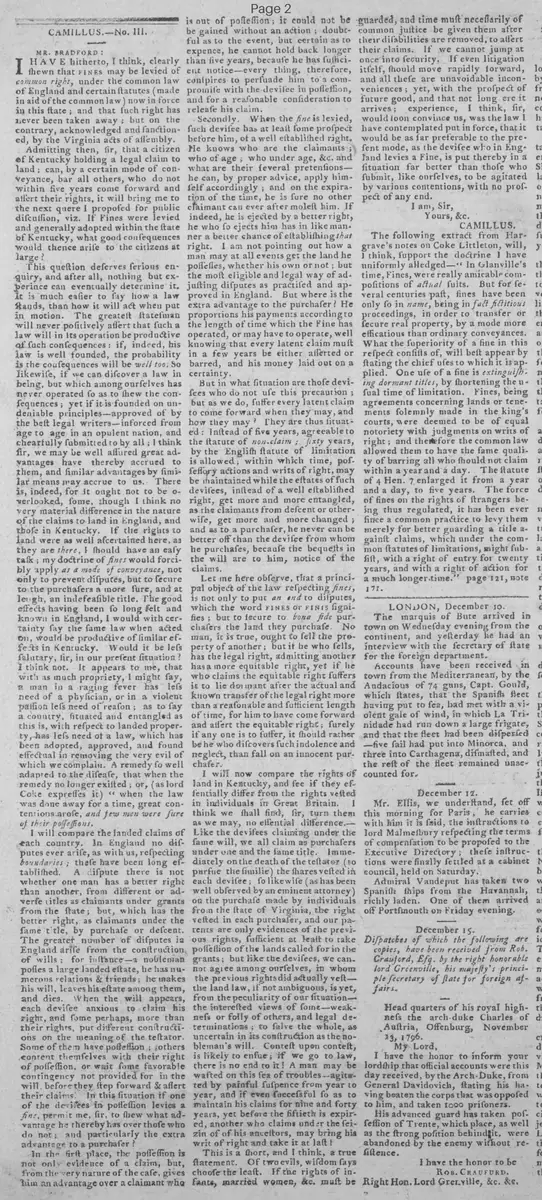
HAVE hitherto, I think, clearly shown that FINES may be levied of common right, under the common law of England and certain statutes (made in aid of the common law) now in force in this state; and that such right has never been taken away; but on the contrary, acknowledged and sanctioned, by the Virginia acts of assembly.
Admitting then, sir, that a citizen of Kentucky holding a legal claim to land; can, by a certain mode of conveyance, bar all others, who do not within five years come forward and assert their rights, it will bring me to the next query I proposed for public discussion, viz. If Fines were levied and generally adopted within the state of Kentucky, what good consequences would thence arise to the citizens at large?
This question deserves serious enquiry, and after all, nothing but experience can eventually determine it. It is much easier to say how a law stands, than how it will act when put in motion. The greatest Statesman will never positively assert that such a law will in its operation be productive of such consequences: if, indeed, his law is well founded, the probability is the consequences will be well too. So likewise, if we can discover a law in being, but which among ourselves has never operated so as to shew the consequences; yet if it is founded on undeniable principles-approved of by the best legal writers-reinforced from age to age in an opulent nation, and cheerfully submitted to by all; I think sir, we may be well assured great advantages have thereby accrued to them, and similar advantages by similar means may accrue to us. There is, indeed, for it ought not to be overlooked, some, though I think no very material difference in the nature of the claims to land in England, and those in Kentucky. If the rights to land were as well ascertained here, as they are there, I should have an easy task; my doctrine of fines would forcibly apply as a mode of conveyance, not only to prevent disputes, but to secure to the purchasers a more sure, and at length, an indefeasible title. The good effects having been so long felt and known in England, I would with certainty say the same law when acted on, would be productive of similar effects in Kentucky. Would it be less salutary, sir, in our present situation? I think not. It appears to me, that with as much propriety, I might say, a man in a raging fever has less need of a physician, or in a violent passion less need of reason; as to say a country, situated and entangled as this is, with respect to landed property,-has less need of a law, which has been adopted, approved, and found effectual in removing the very evil of which we complain. A remedy so well adapted to the disease, that when the remedy no longer existed; or, (as lord Coke expresses it) "when the law was done away for a time, great contentions arose, and few men were sure of their possessions."
I will compare the landed claims of each country. In England no disputes ever arise, as with us, respecting boundaries: those have been long established. A dispute there is not whether one man has a better right than another, from different or adverse titles as claimants under grants from the state; but, which has the better right, as claimants under the same title, by purchase or descent. The greater number of disputes in England arise from the construction of wills; for instance-a nobleman possesses a large landed estate, he has numerous relations & friends; he makes his will, leaves his estate among them. and dies. When the will appears, each devisee anxious to claim his right, and some perhaps, more than their rights, put different constructions on the meaning of the testator. Some of them have possession: others content themselves with their right of possession, or wait some favorable contingency not provided for in the will. before they step forward & assert their claims. In this situation if one of the devisees in possession levies a fine, permit me, sir, to shew what advantage he thereby has over those who do not; and particularly the extra advantage to a purchaser?
In the first place, the possession is not only evidence of a claim, but, from the very nature of the case, gives him an advantage over a claimant who is out of possession: it could not be gained without an action; doubtful as to the event, but certain as to expense, he cannot hold back longer than five years, because he has sufficient notice-every thing, therefore, conspires to persuade him to a compromise with the-devisee in possession, and for a reasonable consideration to release his claim.
Secondly. When the fine is levied. such devisee has at least some prospect before him, of a well established right. He knows who are the claimants; who of age; who under age, &c. and what are their several pretensions- he can, by proper advice, apply himself accordingly; and on the expiration of the time, he is sure no other claimant can ever after molest him. If indeed, he is ejected by a better right, he who so ejects him has in like manner a better chance of establishing that right. I am not pointing out how a man may at all events get the land he possesses, whether his own or not; but the most eligible and legal way of adjusting disputes as practised and approved in England. But where is the extra advantage to the purchaser? He proportions his payments according to the length of time which the Fine has operated, or may have to operate, well knowing that every latent claim must in a few years be either asserted or barred, and his money laid out on a certainty.
But in what situation are those devisees who do not use this precaution; but as we do, suffer every latent claim to come forward when they may, and how they may? They are thus situated : Instead of five years, agreeable to the statute of non-claim; sixty years, by the English statute of limitation is allowed; within which time, possessory actions and writs of right, may be maintained while the estates of such devisees, instead of a well established right, get more and more entangled, as the claimants from descent or otherwise, get more and more changed; and as to a purchaser, he never can be better off than the devisee from whom he purchases, because the bequests in the will are to him, notice of the claims.
Let me here observe, that a principal object of the law respecting fines, is not only to put an end to disputes, which the word FINES or FINES signifies; but to secure to bona fide purchasers the land they purchase. No man, it is true, ought to sell the property of another; but it he who sells, has the legal right, admitting another has a more equitable right, yet if he who claims the equitable right suffers it to lie dormant after the actual and known transfer of the legal right more than a reasonable and sufficient length of time, for him to have come forward and assert the equitable right; surely if any one is to suffer, it should rather be he who discovers such indolence and neglect, than fall on an innocent purchaser.
I wish now compare the rights of land in Kentucky, and see if they essentially differ from the rights vested in individuals in Great Britain. I think we shall find, sir, turn them as we may, no essential difference.-- Like the devisees claiming under the same will, we all claim as purchasers under one and the Same title. Immediately on the death of the testator (to pursue the simile) the shares vested in each devisee; so likewise (as has been well observed by an eminent attorney) on the purchase made by individuals from the state of Virginia, the right vested in each purchaser, and our patents are only evidences of the previous rights, sufficient at least to take possession of the lands called for in the grants; but like the devisees, we cannot agree among ourselves, in whom the previous rights did actually vest- the land law, if not ambiguous, is yet, from the peculiarity of our situation- the interested views of some-weaknesses or folly of others, and legal determinations; to solve the whole, as uncertain in its construction as the nobleman's will. Contest upon contest, is likely to ensue; if we go to law, there is no end to it! A man may be wasted on this sea of troubles--agitated by painful expense from year to year, and if even successful so as to maintain his claims for nine and forty years, yet before the fiftieth is expired, another who claims under the seizin of his ancestors, may bring his writ of right and take it at last!
This is a short, and I think, a true statement. Of two evils, wisdom says choose the least. If the rights of infants, married women, &c. must be guarded, and time must necessarily of common justice be given them after their disabilities are removed. to assert their claims. If we cannot jump at once into security. If even litigation itself, should move rapidly forward, and all these are unavoidable inconveniences; yet, with the prospect of future good, and that not long ere it arrives; experience, I think, sir, would soon convince us, was the law I have contemplated put in force, that it would be as far preferable to the present mode, as the devisee who in England levies a Fine, is put thereby in a situation far better than those who submit, like ourselves, to be agitated by various contentions, with no prospect of any end.
I am, Sir,
Yours, &c.
CAMILLUS.
The following extract from Hargrave's notes on Coke Littleton, will, I think, support the doctrine I have uniformly asserted— In Glanville's time, Fines, were really amicable compositions of actual suits. But for several centuries past, fines have been only so in name, being in fact fictitious proceedings, in order to transfer or secure real property, by a mode more efficacious than ordinary conveyances. What the superiority of a fine in this respect consists of, will best appear by stating the chief uses to which it is applied. One use of a fine is extinguishing dormant titles, by shortening the usual time of limitation. Fines, being agreements concerning lands or tenements solemnly made in the king's courts, were deemed to be of equal notoriety with judgments on writs of right; and therefore the common law allowed them to have the same quality of barring all who should not claim within a year and a day. The statute of 4 Hen. 7 enlarged it from a year and a day, to five years. The force of fines on the rights of strangers being thus regulated, it has been ever since a common practice to levy them merely for better guarding a title against claims, which under the common statutes of limitations, might subsist, with a right of entry for twenty years, and with a right of action for a much longer time." page 121, note 171.
MR. BRADFORD:
HAVE hitherto, I think, clearly shown that FINES may be levied of common right, under the common law of England and certain statutes (made in aid of the common law) now in force in this state; and that such right has never been taken away; but on the contrary, acknowledged and sanctioned, by the Virginia acts of assembly.
Admitting then, sir, that a citizen of Kentucky holding a legal claim to land; can, by a certain mode of conveyance, bar all others, who do not within five years come forward and assert their rights, it will bring me to the next query I proposed for public discussion, viz. If Fines were levied and generally adopted within the state of Kentucky, what good consequences would thence arise to the citizens at large?
This question deserves serious enquiry, and after all, nothing but experience can eventually determine it. It is much easier to say how a law stands, than how it will act when put in motion. The greatest Statesman will never positively assert that such a law will in its operation be productive of such consequences: if, indeed, his law is well founded, the probability is the consequences will be well too. So likewise, if we can discover a law in being, but which among ourselves has never operated so as to shew the consequences; yet if it is founded on undeniable principles-approved of by the best legal writers-reinforced from age to age in an opulent nation, and cheerfully submitted to by all; I think sir, we may be well assured great advantages have thereby accrued to them, and similar advantages by similar means may accrue to us. There is, indeed, for it ought not to be overlooked, some, though I think no very material difference in the nature of the claims to land in England, and those in Kentucky. If the rights to land were as well ascertained here, as they are there, I should have an easy task; my doctrine of fines would forcibly apply as a mode of conveyance, not only to prevent disputes, but to secure to the purchasers a more sure, and at length, an indefeasible title. The good effects having been so long felt and known in England, I would with certainty say the same law when acted on, would be productive of similar effects in Kentucky. Would it be less salutary, sir, in our present situation? I think not. It appears to me, that with as much propriety, I might say, a man in a raging fever has less need of a physician, or in a violent passion less need of reason; as to say a country, situated and entangled as this is, with respect to landed property,-has less need of a law, which has been adopted, approved, and found effectual in removing the very evil of which we complain. A remedy so well adapted to the disease, that when the remedy no longer existed; or, (as lord Coke expresses it) "when the law was done away for a time, great contentions arose, and few men were sure of their possessions."
I will compare the landed claims of each country. In England no disputes ever arise, as with us, respecting boundaries: those have been long established. A dispute there is not whether one man has a better right than another, from different or adverse titles as claimants under grants from the state; but, which has the better right, as claimants under the same title, by purchase or descent. The greater number of disputes in England arise from the construction of wills; for instance-a nobleman possesses a large landed estate, he has numerous relations & friends; he makes his will, leaves his estate among them. and dies. When the will appears, each devisee anxious to claim his right, and some perhaps, more than their rights, put different constructions on the meaning of the testator. Some of them have possession: others content themselves with their right of possession, or wait some favorable contingency not provided for in the will. before they step forward & assert their claims. In this situation if one of the devisees in possession levies a fine, permit me, sir, to shew what advantage he thereby has over those who do not; and particularly the extra advantage to a purchaser?
In the first place, the possession is not only evidence of a claim, but, from the very nature of the case, gives him an advantage over a claimant who is out of possession: it could not be gained without an action; doubtful as to the event, but certain as to expense, he cannot hold back longer than five years, because he has sufficient notice-every thing, therefore, conspires to persuade him to a compromise with the-devisee in possession, and for a reasonable consideration to release his claim.
Secondly. When the fine is levied. such devisee has at least some prospect before him, of a well established right. He knows who are the claimants; who of age; who under age, &c. and what are their several pretensions- he can, by proper advice, apply himself accordingly; and on the expiration of the time, he is sure no other claimant can ever after molest him. If indeed, he is ejected by a better right, he who so ejects him has in like manner a better chance of establishing that right. I am not pointing out how a man may at all events get the land he possesses, whether his own or not; but the most eligible and legal way of adjusting disputes as practised and approved in England. But where is the extra advantage to the purchaser? He proportions his payments according to the length of time which the Fine has operated, or may have to operate, well knowing that every latent claim must in a few years be either asserted or barred, and his money laid out on a certainty.
But in what situation are those devisees who do not use this precaution; but as we do, suffer every latent claim to come forward when they may, and how they may? They are thus situated : Instead of five years, agreeable to the statute of non-claim; sixty years, by the English statute of limitation is allowed; within which time, possessory actions and writs of right, may be maintained while the estates of such devisees, instead of a well established right, get more and more entangled, as the claimants from descent or otherwise, get more and more changed; and as to a purchaser, he never can be better off than the devisee from whom he purchases, because the bequests in the will are to him, notice of the claims.
Let me here observe, that a principal object of the law respecting fines, is not only to put an end to disputes, which the word FINES or FINES signifies; but to secure to bona fide purchasers the land they purchase. No man, it is true, ought to sell the property of another; but it he who sells, has the legal right, admitting another has a more equitable right, yet if he who claims the equitable right suffers it to lie dormant after the actual and known transfer of the legal right more than a reasonable and sufficient length of time, for him to have come forward and assert the equitable right; surely if any one is to suffer, it should rather be he who discovers such indolence and neglect, than fall on an innocent purchaser.
I wish now compare the rights of land in Kentucky, and see if they essentially differ from the rights vested in individuals in Great Britain. I think we shall find, sir, turn them as we may, no essential difference.-- Like the devisees claiming under the same will, we all claim as purchasers under one and the Same title. Immediately on the death of the testator (to pursue the simile) the shares vested in each devisee; so likewise (as has been well observed by an eminent attorney) on the purchase made by individuals from the state of Virginia, the right vested in each purchaser, and our patents are only evidences of the previous rights, sufficient at least to take possession of the lands called for in the grants; but like the devisees, we cannot agree among ourselves, in whom the previous rights did actually vest- the land law, if not ambiguous, is yet, from the peculiarity of our situation- the interested views of some-weaknesses or folly of others, and legal determinations; to solve the whole, as uncertain in its construction as the nobleman's will. Contest upon contest, is likely to ensue; if we go to law, there is no end to it! A man may be wasted on this sea of troubles--agitated by painful expense from year to year, and if even successful so as to maintain his claims for nine and forty years, yet before the fiftieth is expired, another who claims under the seizin of his ancestors, may bring his writ of right and take it at last!
This is a short, and I think, a true statement. Of two evils, wisdom says choose the least. If the rights of infants, married women, &c. must be guarded, and time must necessarily of common justice be given them after their disabilities are removed. to assert their claims. If we cannot jump at once into security. If even litigation itself, should move rapidly forward, and all these are unavoidable inconveniences; yet, with the prospect of future good, and that not long ere it arrives; experience, I think, sir, would soon convince us, was the law I have contemplated put in force, that it would be as far preferable to the present mode, as the devisee who in England levies a Fine, is put thereby in a situation far better than those who submit, like ourselves, to be agitated by various contentions, with no prospect of any end.
I am, Sir,
Yours, &c.
CAMILLUS.
The following extract from Hargrave's notes on Coke Littleton, will, I think, support the doctrine I have uniformly asserted— In Glanville's time, Fines, were really amicable compositions of actual suits. But for several centuries past, fines have been only so in name, being in fact fictitious proceedings, in order to transfer or secure real property, by a mode more efficacious than ordinary conveyances. What the superiority of a fine in this respect consists of, will best appear by stating the chief uses to which it is applied. One use of a fine is extinguishing dormant titles, by shortening the usual time of limitation. Fines, being agreements concerning lands or tenements solemnly made in the king's courts, were deemed to be of equal notoriety with judgments on writs of right; and therefore the common law allowed them to have the same quality of barring all who should not claim within a year and a day. The statute of 4 Hen. 7 enlarged it from a year and a day, to five years. The force of fines on the rights of strangers being thus regulated, it has been ever since a common practice to levy them merely for better guarding a title against claims, which under the common statutes of limitations, might subsist, with a right of entry for twenty years, and with a right of action for a much longer time." page 121, note 171.
What sub-type of article is it?
Persuasive
Informative
Philosophical
What themes does it cover?
Constitutional Rights
Politics
What keywords are associated?
Land Claims
Fines Levy
Kentucky Property
Common Law
Title Security
Dormant Titles
Property Rights
Legal Conveyance
What entities or persons were involved?
Camillus
Mr. Bradford
Letter to Editor Details
Author
Camillus
Recipient
Mr. Bradford
Main Argument
advocates for levying fines under common law in kentucky to bar dormant land claims after five years, securing titles for purchasers and reducing disputes, as practiced and beneficial in england.
Notable Details
References Common Law Of England And Virginia Acts
Cites Lord Coke On Contentions When Fines Were Suspended
Quotes Hargrave's Notes On Coke Littleton Regarding Fines As Fictitious Proceedings To Extinguish Dormant Titles
Compares Land Claims In England (Wills, Descent) To Kentucky (State Grants, Patents)