Thank you for visiting SNEWPapers!
Sign up free
Letter to Editor
December 23, 1887
Bismarck Weekly Tribune
Bismarck, Burleigh County, North Dakota
What is this article about?
George H. Sweet theorizes that mounds near Bismarck, North Dakota, are decayed remains of Arickara Indian villages, detailing construction with sod-covered poles, migration history from Pawnee stock, and excavation evidence like pottery and ashes. Dated December 14, 1887, from Minneapolis.
Clipping
OCR Quality
98%
Excellent
Full Text
THE MOUND BUILDERS
A Theory Regarding the Formation of the Mounds Near Bismarck.
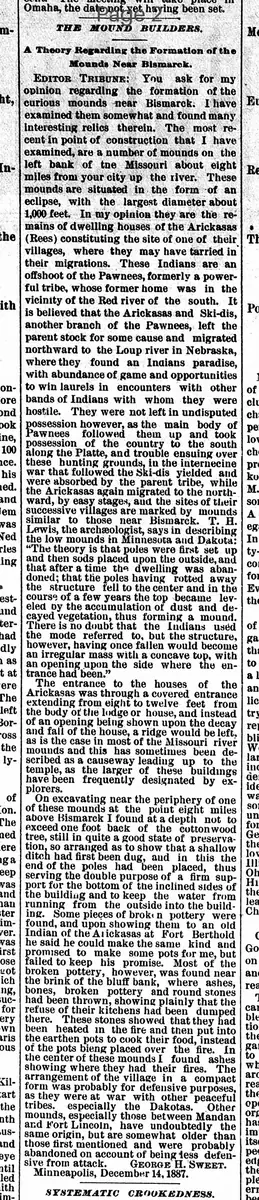
EDITOR TRIBUNE: You ask for my opinion regarding the formation of the curious mounds near Bismarck. I have examined them somewhat and found many interesting relics therein. The most recent in point of construction that I have examined, are a number of mounds on the left bank of the Missouri about eight miles from your city up the river. These mounds are situated in the form of an eclipse, with the largest diameter about 1,000 feet. In my opinion they are the remains of dwelling houses of the Arickaras (Rees) constituting the site of one of their villages, where they may have tarried in their migrations. These Indians are an offshoot of the Pawnees, formerly a powerful tribe, whose former home was in the vicinity of the Red river of the south. It is believed that the Arickaras and Skidi-Pawnees, another branch of the Pawnees, left the parent stock for some cause and migrated northward to the Loup river in Nebraska, where they found an Indians paradise, with abundance of game and opportunities to win laurels in encounters with other bands of Indians with whom they were hostile. They were not left in undisputed possession however, as the main body of Pawnees followed them up and took possession of the country to the south along the Platte, and trouble ensuing over these hunting grounds, in the internecine war that followed the Skidi-Pawnees yielded and were absorbed by the parent tribe, while the Arickaras again migrated to the northward, by easy stages, and the sites of their successive villages are marked by mounds similar to those near Bismarck. T. H. Lewis, the archaeologist, says in describing the low mounds in Minnesota and Dakota: "The theory is that poles were first set up and then sods placed upon the outside, and that after a time the dwelling was abandoned; that the poles having rotted away the structure fell to the center and in the course of a few years the top became leveled by the accumulation of dust and decayed vegetation, thus forming a mound." There is no doubt that the Indians used the mode referred to, but the structure, however, having once fallen would become an irregular mass with a concave top, with an opening upon the side where the entrance had been."
The entrance to the houses of the Arickaras was through a covered entrance extending from eight to twelve feet from the body or the lodge or house, and instead of an opening being shown upon the decay and fall of the house, a ridge would be left, as is the case in most of the Missouri river mounds and this has sometimes been described as a causeway leading up to the temple, as the larger of these buildings have been frequently designated by explorers.
On excavating near the periphery of one of these mounds at the point eight miles above Bismarck I found at a depth not to exceed one foot back of the cotton wood tree, still in quite a good state of preservation, so arranged as to show that a shallow ditch had first been dug, and in this the end of the poles had been placed, thus serving the double purpose of a firm support for the bottom of the inclined sides of the building and to keep the water from running from the outside into the building. Some pieces of broken pottery were found, and upon showing them to an old Indian of the Arickaras at Fort Berthold he said he could make the same kind and promised to make some pots for me, but failed to keep his promise. Most of the broken pottery, however, was found near the brink of the bluff bank, where ashes, bones, broken pottery and round stones had been thrown, showing plainly that the refuse of their kitchens had been dumped there. These stones showed that they had been heated in the fire and then put into the earthen pots to cook their food, instead of the pots being placed over the fire. In the center of these mounds I found ashes showing where they had their fires. The arrangement of the village in a compact form was probably for defensive purposes, as they were at war with other peaceful tribes, especially the Dakotas. Other mounds, especially those between Mandan and Fort Lincoln, have undoubtedly the same origin, but are somewhat older than those first mentioned and were probably abandoned on account of being less defensive from attack.
GEORGE H. SWEET.
Minneapolis, December 14, 1887.
A Theory Regarding the Formation of the Mounds Near Bismarck.
EDITOR TRIBUNE: You ask for my opinion regarding the formation of the curious mounds near Bismarck. I have examined them somewhat and found many interesting relics therein. The most recent in point of construction that I have examined, are a number of mounds on the left bank of the Missouri about eight miles from your city up the river. These mounds are situated in the form of an eclipse, with the largest diameter about 1,000 feet. In my opinion they are the remains of dwelling houses of the Arickaras (Rees) constituting the site of one of their villages, where they may have tarried in their migrations. These Indians are an offshoot of the Pawnees, formerly a powerful tribe, whose former home was in the vicinity of the Red river of the south. It is believed that the Arickaras and Skidi-Pawnees, another branch of the Pawnees, left the parent stock for some cause and migrated northward to the Loup river in Nebraska, where they found an Indians paradise, with abundance of game and opportunities to win laurels in encounters with other bands of Indians with whom they were hostile. They were not left in undisputed possession however, as the main body of Pawnees followed them up and took possession of the country to the south along the Platte, and trouble ensuing over these hunting grounds, in the internecine war that followed the Skidi-Pawnees yielded and were absorbed by the parent tribe, while the Arickaras again migrated to the northward, by easy stages, and the sites of their successive villages are marked by mounds similar to those near Bismarck. T. H. Lewis, the archaeologist, says in describing the low mounds in Minnesota and Dakota: "The theory is that poles were first set up and then sods placed upon the outside, and that after a time the dwelling was abandoned; that the poles having rotted away the structure fell to the center and in the course of a few years the top became leveled by the accumulation of dust and decayed vegetation, thus forming a mound." There is no doubt that the Indians used the mode referred to, but the structure, however, having once fallen would become an irregular mass with a concave top, with an opening upon the side where the entrance had been."
The entrance to the houses of the Arickaras was through a covered entrance extending from eight to twelve feet from the body or the lodge or house, and instead of an opening being shown upon the decay and fall of the house, a ridge would be left, as is the case in most of the Missouri river mounds and this has sometimes been described as a causeway leading up to the temple, as the larger of these buildings have been frequently designated by explorers.
On excavating near the periphery of one of these mounds at the point eight miles above Bismarck I found at a depth not to exceed one foot back of the cotton wood tree, still in quite a good state of preservation, so arranged as to show that a shallow ditch had first been dug, and in this the end of the poles had been placed, thus serving the double purpose of a firm support for the bottom of the inclined sides of the building and to keep the water from running from the outside into the building. Some pieces of broken pottery were found, and upon showing them to an old Indian of the Arickaras at Fort Berthold he said he could make the same kind and promised to make some pots for me, but failed to keep his promise. Most of the broken pottery, however, was found near the brink of the bluff bank, where ashes, bones, broken pottery and round stones had been thrown, showing plainly that the refuse of their kitchens had been dumped there. These stones showed that they had been heated in the fire and then put into the earthen pots to cook their food, instead of the pots being placed over the fire. In the center of these mounds I found ashes showing where they had their fires. The arrangement of the village in a compact form was probably for defensive purposes, as they were at war with other peaceful tribes, especially the Dakotas. Other mounds, especially those between Mandan and Fort Lincoln, have undoubtedly the same origin, but are somewhat older than those first mentioned and were probably abandoned on account of being less defensive from attack.
GEORGE H. SWEET.
Minneapolis, December 14, 1887.
What sub-type of article is it?
Informative
Historical
What themes does it cover?
Science Nature
What keywords are associated?
Mound Builders
Arickaras
Bismarck Mounds
Indian Villages
Archaeology
Sod Houses
Excavation Findings
Pawnee Migration
What entities or persons were involved?
George H. Sweet
Editor Tribune
Letter to Editor Details
Author
George H. Sweet
Recipient
Editor Tribune
Main Argument
the mounds near bismarck are the remains of arickara (rees) indian village dwelling houses, formed by the decay of sod-covered pole structures, rather than ancient mound builder constructions; evidence includes excavation findings of poles, pottery, ashes, and refuse.
Notable Details
References T. H. Lewis's Description Of Mound Formation
Excavation Found Pole Bases In Ditches, Broken Pottery Identified By Arickara Indian
Village Arranged In Eclipse Shape For Defense Against Dakotas
Similar Mounds Mark Successive Arickara Migrations