Thank you for visiting SNEWPapers!
Sign up free
Alexandria Gazette & Advertiser
Alexandria, Virginia
What is this article about?
An article from a late English publication promotes boring as a cheap method to obtain spring water, contrasting it with expensive well-digging. Examples from Tottenham include Mr. Matthew's successful bore at 120 feet and a parish project at 105 feet yielding 14 gallons per minute. Includes a cost table showing boring's affordability.
Merged-components note: The table of prices for boring vs. well sinking is integral to the hydraulics article on obtaining water supplies; merged with overall story label.
Clipping
OCR Quality
Full Text
HYDRAULICS.
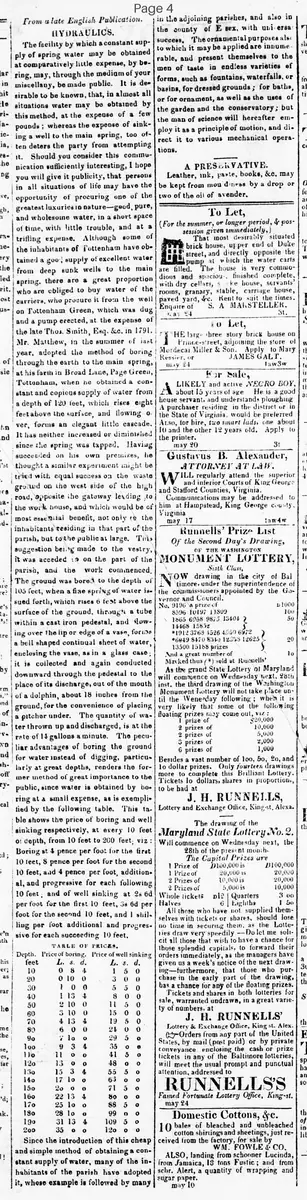
The facility by which a constant supply of spring water may be obtained at comparatively little expense, by boring, may, through the medium of your miscellany, be made public. It is desirable to be known, that, in almost all situations water may be obtained by this method, at the expense of a few pounds; whereas the expense of sinking a well to the main spring, too often deters the party from attempting it. Should you consider this communication sufficiently interesting, I hope you will give it publicity, that persons in all situations of life may have the opportunity of procuring one of the greatest luxuries in nature-good, pure, and wholesome water, in a short space of time, with little trouble, and at a trifling expense. Although some of the inhabitants of Tottenham have obtained a good supply of excellent water from deep sunk wells to the main spring, there are a great proportion who are obliged to buy water of the carriers, who procure it from the well on Tottenham Green, which was dug and a pump erected, at the expense of the late Thos. Smith, Esq. &c. in 1791. Mr. Matthew, in the summer of last year, adopted the method of boring through the earth to the main spring, at his farm in Broad Lane, Page Green, Tottenham, when he obtained a constant and copious supply of water from a depth of 120 feet, which rises eight feet above the surface, and flowing over, forms an elegant little cascade. It has neither increased or diminished since the spring was tapped. Having succeeded on his own premises, he thought a similar experiment might be tried with equal success on the waste ground on the west side of the high road, opposite the gateway leading to the work house, and which would be of most essential benefit, not only to the inhabitants residing in that part of the parish, but to the public at large. This suggestion being made to the vestry, it was acceded to on the part of the parish, and the work commenced. The ground was bored to the depth of 105 feet, when a fine spring of water issued forth, which rises 6 feet above the surface of the ground, through a tube within a cast iron pedestal, and flowing over the lip or edge of a vase, forms a bell shaped continual sheet of water, enclosing the vase, as in a glass case; it is collected and again conducted downward through the pedestal to the place of its discharge, out of the mouth of a dolphin, about 18 inches from the ground, for the convenience of placing a pitcher under. The quantity of water thrown up and discharged, is at the rate of 14 gallons a minute. The peculiar advantages of boring the ground for water instead of digging, particularly at great depths, renders the former method of great importance to the public, since water is obtained by boring at a small expense, as is exemplified by the following table. This table shows the price of boring and well sinking respectively, at every 10 feet of depth, from 10 feet to 200 feet: viz: Boring at 4 pence per foot for the first 10 feet, 8 pence per foot for the second 10 feet, and 4 pence per foot, additional, and progressive for each following 10 feet, and of well sinking at 2s 6d per foot for the first 10 feet, 5s 6d per foot for the second 10 feet, and 1 shilling per foot additional and progressive for each succeeding 10 feet.
TABLE
OF
PRICES,
Since the introduction of this cheap and simple method of obtaining a constant supply of water, many of the inhabitants of the parish have adopted it, whose example is followed by many in the adjoining parishes, and also in the county of Essex, with universal success. The ornamental purposes also to which it may be applied are innumerable, and present themselves to the men of taste in endless varieties of forms, such as fountains, waterfalls, or basins, for dressed grounds; for baths or for ornament, as well as the uses of the garden and the conservatory; but the man of science will hereafter employ it as a principle of motion, and direct it to various mechanical operations.
| feet | L. | s. | d. | L. | s. | d. |
| 10 | 0 | 8 | 4 | 1 | 5 | 0 |
| 20 | 0 | 10 | 0 | 3 | 0 | 0 |
| 30 | 1 | 0 | 0 | 5 | 5 | 0 |
| 40 | 1 | 13 | 4 | 8 | 0 | 0 |
| 50 | 2 | 10 | 0 | 11 | 5 | 0 |
| 60 | 3 | 10 | 0 | 15 | 0 | 0 |
| 70 | 4 | 13 | 4 | 19 | 5 | 0 |
| 80 | 6 | 0 | 0 | 24 | 0 | 0 |
| 90 | 7 | 10 | 0 | 29 | 5 | 0 |
| 100 | 9 | 3 | 4 | 35 | 0 | 0 |
| 110 | 11 | 0 | 0 | 41 | 5 | 0 |
| 120 | 13 | 0 | 0 | 48 | 0 | 0 |
| 130 | 15 | 3 | 4 | 55 | 5 | 0 |
| 140 | 17 | 10 | 0 | 63 | 0 | 0 |
| 150 | 20 | 0 | 0 | 71 | 5 | 0 |
| 160 | 22 | 13 | 4 | 80 | 0 | 0 |
| 170 | 25 | 10 | 0 | 88 | 5 | 0 |
| 180 | 28 | 10 | 0 | 99 | 0 | 0 |
| 190 | 31 | 13 | 4 | 109 | 5 | 0 |
| 200 | 35 | 0 | 0 | 120 | 0 | 0 |
What sub-type of article is it?
What themes does it cover?
What keywords are associated?
What entities or persons were involved?
Where did it happen?
Story Details
Key Persons
Location
Tottenham, England
Event Date
Summer Of Last Year; 1791
Story Details
Promotion of boring method for obtaining spring water cheaply; Mr. Matthew succeeds at 120 feet on his farm; parish bores 105 feet for public fountain yielding 14 gallons per minute; cost table compares boring to well-sinking, showing significant savings; method adopted widely with ornamental and mechanical uses suggested.