Thank you for visiting SNEWPapers!
Sign up free
Editorial
January 16, 1945
The Daily Alaska Empire
Juneau, Juneau County, Alaska
What is this article about?
The editorial warns of a potential surge in crime after WWII, drawing parallels to the 1920s post-WWI era of immorality and gangsterism. It highlights disruptions from war on families, youth, and veterans, exacerbated by economic shifts, and urges preemptive planning beyond the GI Bill.
Clipping
OCR Quality
98%
Excellent
Full Text
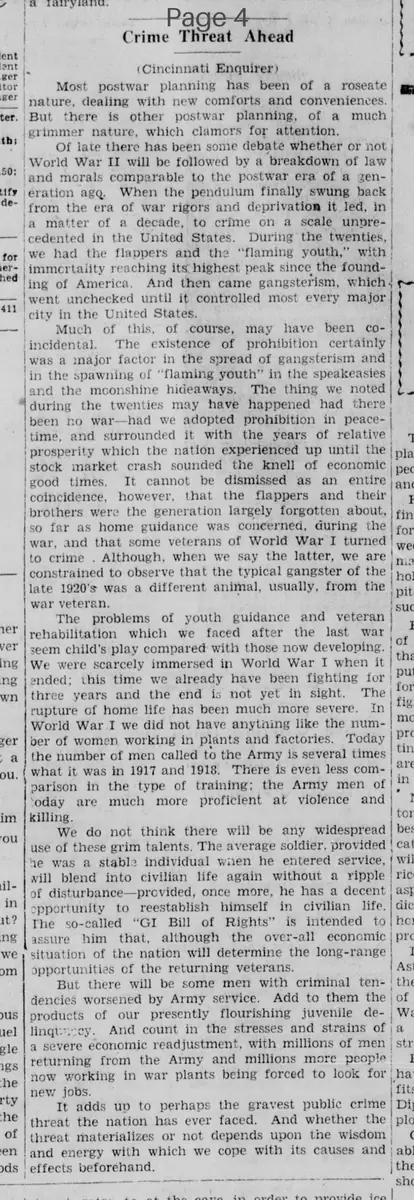
Crime Threat Ahead
(Cincinnati Enquirer)
Most postwar planning has been of a roseate nature, dealing with new comforts and conveniences. But there is other postwar planning, of a much grimer nature, which clamors for attention.
Of late there has been some debate whether or not World War II will be followed by a breakdown of law and morals comparable to the postwar era of a generation ago. When the pendulum finally swung back from the era of war rigors and deprivation it led, in a matter of a decade, to crime on a scale unprecedented in the United States. During the twenties, we had the flappers and the "flaming youth," with immorality reaching its highest peak since the founding of America. And then came gangsterism, which went unchecked until it controlled most every major city in the United States.
Much of this, of course, may have been coincidental. The existence of prohibition certainly was a major factor in the spread of gangsterism and in the spawning of "flaming youth" in the speakeasies and the moonshine hideaways. The thing we noted during the twenties may have happened had there been no war—had we adopted prohibition in peacetime, and surrounded it with the years of relative prosperity which the nation experienced up until the stock market crash sounded the knell of economic good times. It cannot be dismissed as an entire coincidence, however, that the flappers and their brothers were the generation largely forgotten about, so far as home guidance was concerned, during the war, and that some veterans of World War I turned to crime. Although, when we say the latter, we are constrained to observe that the typical gangster of the late 1920's was a different animal, usually, from the war veteran.
The problems of youth guidance and veteran rehabilitation which we faced after the last war seem child's play compared with those now developing. We were scarcely immersed in World War I when it ended; this time we already have been fighting for three years and the end is not yet in sight. The rupture of home life has been much more severe. In World War I we did not have anything like the number of women working in plants and factories. Today the number of men called to the Army is several times what it was in 1917 and 1918. There is even less comparison in the type of training: the Army men of today are much more proficient at violence and killing.
We do not think there will be any widespread use of these grim talents. The average soldier, provided he was a stable individual when he entered service, will blend into civilian life again without a ripple of disturbance—provided, once more, he has a decent opportunity to reestablish himself in civilian life. The so-called "GI Bill of Rights" is intended to assure him that, although the over-all economic situation of the nation will determine the long-range opportunities of the returning veterans.
But there will be some men with criminal tendencies worsened by Army service. Add to them the products of our presently flourishing juvenile delinquency. And count in the stresses and strains of a severe economic readjustment, with millions of men returning from the Army and millions more people now working in war plants being forced to look for new jobs.
It adds up to perhaps the gravest public crime threat the nation has ever faced. And whether the threat materializes or not depends upon the wisdom and energy with which we cope with its causes and effects beforehand.
(Cincinnati Enquirer)
Most postwar planning has been of a roseate nature, dealing with new comforts and conveniences. But there is other postwar planning, of a much grimer nature, which clamors for attention.
Of late there has been some debate whether or not World War II will be followed by a breakdown of law and morals comparable to the postwar era of a generation ago. When the pendulum finally swung back from the era of war rigors and deprivation it led, in a matter of a decade, to crime on a scale unprecedented in the United States. During the twenties, we had the flappers and the "flaming youth," with immorality reaching its highest peak since the founding of America. And then came gangsterism, which went unchecked until it controlled most every major city in the United States.
Much of this, of course, may have been coincidental. The existence of prohibition certainly was a major factor in the spread of gangsterism and in the spawning of "flaming youth" in the speakeasies and the moonshine hideaways. The thing we noted during the twenties may have happened had there been no war—had we adopted prohibition in peacetime, and surrounded it with the years of relative prosperity which the nation experienced up until the stock market crash sounded the knell of economic good times. It cannot be dismissed as an entire coincidence, however, that the flappers and their brothers were the generation largely forgotten about, so far as home guidance was concerned, during the war, and that some veterans of World War I turned to crime. Although, when we say the latter, we are constrained to observe that the typical gangster of the late 1920's was a different animal, usually, from the war veteran.
The problems of youth guidance and veteran rehabilitation which we faced after the last war seem child's play compared with those now developing. We were scarcely immersed in World War I when it ended; this time we already have been fighting for three years and the end is not yet in sight. The rupture of home life has been much more severe. In World War I we did not have anything like the number of women working in plants and factories. Today the number of men called to the Army is several times what it was in 1917 and 1918. There is even less comparison in the type of training: the Army men of today are much more proficient at violence and killing.
We do not think there will be any widespread use of these grim talents. The average soldier, provided he was a stable individual when he entered service, will blend into civilian life again without a ripple of disturbance—provided, once more, he has a decent opportunity to reestablish himself in civilian life. The so-called "GI Bill of Rights" is intended to assure him that, although the over-all economic situation of the nation will determine the long-range opportunities of the returning veterans.
But there will be some men with criminal tendencies worsened by Army service. Add to them the products of our presently flourishing juvenile delinquency. And count in the stresses and strains of a severe economic readjustment, with millions of men returning from the Army and millions more people now working in war plants being forced to look for new jobs.
It adds up to perhaps the gravest public crime threat the nation has ever faced. And whether the threat materializes or not depends upon the wisdom and energy with which we cope with its causes and effects beforehand.
What sub-type of article is it?
Crime Or Punishment
Social Reform
Moral Or Religious
What keywords are associated?
Postwar Crime
Veteran Rehabilitation
Youth Guidance
Juvenile Delinquency
Gangsterism
Economic Readjustment
Gi Bill Of Rights
What entities or persons were involved?
Veterans
Youth
Gangsters
Editorial Details
Primary Topic
Postwar Crime Threat From Veterans And Youth
Stance / Tone
Warning And Call For Proactive Planning
Key Figures
Veterans
Youth
Gangsters
Key Arguments
Postwar Era After Wwi Led To Unprecedented Crime And Immorality In The 1920s
Prohibition Contributed To Gangsterism And Flaming Youth
War Disrupted Home Guidance, Leading To Neglected Youth Turning To Crime
Current Wwii Has More Severe Home Life Ruptures With Women In Factories And Larger Army
Soldiers Trained In Violence May Have Criminal Tendencies Worsened By Service
Juvenile Delinquency Is Flourishing Now
Economic Readjustment Will Add Stresses With Millions Returning To Civilian Jobs
Gi Bill Of Rights Helps But Overall Economy Matters
Nation Faces Gravest Public Crime Threat Ever, Depending On Coping With Causes Beforehand