Thank you for visiting SNEWPapers!
Sign up free
Story
March 6, 1890
The Sauk Centre Herald
Sauk Centre, Stearns County, Minnesota
What is this article about?
Article on industrial efficiency in cattle slaughter at Newark, N.J., detailing how every part of a steer—from blood and stomach to bones and hide—is utilized in manufacturing, ensuring no waste except the dying breath.
Clipping
OCR Quality
95%
Excellent
Full Text
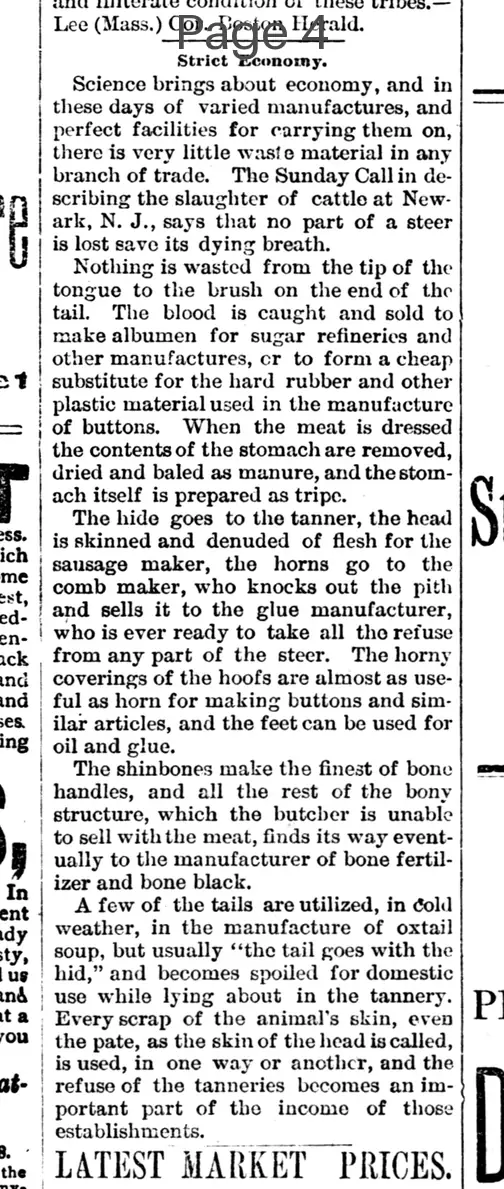
Strict Economy.
Science brings about economy, and in these days of varied manufactures, and perfect facilities for carrying them on, there is very little waste material in any branch of trade. The Sunday Call in describing the slaughter of cattle at Newark, N. J., says that no part of a steer is lost save its dying breath.
Nothing is wasted from the tip of the tongue to the brush on the end of the tail. The blood is caught and sold to make albumen for sugar refineries and other manufactures, or to form a cheap substitute for the hard rubber and other plastic material used in the manufacture of buttons. When the meat is dressed the contents of the stomach are removed, dried and baled as manure, and the stomach itself is prepared as tripe.
The hide goes to the tanner, the head is skinned and denuded of flesh for the sausage maker, the horns go to the comb maker, who knocks out the pith and sells it to the glue manufacturer, who is ever ready to take all the refuse from any part of the steer. The horny coverings of the hoofs are almost as useful as horn for making buttons and similar articles, and the feet can be used for oil and glue.
The shinbones make the finest of bond handles, and all the rest of the bony structure, which the butcher is unable to sell with the meat, finds its way eventually to the manufacturer of bone fertilizer and bone black.
A few of the tails are utilized, in cold weather, in the manufacture of oxtail soup, but usually "the tail goes with the hide," and becomes spoiled for domestic use while lying about in the tannery.
Every scrap of the animal's skin, even the pate, as the skin of the head is called, is used, in one way or another, and the refuse of the tanneries becomes an important part of the income of those establishments.
Science brings about economy, and in these days of varied manufactures, and perfect facilities for carrying them on, there is very little waste material in any branch of trade. The Sunday Call in describing the slaughter of cattle at Newark, N. J., says that no part of a steer is lost save its dying breath.
Nothing is wasted from the tip of the tongue to the brush on the end of the tail. The blood is caught and sold to make albumen for sugar refineries and other manufactures, or to form a cheap substitute for the hard rubber and other plastic material used in the manufacture of buttons. When the meat is dressed the contents of the stomach are removed, dried and baled as manure, and the stomach itself is prepared as tripe.
The hide goes to the tanner, the head is skinned and denuded of flesh for the sausage maker, the horns go to the comb maker, who knocks out the pith and sells it to the glue manufacturer, who is ever ready to take all the refuse from any part of the steer. The horny coverings of the hoofs are almost as useful as horn for making buttons and similar articles, and the feet can be used for oil and glue.
The shinbones make the finest of bond handles, and all the rest of the bony structure, which the butcher is unable to sell with the meat, finds its way eventually to the manufacturer of bone fertilizer and bone black.
A few of the tails are utilized, in cold weather, in the manufacture of oxtail soup, but usually "the tail goes with the hide," and becomes spoiled for domestic use while lying about in the tannery.
Every scrap of the animal's skin, even the pate, as the skin of the head is called, is used, in one way or another, and the refuse of the tanneries becomes an important part of the income of those establishments.
What sub-type of article is it?
Curiosity
What themes does it cover?
Moral Virtue
What keywords are associated?
Cattle Slaughter
Waste Utilization
Industrial Economy
Newark Nj
Steer Processing
Where did it happen?
Newark, N. J.
Story Details
Location
Newark, N. J.
Story Details
Description of the complete utilization of a steer in various industries after slaughter, from blood for albumen and buttons to hides for tanning and bones for fertilizer, emphasizing strict economy and minimal waste.