Thank you for visiting SNEWPapers!
Sign up free
Letter to Editor
November 4, 1819
Daily National Intelligencer
Washington, District Of Columbia
What is this article about?
A citizen writing to the editors praises the Washington city council's recent law taxing dram shops and porter cellars to combat drunkenness, gambling, and related social evils, hoping it will elevate the city's reputation and moral standing among other American cities.
Clipping
OCR Quality
98%
Excellent
Full Text
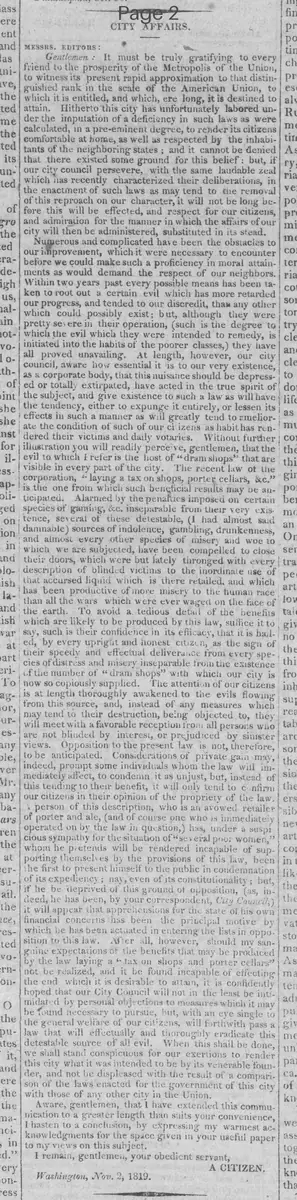
CITY AFFAIRS.
MESSRS. EDITORS:
Gentlemen: It must be truly gratifying to every friend to the prosperity of the Metropolis of the Union, to witness its present rapid approximation to that distinguished rank in the scale of the American Union, to which it is entitled, and which, ere long, it is destined to attain. Hitherto this city has unfortunately labored under the imputation of a deficiency in such laws as were calculated, in a pre-eminent degree, to render its citizens comfortable at home, as well as respected by the inhabitants of the neighboring states; and it cannot be denied that there existed some ground for this belief: but, if our city council persevere, with the same laudable zeal which has recently characterized their deliberations, in the enactment of such laws as may tend to the removal of this reproach on our character, it will not be long before this will be effected, and respect for our citizens, and admiration for the manner in which the affairs of our city will then be administered, substituted in its stead.
Numerous and complicated have been the obstacles to our improvement, which it were necessary to encounter before we could make such a proficiency in moral attainments as would demand the respect of our neighbors. Within two years past every possible means has been taken to root out a certain evil which has more retarded our progress, and tended to our discredit, than any other which could possibly exist; but, although they were pretty severe in their operation, (such is the degree to which the evil which they were intended to remedy, is initiated into the habits of the poorer classes,) they have all proved unavailing. At length, however, our city council, aware how essential it is to our very existence, as a corporate body, that this nuisance should be depressed or totally extirpated, have acted in the true spirit of the subject, and give existence to such a law as will have the tendency, either to expunge it entirely, or lessen its effects in such a manner as will greatly tend to ameliorate the condition of such of our citizens as habit has rendered their victims and daily votaries. Without further illustration you will readily perceive, gentlemen, that the evil to which I refer is the host of "dram shops" that are visible in every part of the city. The recent law of the corporation, laying a tax on shops, porter cellars, &c. is the one from which such beneficial results may be anticipated. Alarmed by the penalties imposed on certain species of gaming, &c. inseparable from their very existence, several of these detestable, (I had almost said damnable) sources of indolence, gambling, drunkenness, and almost every other species of misery and woe to which we are subjected, have been compelled to close their doors, which were but lately thronged with every description of blinded victims to the inordinate use of that accursed liquid which is there retailed, and which has been productive of more misery to the human race than all the wars which were ever waged on the face of the earth. To avoid a tedious detail of the benefits which are likely to be produced by this law, suffice it to say, such is their confidence in its efficacy, that it is hailed, by every upright and honest citizen, as the sign of their speedy and effectual deliverance from every species of distress and misery inseparable from the existence of the number of "dram shops" with which our city is now so copiously supplied. The attention of our citizens is at length thoroughly awakened to the evils flowing from this source, and, instead of any measures which may tend to their destruction, being objected to, they will meet with a favorable reception from all persons who are not blinded by interest, or prejudiced by sinister views. Opposition to the present law is not, therefore, to be anticipated. Considerations of private gain may, indeed, prompt some individuals whom the law will immediately affect, to condemn it as unjust, but, instead of this tending to their benefit, it will only tend to confirm our citizens in their opinion of the propriety of the law. A person of this description, who is an avowed retailer of porter and ale, (and of course one who is immediately operated on by the law in question,) has, under a suspicious sympathy for the situation of "several poor women," whom he pretends will be rendered incapable of supporting themselves by the provisions of this law, been the first to present himself to the public in condemnation of its expediency; nay, even of its constitutionality; but, if he be deprived of this ground of opposition, (as, indeed, he has been, by your correspondent, City Council,) it will appear that apprehensions for the state of his own financial concerns has been the principal motive by which he has been actuated in entering the lists in opposition to this law. After all, however, should my sanguine expectations of the benefits that may be produced by the law laying a "tax on shops and porter cellars" not be realized, and it be found incapable of effecting the end which it is desirable to attain, it is confidently hoped that our City Council will not in the least be intimidated by personal objections to measures which it may be found necessary to pursue, but, with an eye single to the general welfare of our citizens, will forthwith pass a law that will effectually and thoroughly eradicate this detestable source of all evil. When this shall be done, we shall stand conspicuous for our exertions to render this city what it was intended to be by its venerable founder, and not be displeased with the result of a comparison of the laws enacted for the government of this city with those of any other city in the Union.
Aware, gentlemen, that I have extended this communication to a greater length than suits your convenience, I hasten to a conclusion, by expressing my warmest acknowledgments for the space given in your useful paper to my views on this subject.
I remain, gentlemen, your obedient servant,
A CITIZEN.
Washington, Nov. 2, 1819.
MESSRS. EDITORS:
Gentlemen: It must be truly gratifying to every friend to the prosperity of the Metropolis of the Union, to witness its present rapid approximation to that distinguished rank in the scale of the American Union, to which it is entitled, and which, ere long, it is destined to attain. Hitherto this city has unfortunately labored under the imputation of a deficiency in such laws as were calculated, in a pre-eminent degree, to render its citizens comfortable at home, as well as respected by the inhabitants of the neighboring states; and it cannot be denied that there existed some ground for this belief: but, if our city council persevere, with the same laudable zeal which has recently characterized their deliberations, in the enactment of such laws as may tend to the removal of this reproach on our character, it will not be long before this will be effected, and respect for our citizens, and admiration for the manner in which the affairs of our city will then be administered, substituted in its stead.
Numerous and complicated have been the obstacles to our improvement, which it were necessary to encounter before we could make such a proficiency in moral attainments as would demand the respect of our neighbors. Within two years past every possible means has been taken to root out a certain evil which has more retarded our progress, and tended to our discredit, than any other which could possibly exist; but, although they were pretty severe in their operation, (such is the degree to which the evil which they were intended to remedy, is initiated into the habits of the poorer classes,) they have all proved unavailing. At length, however, our city council, aware how essential it is to our very existence, as a corporate body, that this nuisance should be depressed or totally extirpated, have acted in the true spirit of the subject, and give existence to such a law as will have the tendency, either to expunge it entirely, or lessen its effects in such a manner as will greatly tend to ameliorate the condition of such of our citizens as habit has rendered their victims and daily votaries. Without further illustration you will readily perceive, gentlemen, that the evil to which I refer is the host of "dram shops" that are visible in every part of the city. The recent law of the corporation, laying a tax on shops, porter cellars, &c. is the one from which such beneficial results may be anticipated. Alarmed by the penalties imposed on certain species of gaming, &c. inseparable from their very existence, several of these detestable, (I had almost said damnable) sources of indolence, gambling, drunkenness, and almost every other species of misery and woe to which we are subjected, have been compelled to close their doors, which were but lately thronged with every description of blinded victims to the inordinate use of that accursed liquid which is there retailed, and which has been productive of more misery to the human race than all the wars which were ever waged on the face of the earth. To avoid a tedious detail of the benefits which are likely to be produced by this law, suffice it to say, such is their confidence in its efficacy, that it is hailed, by every upright and honest citizen, as the sign of their speedy and effectual deliverance from every species of distress and misery inseparable from the existence of the number of "dram shops" with which our city is now so copiously supplied. The attention of our citizens is at length thoroughly awakened to the evils flowing from this source, and, instead of any measures which may tend to their destruction, being objected to, they will meet with a favorable reception from all persons who are not blinded by interest, or prejudiced by sinister views. Opposition to the present law is not, therefore, to be anticipated. Considerations of private gain may, indeed, prompt some individuals whom the law will immediately affect, to condemn it as unjust, but, instead of this tending to their benefit, it will only tend to confirm our citizens in their opinion of the propriety of the law. A person of this description, who is an avowed retailer of porter and ale, (and of course one who is immediately operated on by the law in question,) has, under a suspicious sympathy for the situation of "several poor women," whom he pretends will be rendered incapable of supporting themselves by the provisions of this law, been the first to present himself to the public in condemnation of its expediency; nay, even of its constitutionality; but, if he be deprived of this ground of opposition, (as, indeed, he has been, by your correspondent, City Council,) it will appear that apprehensions for the state of his own financial concerns has been the principal motive by which he has been actuated in entering the lists in opposition to this law. After all, however, should my sanguine expectations of the benefits that may be produced by the law laying a "tax on shops and porter cellars" not be realized, and it be found incapable of effecting the end which it is desirable to attain, it is confidently hoped that our City Council will not in the least be intimidated by personal objections to measures which it may be found necessary to pursue, but, with an eye single to the general welfare of our citizens, will forthwith pass a law that will effectually and thoroughly eradicate this detestable source of all evil. When this shall be done, we shall stand conspicuous for our exertions to render this city what it was intended to be by its venerable founder, and not be displeased with the result of a comparison of the laws enacted for the government of this city with those of any other city in the Union.
Aware, gentlemen, that I have extended this communication to a greater length than suits your convenience, I hasten to a conclusion, by expressing my warmest acknowledgments for the space given in your useful paper to my views on this subject.
I remain, gentlemen, your obedient servant,
A CITIZEN.
Washington, Nov. 2, 1819.
What sub-type of article is it?
Persuasive
Ethical Moral
Social Critique
What themes does it cover?
Temperance
Morality
Social Issues
What keywords are associated?
Dram Shops
Porter Cellars
Alcohol Tax
City Council
Washington Dc
Drunkenness
Moral Reform
What entities or persons were involved?
A Citizen
Messrs. Editors
Letter to Editor Details
Author
A Citizen
Recipient
Messrs. Editors
Main Argument
the new city law taxing dram shops and porter cellars is a vital step to eradicate the evils of drunkenness, gambling, and indolence among the poorer classes, improving washington's moral reputation; further measures should follow if necessary.
Notable Details
References Opposition From A Porter And Ale Retailer Citing Impact On Poor Women
Mentions Correspondent 'City Council' Refuting The Opposition
Compares Alcohol's Misery To All Wars Ever Waged