Thank you for visiting SNEWPapers!
Sign up free
Editorial
June 17, 1884
The Silver State
Unionville, Winnemucca, Humboldt County, Nevada
What is this article about?
Editorial critiques the current political campaign, emphasizing government reform, honest administration, and tax reduction over partisan strife. Condemns both Republican and Democratic parties for corruption, quoting Harper's Weekly's opposition to Blaine's nomination as a fall from Republican principles.
Clipping
OCR Quality
98%
Excellent
Full Text
POLITICAL INDEPENDENCE.
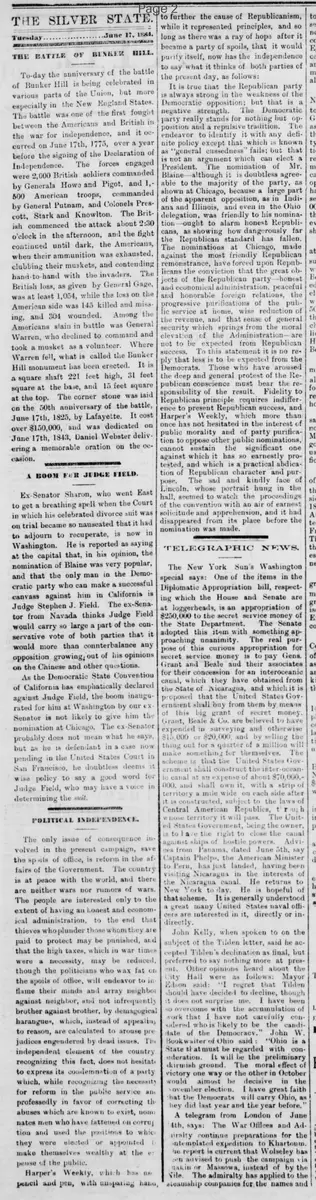
The only issue of consequence involved in the present campaign, save the spoils of office, is reform in the affairs of the Government. The country is at peace with the world, and there are neither wars nor rumors of wars. The people are interested only to the extent of having an honest and economical administration, to the end that thieves who plunder those whom they are paid to protect may be punished, and that the high taxes, which in war times were a necessity, may be reduced. Though the politicians who wax fat on the spoils of office, will endeavor to inflame their minds and array neighbor against neighbor, and not infrequently brother against brother, by demagogical harangues, which, instead of appealing to reason, are calculated to arouse prejudices engendered by dead issues. The independent element of the country recognizing this fact, does not hesitate to express its condemnation of a party which, while recognizing the necessity for reform in the public service and professedly in favor of correcting the abuses which are known to exist, nominates men who have fattened on corruption and used the positions to which they were elected or appointed to make themselves wealthy at the expense of the public.
Harper's Weekly, which has used its pencil and pen, with unsparing hand to further the cause of Republicanism, while it represented principles, and so long as there was a ray of hope after it became a party of spoils, that it would purify itself, now has the independence to say what it thinks of both parties of the present day, as follows:
It is true that the Republican party is always strong in the weakness of the Democratic opposition; but that is a negative strength. The Democratic party really stands for nothing but opposition and a repulsive tradition. The endeavor to identify it with any definite policy except that which is known as "general cussedness" fails; but that is not an argument which can elect a President. The nomination of Mr. Blaine—although it is doubtless agreeable to the majority of the party, as shown at Chicago, because a large part of the apparent opposition, as in Indiana and Illinois, and even in the Ohio delegation, was friendly to his nomination—ought to alarm honest Republicans, as showing how dangerously far the Republican standard has fallen. The nominations at Chicago, made against the most friendly Republican remonstrance, have forced upon Republicans the conviction that the great objects of the Republican party—honest and economical administration, peaceful and honorable foreign relations, the progressive purifications of the public service at home, wise reduction of the revenue, and that sense of general security which springs from the moral elevation of the Administration—are not to be expected from Republican success. To this statement it is no reply that less is to be expected from the Democrats. Those who have aroused the deep and general protest of the Republican conscience must bear the responsibility of the result. Fidelity to Republican principle requires indifference to present Republican success, and Harper's Weekly, which more than once has not hesitated in the interest of public morality and of party purification to oppose other public nominations, cannot sustain the significant one against which it has so earnestly protested, and which is a practical abdication of Republican character and purpose. The sad and kindly face of Lincoln, whose portrait hung in the hall, seemed to watch the proceedings of the convention with an air of earnest solicitude and apprehension, and it had disappeared from its place before the nomination was made.
The only issue of consequence involved in the present campaign, save the spoils of office, is reform in the affairs of the Government. The country is at peace with the world, and there are neither wars nor rumors of wars. The people are interested only to the extent of having an honest and economical administration, to the end that thieves who plunder those whom they are paid to protect may be punished, and that the high taxes, which in war times were a necessity, may be reduced. Though the politicians who wax fat on the spoils of office, will endeavor to inflame their minds and array neighbor against neighbor, and not infrequently brother against brother, by demagogical harangues, which, instead of appealing to reason, are calculated to arouse prejudices engendered by dead issues. The independent element of the country recognizing this fact, does not hesitate to express its condemnation of a party which, while recognizing the necessity for reform in the public service and professedly in favor of correcting the abuses which are known to exist, nominates men who have fattened on corruption and used the positions to which they were elected or appointed to make themselves wealthy at the expense of the public.
Harper's Weekly, which has used its pencil and pen, with unsparing hand to further the cause of Republicanism, while it represented principles, and so long as there was a ray of hope after it became a party of spoils, that it would purify itself, now has the independence to say what it thinks of both parties of the present day, as follows:
It is true that the Republican party is always strong in the weakness of the Democratic opposition; but that is a negative strength. The Democratic party really stands for nothing but opposition and a repulsive tradition. The endeavor to identify it with any definite policy except that which is known as "general cussedness" fails; but that is not an argument which can elect a President. The nomination of Mr. Blaine—although it is doubtless agreeable to the majority of the party, as shown at Chicago, because a large part of the apparent opposition, as in Indiana and Illinois, and even in the Ohio delegation, was friendly to his nomination—ought to alarm honest Republicans, as showing how dangerously far the Republican standard has fallen. The nominations at Chicago, made against the most friendly Republican remonstrance, have forced upon Republicans the conviction that the great objects of the Republican party—honest and economical administration, peaceful and honorable foreign relations, the progressive purifications of the public service at home, wise reduction of the revenue, and that sense of general security which springs from the moral elevation of the Administration—are not to be expected from Republican success. To this statement it is no reply that less is to be expected from the Democrats. Those who have aroused the deep and general protest of the Republican conscience must bear the responsibility of the result. Fidelity to Republican principle requires indifference to present Republican success, and Harper's Weekly, which more than once has not hesitated in the interest of public morality and of party purification to oppose other public nominations, cannot sustain the significant one against which it has so earnestly protested, and which is a practical abdication of Republican character and purpose. The sad and kindly face of Lincoln, whose portrait hung in the hall, seemed to watch the proceedings of the convention with an air of earnest solicitude and apprehension, and it had disappeared from its place before the nomination was made.
What sub-type of article is it?
Partisan Politics
Economic Policy
Moral Or Religious
What keywords are associated?
Political Independence
Government Reform
Party Corruption
Blaine Nomination
Honest Administration
Tax Reduction
Public Morality
What entities or persons were involved?
Republican Party
Democratic Party
Mr. Blaine
Harper's Weekly
Lincoln
Editorial Details
Primary Topic
Reform In Government Affairs And Criticism Of Party Nominations
Stance / Tone
Independent Condemnation Of Corruption In Both Parties
Key Figures
Republican Party
Democratic Party
Mr. Blaine
Harper's Weekly
Lincoln
Key Arguments
Only Significant Issue Is Government Reform Beyond Spoils Of Office
People Seek Honest, Economical Administration And Tax Reduction
Politicians Inflame Prejudices With Demagoguery On Dead Issues
Independent Voters Condemn Parties Nominating Corrupt Figures
Republican Nomination Of Blaine Alarms Honest Republicans
Republican Success Unlikely To Deliver Honest Administration Or Revenue Reduction
Democratic Party Stands For Opposition Without Definite Policy
Fidelity To Principles Requires Opposing Corrupt Nominations
Harper's Weekly Cannot Support Blaine's Nomination For Public Morality