Thank you for visiting SNEWPapers!
Sign up free
Story
October 20, 1884
Evening Capital
Annapolis, Anne Arundel County, Maryland
What is this article about?
Historical account of Vinalhaven Island, Maine, known for its granite quarries. Settled in 1765, quarrying began in 1851 by Moses Webster and J.R. Sadwell. Describes operations employing hundreds, techniques, and stone used in major U.S. buildings and monuments.
Clipping
OCR Quality
65%
Fair
Full Text
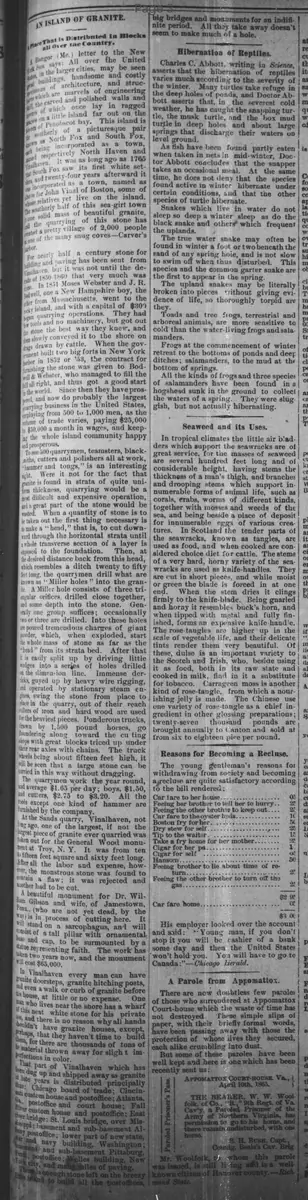
AN ISLAND OF GRANITE.
In a region that is distributed in blocks all over the country,
J.S. says: All over the United States, in the larger cities, may be seen buildings, handsome and costly, which are marvels of engineering architecture, polished towers of which once lay in ragged form far out on the southerly of picturesque pair of Penobscot bay. This island is known as North Fox and South Fox, being incorporated as a town, and respectively North Haven and Vinalhaven. It was as long ago as 1765 South Fox saw its first white settlement, and twenty-four years afterward was incorporated as a town, named Vinalhaven, and some of those relatives yet live on the island. The southerly half of this sea-girt town and the quarrying of this stone has made beautiful granite homes in the many snug coves—Carver's pretty village of 000 people, harbor, Vinalhaven. But it was not until the decade 1850-1860 that very much was done. For nearly half a century stone for building and paving has been sent from the rocky island. In 1851 Moses Webster and J. R. Sadwell, one a New Hampshire boy, the other from Massachusetts, went to the island and with a capital of $302 began quarrying operations. They had no tools and no machinery, but got out the stone the best way they knew, and then slowly conveyed it to the shore on drags drawn by cattle. When the government built two big forts in New York harbor in 1852 or '58, the contract for furnishing the stone was given to Bodwell & Webster, who managed to fill it all right, and thus got a good start in the world. Since then they have prospered, and now do probably the largest quarrying business in the United States, employing from 500 to 1,000 men, as the volume of trade varies, paying $25,000 to $50,000 a month in wages, and keeping the whole island community happy and prosperous.
To see 500 quarrymen, teamsters, blacksmiths, cutters and polishers all at work, "hammer and tongs," is an interesting sight. Were it not for the fact that granite is found in strata of quite uniform thickness, quarrying would be a most difficult and expensive operation, and a great part of the stone would be wasted. When a quantity of stone is to be taken out the first thing necessary is to make a "head," that is, to cut downward through the horizontal strata until the whole transverse section of a layer is exposed to the foundation. Then, at the desired distance back from this head, which resembles a ditch twenty to fifty feet long, the quarrymen drill what are known as "Miller holes" into the granite. A Miller hole consists of three triangular orifices, drilled close together, and some depth into the stone. Generally one group suffices; occasionally two or three are drilled. Into these holes are poured tremendous charges of giant powder, which, when exploded, start the whole mass of stone as far as the "head" from its strata bed. After that it is easily split up by driving little wedges into a series of holes drilled on the dimension line. Immense derricks, guyed up by heavy wire rigging, and operated by stationary steam engines, swing the stone from place to place in the quarry; out of their reach rollers of iron and hard wood are used for the heaviest pieces. Ponderous trucks, drawn by 1,500 pound horses, go foundering along toward the cutting shops with great blocks triced up under their rear axles with chains. The truck wheels being about fifteen feet high, it will be seen that a large stone can be carried in this way without dragging. The quarrymen work the year round, and average $1.65 per day; boys, $1.50, and cutters, $2.75 to $3.20. All the tools except one kind of hammer are furnished by the company.
At the Sands quarry, Vinalhaven, not long ago, one of the largest, if not the largest piece of granite ever quarried was taken out for the General Wood monument at Troy, N. Y. It was from ten to fifteen feet square and sixty feet long. After all the labor and expense, however, the monstrous stone was found to contain a flaw; it was rejected and another had to be cut.
A beautiful monument for Dr. William Gibson and wife, of Jamestown, Penn., (who are not yet dead, by the way) is in process of cutting here. It will stand on a sarcophagus and will consist of a tall pillar with ornamental base and cap, to be surmounted by a statue representing faith. The work has taken two years now, and the monument will cost $65,000.
In Vinalhaven every man can have granite doorsteps, granite hitching posts, and even a walk or curb of granite before his house, at little or no expense. One man who lives near the shore has a wharf of this neat white stone for his private use, and there is no reason why all shouldn't have granite houses, except, perhaps that they haven't time to build them, for there are thousands of tons of the material thrown away for slight imperfections in color.
That part of Vinalhaven which has been dug up and shipped away in late years is distributed principally to custom house and postoffice in Ga., River bridge custom postoffice St. Louis and court house bridge postoffice over East Mississippi; basement and sub-basement Albany postoffice; lower part of new state, war and navy basement and sub-basement Pittsburgh, postoffice building, Welles building, New Washington; Fork city, and many miles of paving. There is enough stone left on the breezy little island to build all the postoffices, big bridges and monuments for an indefinite period. All they take away doesn't seem to make much of a hole.
In a region that is distributed in blocks all over the country,
J.S. says: All over the United States, in the larger cities, may be seen buildings, handsome and costly, which are marvels of engineering architecture, polished towers of which once lay in ragged form far out on the southerly of picturesque pair of Penobscot bay. This island is known as North Fox and South Fox, being incorporated as a town, and respectively North Haven and Vinalhaven. It was as long ago as 1765 South Fox saw its first white settlement, and twenty-four years afterward was incorporated as a town, named Vinalhaven, and some of those relatives yet live on the island. The southerly half of this sea-girt town and the quarrying of this stone has made beautiful granite homes in the many snug coves—Carver's pretty village of 000 people, harbor, Vinalhaven. But it was not until the decade 1850-1860 that very much was done. For nearly half a century stone for building and paving has been sent from the rocky island. In 1851 Moses Webster and J. R. Sadwell, one a New Hampshire boy, the other from Massachusetts, went to the island and with a capital of $302 began quarrying operations. They had no tools and no machinery, but got out the stone the best way they knew, and then slowly conveyed it to the shore on drags drawn by cattle. When the government built two big forts in New York harbor in 1852 or '58, the contract for furnishing the stone was given to Bodwell & Webster, who managed to fill it all right, and thus got a good start in the world. Since then they have prospered, and now do probably the largest quarrying business in the United States, employing from 500 to 1,000 men, as the volume of trade varies, paying $25,000 to $50,000 a month in wages, and keeping the whole island community happy and prosperous.
To see 500 quarrymen, teamsters, blacksmiths, cutters and polishers all at work, "hammer and tongs," is an interesting sight. Were it not for the fact that granite is found in strata of quite uniform thickness, quarrying would be a most difficult and expensive operation, and a great part of the stone would be wasted. When a quantity of stone is to be taken out the first thing necessary is to make a "head," that is, to cut downward through the horizontal strata until the whole transverse section of a layer is exposed to the foundation. Then, at the desired distance back from this head, which resembles a ditch twenty to fifty feet long, the quarrymen drill what are known as "Miller holes" into the granite. A Miller hole consists of three triangular orifices, drilled close together, and some depth into the stone. Generally one group suffices; occasionally two or three are drilled. Into these holes are poured tremendous charges of giant powder, which, when exploded, start the whole mass of stone as far as the "head" from its strata bed. After that it is easily split up by driving little wedges into a series of holes drilled on the dimension line. Immense derricks, guyed up by heavy wire rigging, and operated by stationary steam engines, swing the stone from place to place in the quarry; out of their reach rollers of iron and hard wood are used for the heaviest pieces. Ponderous trucks, drawn by 1,500 pound horses, go foundering along toward the cutting shops with great blocks triced up under their rear axles with chains. The truck wheels being about fifteen feet high, it will be seen that a large stone can be carried in this way without dragging. The quarrymen work the year round, and average $1.65 per day; boys, $1.50, and cutters, $2.75 to $3.20. All the tools except one kind of hammer are furnished by the company.
At the Sands quarry, Vinalhaven, not long ago, one of the largest, if not the largest piece of granite ever quarried was taken out for the General Wood monument at Troy, N. Y. It was from ten to fifteen feet square and sixty feet long. After all the labor and expense, however, the monstrous stone was found to contain a flaw; it was rejected and another had to be cut.
A beautiful monument for Dr. William Gibson and wife, of Jamestown, Penn., (who are not yet dead, by the way) is in process of cutting here. It will stand on a sarcophagus and will consist of a tall pillar with ornamental base and cap, to be surmounted by a statue representing faith. The work has taken two years now, and the monument will cost $65,000.
In Vinalhaven every man can have granite doorsteps, granite hitching posts, and even a walk or curb of granite before his house, at little or no expense. One man who lives near the shore has a wharf of this neat white stone for his private use, and there is no reason why all shouldn't have granite houses, except, perhaps that they haven't time to build them, for there are thousands of tons of the material thrown away for slight imperfections in color.
That part of Vinalhaven which has been dug up and shipped away in late years is distributed principally to custom house and postoffice in Ga., River bridge custom postoffice St. Louis and court house bridge postoffice over East Mississippi; basement and sub-basement Albany postoffice; lower part of new state, war and navy basement and sub-basement Pittsburgh, postoffice building, Welles building, New Washington; Fork city, and many miles of paving. There is enough stone left on the breezy little island to build all the postoffices, big bridges and monuments for an indefinite period. All they take away doesn't seem to make much of a hole.
What sub-type of article is it?
Historical Event
Curiosity
Personal Triumph
What themes does it cover?
Triumph
Fortune Reversal
Exploration
What keywords are associated?
Granite Quarrying
Vinalhaven Island
Moses Webster
J.R. Sadwell
Quarrying Techniques
Monuments
Us Buildings
Penobscot Bay
What entities or persons were involved?
Moses Webster
J. R. Sadwell
Dr. William Gibson
Where did it happen?
Vinalhaven, Penobscot Bay, Maine
Story Details
Key Persons
Moses Webster
J. R. Sadwell
Dr. William Gibson
Location
Vinalhaven, Penobscot Bay, Maine
Event Date
1765 To 1890s
Story Details
Vinalhaven Island's granite quarrying history begins with settlement in 1765. In 1851, Webster and Sadwell start operations with minimal resources, securing government contracts and building the largest U.S. quarrying business. Details quarrying methods, workforce, and stone uses in monuments and buildings.