Thank you for visiting SNEWPapers!
Sign up free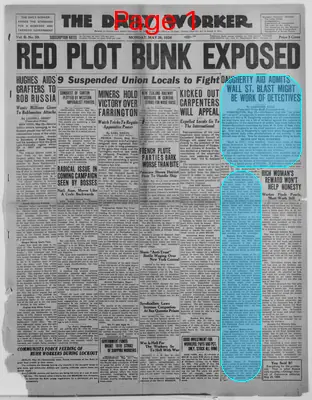
The Daily Worker
Chicago, Cook County, Illinois
What is this article about?
John W. H. Crim, former assistant to Attorney General Daugherty, confesses to the Wheeler-Brookhart committee that anti-radical 'red peril' propaganda was fabricated without evidence, reveals Department of Justice inefficiencies, and suggests the 1920 Wall Street bomb was a staged incident by J.P. Morgan and detectives to evade lawsuits and persecute radicals.
Clipping
OCR Quality
Full Text
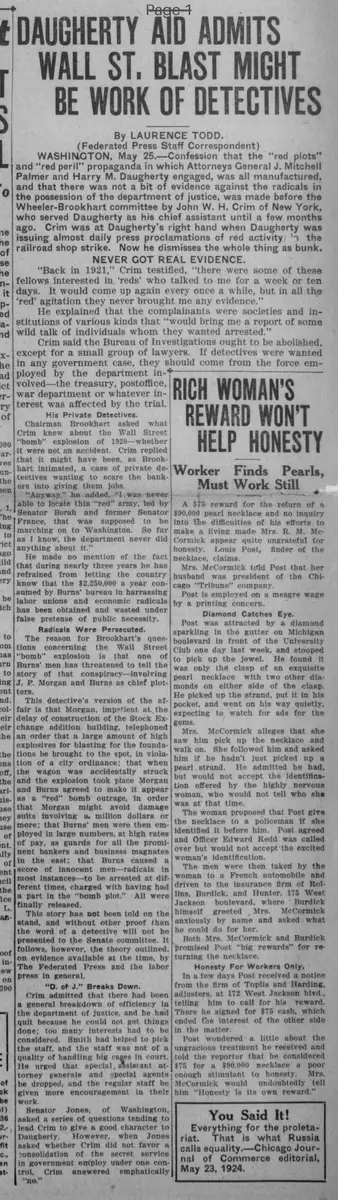
By LAURENCE TODD.
(Federated Press Staff Correspondent)
WASHINGTON, May 25.—Confession that the "red plots" and "red peril" propaganda in which Attorneys General J. Mitchell Palmer and Harry M. Daugherty engaged, was all manufactured, and that there was not a bit of evidence against the radicals in the possession of the department of justice, was made before the Wheeler-Brookhart committee by John W. H. Crim of New York. who served Daugherty as his chief assistant until a few months ago.
Crim was at Daugherty's right hand when Daugherty was issuing almost daily press proclamations of red activity in the railroad shop strike. Now he dismisses the whole thing as bunk.
NEVER GOT REAL EVIDENCE.
"Back in 1921," Crim testified, "there were some of these fellows interested in, 'reds' who talked to me for a week or ten days. It would come up again every once a while, but in all the 'red' agitation they never brought me any evidence."
He explained that the complainants were societies and institutions of various kinds that "would bring me a report of some wild talk of individuals whom they wanted arrested."
Crim said the Bureau of Investigations ought to be abolished. except for a small group of lawyers. If detectives were wanted in any government case, they should come from the force employed by the treasury, postoffice. war department or whatever interest was affected by the trial.
His Private Detectives.
Chairman Brookhart asked what Crim knew about the Wall Street "bomb" explosion of 1920-whether it were not an accident. Crim replied that it might have been, as Brookhart intimated, a case of private detectives wanting to scare the bankers into giving them jobs.
"Anyway." he added, "I was never able to locate this "red" army, led by Senator Borah and former Senator France, that was supposed to be marching on to Washington. So far as I know. the department never did anything about it."
He made no mention of the fact that during nearly three years he has refrained from letting the country know that the $2,250.000 a year consumed by Burns' bureau in harrassing labor unions and economic radicals has been obtained and wasted under false pretense of public necessity.
Radicals Were Persecuted.
The reason for Brookhart's questions concerning the Wall Street "bomb" explosion is that one of Burns' men has threatened to tell the story of that conspiracy-involving J. P. Morgan and Burns as chief plotters.
This detective's version of the affair is that Morgan, impatient at the delay of construction of the Stock Exchange addition building, telephoned an order that a large amount of high explosives for blasting for the foundations be brought to the spot. in violation of a city ordinance; that when the wagon was accidentally struck and the explosion took place Morgan and Burns agreed to make it appear as a "red" bomb outrage, in order that Morgan might avoid damage suits involving a million dollars or more: that Burns' men were then employed in large numbers, at high rates of pay, as guards for all the prominent bankers and business magnates in the east; that Burns caused a score of innocent men-radicals in most instances-to be arrested at different times, charged with having had a part in the "bomb plot." All were finally released.
This story has not been told on the stand, and without other proof than the word of a detective will not be presented to the Senate committee. It follows. however, the theory outlined, on evidence available at the time. by The Federated Press and the labor press in general.
"D. of J." Breaks Down.
Crim admitted that there had been a general breakdown of efficiency in the department of justice, and he had quit because he could not get things done; too many Interests had to be considered. Smith had helped to pick the staff, and the staff was not of a quality of handling big cases in court.
He urged that special, assistant attorney generals and special agents be dropped, and the regular staff be given more encouragement in their work.
Senator Jones, of Washington, asked a series of questions tending to lead Crim to give a good character to Daugherty.
However, when Jones asked whether Crim did not favor a consolidation of the secret service in government employ under one control. Crim answered emphatically "no."
What sub-type of article is it?
What themes does it cover?
What keywords are associated?
What entities or persons were involved?
Where did it happen?
Story Details
Key Persons
Location
Washington, Wall Street
Event Date
May 25
Story Details
John W. H. Crim testifies before the Wheeler-Brookhart committee that 'red plots' propaganda by Palmer and Daugherty was manufactured with no evidence against radicals; suggests Wall Street 1920 bomb explosion might be a conspiracy by private detectives and J.P. Morgan to avoid lawsuits and secure jobs, leading to persecution of innocent radicals.