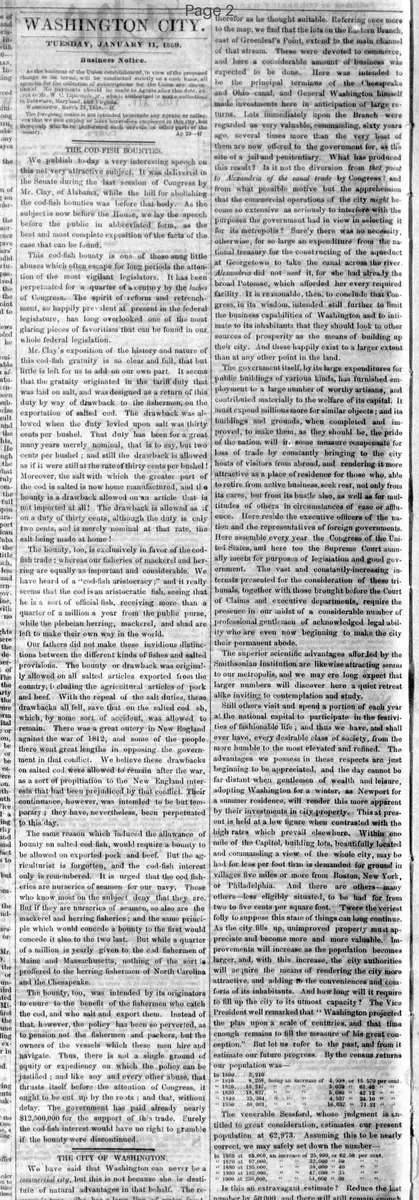
WASHINGTON CITY. TUESDAY, JANUARY 11, 1859. Business Notice. As the business of the Union establishment, in view of the proposed change in its terms, will be conducted strictly on a cash basis, all agencies for the collection of subscriptions for the Union are discontinued. No payments should be made to Agents after this date, except to Mr. W. C. Lipscomb, Jr., who is authorized to make collections in Delaware, Maryland, and Virginia. Washington, March 23, 1858. The foregoing notice is not intended to include any agents or collectors that we now employ or have heretofore employed in this city, but those only who have performed such service in other parts of the country. THE COD-FISH BOUNTIES. We publish to-day a very interesting speech on this not very attractive subject. It was delivered in the Senate during the last session of Congress by Mr. Clay, of Alabama, while the bill for abolishing the cod-fish bounties was before that body. As the subject is now before the House, we lay the speech before the public in abbreviated form, as the best and most complete exposition of the facts of the case that can be found. This cod-fish bounty is one of those snug little abuses which often escape for long periods the attention of the most vigilant legislators. It has been perpetuated for a quarter of a century by the laches of Congress. The spirit of reform and retrenchment, so happily prevalent at present in the federal legislature, has long overlooked one of the most glaring pieces of favoritism that can be found in our whole federal legislation. Mr. Clay's exposition of the history and nature of this cod-fish gratuity is so clear and full, that but little is left for us to add on our own part. It seems that the gratuity originated in the tariff duty that was laid on salt, and was designed as a return of this duty by way of drawback to the fishermen, on the exportation of salted cod. The drawback was allowed when the duty levied upon salt was thirty cents per bushel. That duty has been for a great many years merely nominal, that is to say, but two cents per bushel; and still the drawback is allowed as if it were still at the rate of thirty cents per bushel! Moreover, the salt with which the greater part of the cod is salted is now home manufactured, and the bounty is a drawback allowed on an article that is not imported at all! The drawback is allowed as if on a duty of thirty cents, although the duty is only two cents, and is merely nominal at that rate, the salt being made at home! The bounty, too, is exclusively in favor of the cod-fish trade; whereas our fisheries of mackerel and herring are equally as important and considerable. We have heard of a "cod-fish aristocracy;" and it really seems that the cod is an aristocratic fish, seeing that he is a sort of official fish, receiving more than a quarter of a million a year from the public purse, while the plebeian herring, mackerel, and shad are left to make their own way in the world. Our fathers did not make these invidious distinctions between the different kinds of fishes and salted provisions. The bounty or drawback was originally allowed on all salted articles exported from the country, including the agricultural articles of pork and beef. With the repeal of the salt duties, these drawbacks all fell, save that on the salted cod fish, which, by some sort of accident, was allowed to remain. There was a great outcry in New England against the war of 1812, and some of the people there went great lengths in opposing the government in that conflict. We believe these drawbacks on salted cod were allowed to remain after the war, as a sort of propitiation to the New England interests that had been prejudiced by that conflict. Their continuance, however, was intended to be but temporary; they have, nevertheless, been perpetuated to this day. The same reason which induced the allowance of bounty on salted cod fish, would require a bounty to be allowed on exported pork and beef. But the agriculturist is forgotten, and the cod-fish interest only is remembered. It is urged that the cod fisheries are nurseries of seamen for our navy. Those who know most on the subject deny that they are. But if they are nurseries of seamen, so also are the mackerel and herring fisheries; and the same principle which would concede a bounty to the first would concede it also to the two last. But while a quarter of a million is yearly given to the cod fishermen of Maine and Massachusetts, nothing of the sort is proffered to the herring fishermen of North Carolina and the Chesapeake. The bounty, too, was intended by its originators to enure to the benefit of the fishermen who catch the cod, and who salt and export them. Instead of that, however, the policy has been so perverted, as to pension not the fishermen and packers, but the owners of the vessels which these men hire and navigate. Thus, there is not a single ground of equity or expediency on which the policy can be justified; and like any and every other abuse, that thrusts itself before the attention of Congress, it ought to be cut up by the roots; and that, without delay. The government has paid already nearly $12,500,000 for the support of this trade. Surely the cod-fish interest would have no right to grumble if the bounty were discontinued.
| 1810 | 8,208, being an increase of | 4,938, or | 15,570 per cent. |
| 1820 | 13,247, | 5,039 | 61.40 |
| 1830 | 18,827, | 5,680 | 42.12 |
| 1840 | 23,364, | 4,537 | 24.10 |
| 1850 | 40,001, | 16,637 | 71.21 |
| In 1860 at | 65,000, an increase of | 25,999, or 62.50 | per cent |
| “1870 at | 97,000, | 32,000 | 50 |
| “1880 at | 135,000, | 38,000 | 40 |
| “1890 at | 182,000, | 47,000 | 35 |
| “1900 at | 236,600, | 54,600 | 30 |