Thank you for visiting SNEWPapers!
Sign up free
Story
September 22, 1828
The Virginian
Lynchburg, Virginia
What is this article about?
Robert Sinclair provides practical advice on cultivating various grasses like red clover, timothy, herd's grass, tall oat grass, orchard grass, and lucerne in the Southern States, emphasizing land improvement, seeding rates, and preparation methods for better yields on different soil types.
Clipping
OCR Quality
85%
Good
Full Text
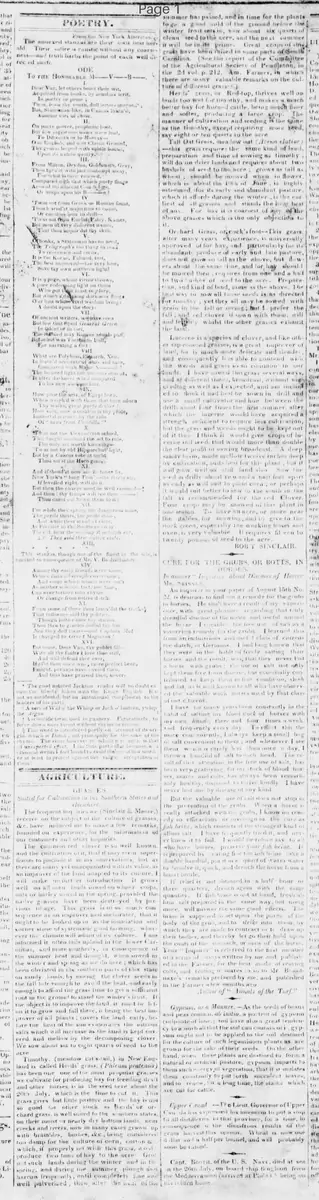
AGRICULTURE.
GRASSES
Suited for Cultivation in the Southern States and elsewhere
The frequent inquiries we (Sinclair & Moore.) receive on the subject of the culture of grasses, &c. have induced me to make a few remarks, founded on experience, for the information of our customers and other inquiries
The common red clover is so well known and the cultivation of, that it may seem superfluous to give it any introduction. But as there are many yet unacquainted with its value, as an improver of the land adapted to its culture. I will make you a further introduction it grows well on all corn lands sowed on winter crops, oats or barley sowed in the spring, provided the previous grasses have been destroyed by previous tillage. This grass is at so much consequence as an improver and meliorater, that it ought to be looked up to as the foundation and corner stone of systematic good farming, wherever the climate will admit of its culture. I am informed it often fails upland in the lower Carolinas, and more southerly. in consequence of the super heat and drought, when sowed in the winter and spring as we do here; which has been obviated in the southern parts of this state on sandy lands, by sowing the clover seeds in the fall late enough to avoid the heat, and early enough to afford the grass time to get a sufficient root in the ground to stand the winter's frost. If the object is to improve the land it must be laid on it to grow and fall there, it being the best improver of all plants; covers the land early, before the heat of the sun evaporates the nitrous salts which will increase as the land is kept covered and mellow by the decomposing clover We sow about six to eight quarts of seed to the acre
Timothy. (meadow cat's-tail.) in New England is called Herd's grass, (Phleum pratense) has been one of the most popular grasses we cultivate for producing hay for feeding draft and other horses. it is in the seed here about the 10th July, which is the time to cut it. This grass gives but little pasture and the hay is not so good for other stock as Herd's or orchard grass. is well suited to the southern states. on their moist or nearly dry bottom lands, near creeks and rivers, now in many cases grown up with brambles, bushes, are, being considered too damp for the culture of corn, cotton & which, if properly set with this grass, would produce two tons of hay to the acre. Get out such lands during the winter and in the spring, and during the summer plough and harrow frequently, until completely fine and well pulverised, then after the use of the summer has passed, and in time for the plants to get a good hold of the ground before the winter frost sets in, Sow about six quarts of clean seed to the acre, and the next summer it will be in its prime. Great crops of this grass have been raised in some parts of South Carolina. (See the report of the Committee of the Agricultural Society of Pendleton, in the 24 vol. p 212, Am. Farmer, in which there are many valuable remarks on the culture of different grasses..)
Herd's grass, or Red-top, thrives well on lands too wet for timothy. and makes a much better hay for horned cattle. being much finer and softer, producing a large crop. The manner of cultivation and seeding is the same as the timothy, except regarding more seed. say eight or ten quarts to the acre
Tall Oat Grass, meadow oat (Triticum elatior) -this grass requires the same kind of land. preparation and time of sowing as timothy will do on drier lands and requires about two bushels of seed to the acre ; grows as tall as wheat : should be mowed when in flower which is about the 1st of June ; is highly esteemed for its early and abundant pasture which it affords during the winter is the earliest of all grasses, and stands the heat best of any. For hay it is coarsest of any of the above grasses which is the only objection to it.
Orchard Grass, or cock's-foot-This grass after many years experience, is universally approved of for hay, and particularly for its. abundant produce of early and late pasture, does not grow so tall as the above, but flowers about the same time, and for hay. should be mowed then . requires from one and a half to two bushels of seed to the acre. Preparation, and kind of land, same as the above. The best way to sow all those seeds, is as directed for timothy , yet they all may be sowed with grain in the fall or spring: but I prefer the fall, and red clover if sown with them, will stand and grow freely whilst the other grasses exhaust the land.
Lucerne is a species of clover, and like other tap-rooted grasses, is a great improver of land, but is much more delicate and tender. and consequently less able to contend with the weeds and grasses so common in our lands. I have sowed this grass several ways, and at different times, broadcast, without success Crediting as well as I expected, and am convinced it had be st be sown in drill and use a small cultivator and hoe between the drills about four times the first summer, after which the undergrowth would have acquired a strength sufficient to require less cultivation, but the grass and weeds ought to be kept out of it then. I think it would give crops of Lucerne and seed. that would more than double the clear profit of sowing broadcast. A deep sandy loam, made mellow twelve inches deep by cultivation, suits best for this plant , but it will grow well on stiff land also Sow the seed in drills about two and a half feet apart as well suited to plant corn, or perhaps it would suit better to sow in the fall as recommended for the red Clover I have crops may be mowed in this plant in one season T.'have an acre, or more near the stables, for mowing, and to give to the stock green, especially the working horses and oxen, is very valuable It requires at from ten to twenty pounds of seed to the acre
ROBT. SINCLAIR.
GRASSES
Suited for Cultivation in the Southern States and elsewhere
The frequent inquiries we (Sinclair & Moore.) receive on the subject of the culture of grasses, &c. have induced me to make a few remarks, founded on experience, for the information of our customers and other inquiries
The common red clover is so well known and the cultivation of, that it may seem superfluous to give it any introduction. But as there are many yet unacquainted with its value, as an improver of the land adapted to its culture. I will make you a further introduction it grows well on all corn lands sowed on winter crops, oats or barley sowed in the spring, provided the previous grasses have been destroyed by previous tillage. This grass is at so much consequence as an improver and meliorater, that it ought to be looked up to as the foundation and corner stone of systematic good farming, wherever the climate will admit of its culture. I am informed it often fails upland in the lower Carolinas, and more southerly. in consequence of the super heat and drought, when sowed in the winter and spring as we do here; which has been obviated in the southern parts of this state on sandy lands, by sowing the clover seeds in the fall late enough to avoid the heat, and early enough to afford the grass time to get a sufficient root in the ground to stand the winter's frost. If the object is to improve the land it must be laid on it to grow and fall there, it being the best improver of all plants; covers the land early, before the heat of the sun evaporates the nitrous salts which will increase as the land is kept covered and mellow by the decomposing clover We sow about six to eight quarts of seed to the acre
Timothy. (meadow cat's-tail.) in New England is called Herd's grass, (Phleum pratense) has been one of the most popular grasses we cultivate for producing hay for feeding draft and other horses. it is in the seed here about the 10th July, which is the time to cut it. This grass gives but little pasture and the hay is not so good for other stock as Herd's or orchard grass. is well suited to the southern states. on their moist or nearly dry bottom lands, near creeks and rivers, now in many cases grown up with brambles, bushes, are, being considered too damp for the culture of corn, cotton & which, if properly set with this grass, would produce two tons of hay to the acre. Get out such lands during the winter and in the spring, and during the summer plough and harrow frequently, until completely fine and well pulverised, then after the use of the summer has passed, and in time for the plants to get a good hold of the ground before the winter frost sets in, Sow about six quarts of clean seed to the acre, and the next summer it will be in its prime. Great crops of this grass have been raised in some parts of South Carolina. (See the report of the Committee of the Agricultural Society of Pendleton, in the 24 vol. p 212, Am. Farmer, in which there are many valuable remarks on the culture of different grasses..)
Herd's grass, or Red-top, thrives well on lands too wet for timothy. and makes a much better hay for horned cattle. being much finer and softer, producing a large crop. The manner of cultivation and seeding is the same as the timothy, except regarding more seed. say eight or ten quarts to the acre
Tall Oat Grass, meadow oat (Triticum elatior) -this grass requires the same kind of land. preparation and time of sowing as timothy will do on drier lands and requires about two bushels of seed to the acre ; grows as tall as wheat : should be mowed when in flower which is about the 1st of June ; is highly esteemed for its early and abundant pasture which it affords during the winter is the earliest of all grasses, and stands the heat best of any. For hay it is coarsest of any of the above grasses which is the only objection to it.
Orchard Grass, or cock's-foot-This grass after many years experience, is universally approved of for hay, and particularly for its. abundant produce of early and late pasture, does not grow so tall as the above, but flowers about the same time, and for hay. should be mowed then . requires from one and a half to two bushels of seed to the acre. Preparation, and kind of land, same as the above. The best way to sow all those seeds, is as directed for timothy , yet they all may be sowed with grain in the fall or spring: but I prefer the fall, and red clover if sown with them, will stand and grow freely whilst the other grasses exhaust the land.
Lucerne is a species of clover, and like other tap-rooted grasses, is a great improver of land, but is much more delicate and tender. and consequently less able to contend with the weeds and grasses so common in our lands. I have sowed this grass several ways, and at different times, broadcast, without success Crediting as well as I expected, and am convinced it had be st be sown in drill and use a small cultivator and hoe between the drills about four times the first summer, after which the undergrowth would have acquired a strength sufficient to require less cultivation, but the grass and weeds ought to be kept out of it then. I think it would give crops of Lucerne and seed. that would more than double the clear profit of sowing broadcast. A deep sandy loam, made mellow twelve inches deep by cultivation, suits best for this plant , but it will grow well on stiff land also Sow the seed in drills about two and a half feet apart as well suited to plant corn, or perhaps it would suit better to sow in the fall as recommended for the red Clover I have crops may be mowed in this plant in one season T.'have an acre, or more near the stables, for mowing, and to give to the stock green, especially the working horses and oxen, is very valuable It requires at from ten to twenty pounds of seed to the acre
ROBT. SINCLAIR.
What sub-type of article is it?
Agricultural Guide
Farming Advice
What keywords are associated?
Red Clover
Timothy Grass
Herds Grass
Tall Oat Grass
Orchard Grass
Lucerne
Southern Cultivation
Hay Production
Land Improver
What entities or persons were involved?
Sinclair & Moore
Robt. Sinclair
Where did it happen?
Southern States, Lower Carolinas, South Carolina
Story Details
Key Persons
Sinclair & Moore
Robt. Sinclair
Location
Southern States, Lower Carolinas, South Carolina
Story Details
Detailed instructions on cultivating red clover, timothy, herd's grass, tall oat grass, orchard grass, and lucerne, including soil preparation, seeding rates, timing, and benefits for land improvement and livestock feed in southern climates.