Thank you for visiting SNEWPapers!
Sign up free
Daily National Intelligencer
Washington, District Of Columbia
What is this article about?
Extracts from an American's diary in Paris detail the French victory reports on June 18, 1815, followed by Napoleon's defeat at Waterloo on June 20, leading to political debates on abdication, regency, and restoration amid threats from allied forces.
Clipping
OCR Quality
Full Text
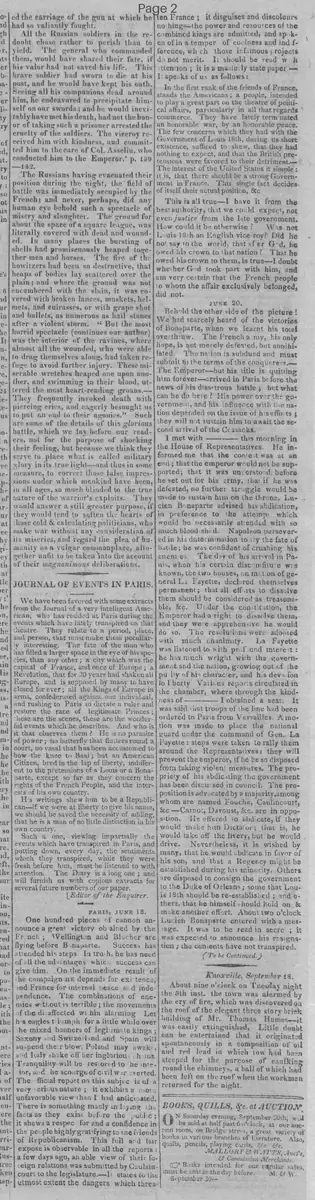
We have been favored with some extracts from the Journal of a very intelligent American, who has resided at Paris during the events which have lately transpired on that theatre. They relate to a period, place, and person, that must make them peculiarly interesting. The fate of the man who has filled a larger space in the eye of his species, than any other; a city which was the capital of France, and once of Europe; a Revolution, that for 30 years had shaken all Europe, and is supposed by many to have closed for ever: all the Kings of Europe in arms, confederated against one individual, and rushing to Paris to dictate a ruler and restore the race of legitimate Princes: these are the scenes, these are the wonderful events which he describes. And who is it that observes them? He is no parasite of power: no butterfly that flutters round a court, no vassal that has been accustomed to bow the knee to Baal; but an American Citizen, bred in the lap of liberty, indifferent to the pretensions of a Louis or a Bonaparte, except so far as they concern the rights of the French People, and the interests of his own country. His writings shew him to be a Republican—if we were at liberty to give his name, we should be saved the necessity of adding, that he is a man of no little distinction in his own country. Such a one, viewing impartially the events which have transpired in Paris, and putting down, every day, the sentiments which they transpired, while they were fresh before him, must be listened to with attention. The Diary is a long one; and will furnish us with copious extracts for several future numbers of our paper.
[Editor of the Enquirer.
PARIS, JUNE 18.
One hundred pieces of cannon announce a great victory obtained by the French; Wellington and Blucher are flying before Bonaparte. Success has attended his steps. In truth, he has need of all the advantages which success can give him. On the immediate result of the campaign he depends for existence, and France for internal peace and independence. The combinations of enemies without is terrible; the movements of the disaffected within alarming Let his eagles triumph for a little while over the mixed banners of legitimate kings; Saxony and Switzerland and Spain will suspend their blow, Poland may awake, and Italy shake off her inglorious chains Tranquility will be restored to the interior, and the scourge of civil war averted. The official report on this subject is of a very serious nature; it exhibits a more unfavorable view than I had anticipated. There is something manly in laying the facts as they exist before the public; it shews a respect for and a confidence in the people highly gratifying to the friends of Republicanism. This full and fair expose is observable in all the reports: a few days ago, an able view of their foreign relations was submitted by Caulaincourt to the legislature.—It states to the utmost extent the dangers which threaten France; it disguises and discolours no thing the power and resources of the combined kings are admitted, and spoken of in a temper of coolness and indifference, which those infamous projects do not merit. It should be read with attention; it is a masterly state paper.—It speaks of us as follows:
In the first rank of the friends of France, stands the Americans; a people, intended to play a great part on the theatre of political affairs, particularly in all that regards commerce. They have lately terminated an honorable war, by an honorable peace. The few concerns which they had with the Government of Louis 18th, during its short existence, sufficed to shew, that they had nothing to expect, and that the British pretensions were favored to their detriment.—The interest of the United States is simple: it is, that there should be a strong Government in France. This single fact decides, of itself their actual position, &c
This is all true—I have it from the best authority, that we could expect, not even justice from the late government. How could it be otherwise? Was not Louis 18th an English viceroy? Did he not say to the world, that after God, he owed his crown to that nation? That he owed his crown to them, is true—I doubt whether God took part with him, and am very certain that the French people to whom the affair exclusively belonged, did not.
JUNE 20.
Behold the other side of the picture! We had scarcely heard of the victories of Bonaparte, when we learnt his total overthrow. The French army, his only hope, is not merely defeated, but annihilated. The nation is subdued and must submit to the terms of the conquerors.—The Emperor—but his title is quitting him forever—arrived in Paris before the news of his disastrous battle; but what can he do here? His power over the government, and his influence with the nation depended on the issue of his efforts; they will not sustain him to await the second arrival of the Cossacks.
I met with —_ this morning in the House of Representatives. He informed me that the contest was at an end; that the emperor would not be supported; that it was understood, before he set out for his army, that if he was defeated, no further struggle would be made to sustain him on the throne. Lucien Bonaparte advised his abdication, in preference to the attempt which would be necessarily attended with so much blood-shed. Napoleon persevered in his determination to try the fate of battle; he was confident of crushing his enemies. The day of his arrival in Paris, when his certain discomfiture was known, the two houses, on motion of general La Fayette, declared themselves permanent; that all efforts to dissolve them should be considered as treasonable, &c. Under the constitution, the Emperor had a right to dissolve them, and they were apprehensive he would do so. The resolutions were adopted with much unanimity. La Fayette was listened to with profound interest: he has much weight with the government and the nation, growing out of the purity of his character, and his devotion to liberty Various reports circulated in the chamber, where through the kindness of - I obtained a seat. It was said that troops of the line had been ordered to Paris from Versailles. A motion was made to place the national guard under the command of Gen. La Fayette: steps were taken to rally them around the Representatives: they will prevent the emperor, if he be so disposed from taking violent measures. The propriety of his abdicating the government has been discussed in council. The proposition is advocated by a majority, among whom are named Fouche, Caulaincourt, &c -Carnot, Davoust, &c. are in opposition. He offered to abdicate, if they would make him Dictator; that is, he would take off the livery, but he would drive. Nevertheless, it is wished by many, that he would abdicate in favor of his son, and that a Regency might be established during his minority. Others are disposed to consign the government to the Duke of Orleans; some that Louis 18th should be re-established: and others, that he himself should hold on & make another effort. About two o'clock Lucien Bonaparte entered with a message. It was to be read in secret; it was expected to announce his resignation; the contents have not transpired.
(To be Continued.)
What sub-type of article is it?
What keywords are associated?
What entities or persons were involved?
Where did it happen?
Foreign News Details
Primary Location
Paris
Event Date
June 18 And June 20
Key Persons
Outcome
french army annihilated; nation subdued and must submit to conquerors; discussions on abdication, regency, or restoration
Event Details
Initial reports of French victory over Wellington and Blucher on June 18; by June 20, news of total defeat; political debates in legislature on Napoleon's abdication, with proposals for regency, Duke of Orleans, or Louis 18th restoration; La Fayette leads resolutions to protect assembly