Thank you for visiting SNEWPapers!
Sign up free
Literary
November 21, 1838
Danbury Times
Danbury, Fairfield County, Connecticut
What is this article about?
A poor fisherman named Kalid, content with his lot, becomes envious after glimpsing a noble's luxury. A Genie grants his wish, and he inherits the noble's wealth after the Barmecides' fall under Caliph Haroun Alraschid. But riches bring misery, teaching him that true happiness lies in contentment.
Clipping
OCR Quality
98%
Excellent
Full Text
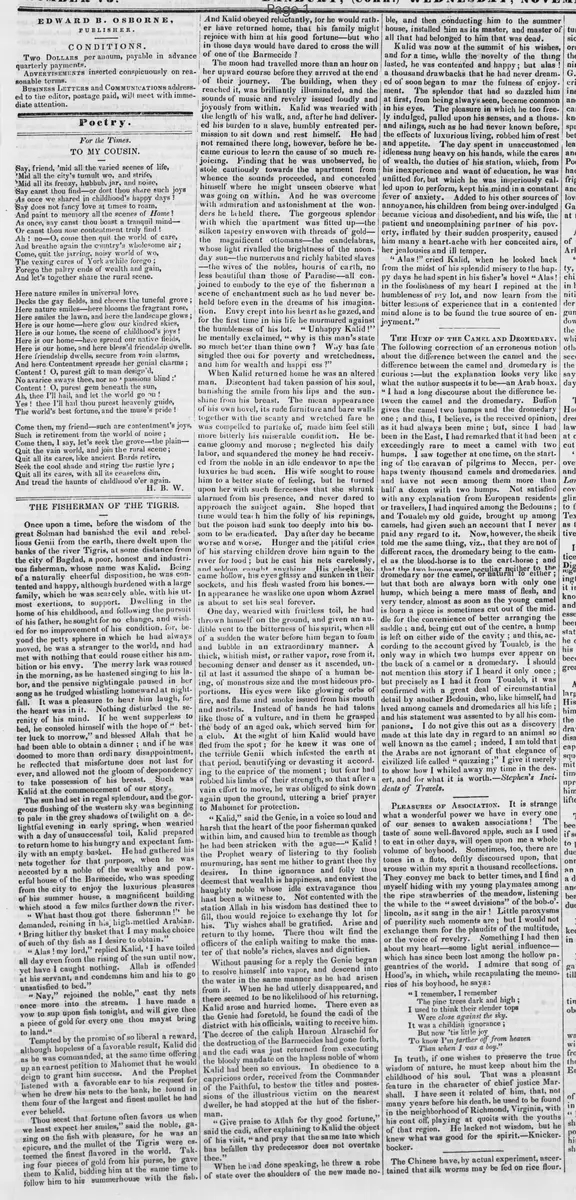
THE FISHERMAN OF THE TIGRIS.
Once upon a time, before the wisdom of the great Solman had banished the evil and rebellious Genii from the earth, there dwelt upon the banks of the river Tigris, at some distance from the city of Bagdad, a poor, honest and industrious fisherman, whose name was Kalid. Being of a naturally cheerful disposition, he was contented and happy, although burdened with a large family, which he was scarcely able with his utmost exertions, to support. Dwelling in the home of his childhood, and following the pursuit of his father, he sought for no change, and wished for no improvement of his condition. for, beyond the petty sphere in which he had always moved, he was a stranger to the world, and had met with nothing that could rouse either his ambition or his envy. The merry lark was roused in the morning, as he hastened singing to his labor, and the pensive nightingale paused in her song as he trudged whistling homeward at nightfall. It was a pleasure to hear him laugh, for the heart was in it. Nothing disturbed the serenity of his mind. If he went supperless to bed, he consoled himself with the hope of "better luck to morrow," and blessed Allah that he had been able to obtain a dinner; and if he was doomed to more than ordinary disappointment, he reflected that misfortune does not last forever, and allowed not the gloom of despondency to take possession of his breast. Such was Kalid at the commencement of our story.
The sun had set in regal splendour, and the gorgeous flushing of the western sky was beginning to pale in the grey shadows of twilight on a delightful evening in early spring, when wearied with a day of unsuccessful toil, Kalid prepared to return home to his hungry and expectant family with an empty basket. He had gathered his nets together for that purpose, when he was accosted by a noble of the wealthy and powerful house of the Barmecide, who was speeding from the city to enjoy the luxurious pleasures of his summer house, a magnificent building which stood a few miles further down the river.
"What hast thou got there fisherman!" he demanded, reining in his high-mettled Arabian. "Bring hither thy basket that I may make choice of such of thy fish as I desire to obtain."
"Alas! my lord," replied Kalid, "I have toiled all day even from the rising of the sun until now, yet have I caught nothing. Allah is offended at his servant, and condemns him and his to go unsatisfied to bed."
"Nay," rejoined the noble, "cast thy nets once more into the stream. I have made a vow to sup upon fish tonight, and will give thee a piece of gold for every one thou mayst bring to land."
Tempted by the promise of so liberal a reward, although hopeless of a favorable result, Kalid did as he was commanded, at the same time offering up an earnest petition to Mahomet that he would deign to grant him success. And the Prophet listened with a favorable ear to his request for when he drew his nets to the bank, he found in them four of the largest and finest mullet he had ever beheld.
"Thou seest that fortune often favors us when we least expect her smiles," said the noble, gazing on the fish with pleasure, for he was an epicure, and the mullet of the Tigris were esteemed the finest flavored in the world. Taking four pieces of gold from his purse, he gave them to Kalid, bidding him at the same time to follow him to his summerhouse with the fish.
And Kalid obeyed reluctantly. for he would rather have returned home, that his family might rejoice with him at his good fortune—but who in those days would have dared to cross the will of one of the Barmecide?
The moon had travelled more than an hour on her upward course before they arrived at the end of their journey. The building, when they reached it, was brilliantly illuminated, and the sounds of music and revelry issued loudly and joyously from within. Kalid was wearied with the length of his walk, and, after he had delivered his burden to a slave, humbly entreated permission to sit down and rest himself. He had not remained there long, however, before he became curious to learn the cause of so much rejoicing. Finding that he was unobserved, he stole cautiously towards the apartment from whence the sounds proceeded, and concealed himself where he might unseen observe what was going on within. And he was overcome with admiration and astonishment at the wonders he beheld there. The gorgeous splendor with which the apartment was fitted up—the silken tapestry enwoven with threads of gold—the magnificent ottomans—the candelabras, whose light rivalled the brightness of the noonday sun—the numerous and richly habited slaves—the wives of the nobles, houris of earth, no less beautiful than those of Paradise—all conjoined to embody to the eye of the fisherman a scene of enchantment such as he had never beheld before even in the dreams of his imagination. Envy crept into his heart as he gazed, and for the first time in his life he murmured against the humbleness of his lot. "Unhappy Kalid!" he mentally exclaimed, "why is this man's state so much better than thine own? Why has fate singled thee out for poverty and wretchedness, and him for wealth and happiness?"
When Kalid returned home he was an altered man. Discontent had taken possession of his soul, banishing the smile from his lips and the sunshine from his breast. The mean appearance of his own hovel, its rude furniture and bare walls together with the scanty and wretched fare he was compelled to partake of, made him feel still more bitterly his miserable condition. He became gloomy and morose; neglected his daily labor, and squandered the money he had received from the noble in an idle endeavor to ape the luxuries he had seen. His wife sought to rouse him to a better state of feeling, but he turned upon her with such fierceness that she shrunk alarmed from his presence, and never dared to approach the subject again. She hoped that time would teach him the folly of his repinings. but the poison had sunk too deeply into his bosom to be eradicated. Day after day he became worse and worse. Hunger and the pitiful cries of his starving children drove him again to the river for food; but he cast his nets carelessly, and seldom caught anything His cheeks became hollow, his eyes glassy and sunken in their sockets, and his flesh wasted from his bones. In appearance he was like one upon whom Azrael is about to set his seal forever.
One day, wearied with fruitless toil, he had thrown himself on the ground, and given an audible vent to the bitterness of his spirit, when all of a sudden the water before him began to foam and bubble in an extraordinary manner. A thick, whitish mist, or rather vapor, rose from it, becoming denser and denser as it ascended, until at last it assumed the shape of a human being, of monstrous size and the most hideous proportions. His eyes were like glowing orbs of fire, and flame and smoke issued from his mouth and nostrils. Instead of hands he had talons like those of a vulture, and in them he grasped the body of an aged oak, which served him for a club. At the sight of him Kalid would have fled from the spot; for he knew it was one of the terrible Genii which infested the earth at that period, beautifying or devastating it according to the caprice of the moment; but fear had robbed his limbs of their strength, so that after a vain effort to move, he was obliged to sink down again upon the ground, uttering a brief prayer to Mahomet for protection.
"Kalid," said the Genie, in a voice so loud and harsh that the heart of the poor fisherman quaked within him, and caused him to tremble as though he had been stricken with the ague—"Kalid! the Prophet weary of listening to thy foolish murmuring, has sent me hither to grant thee thy desires. In thine ignorance and folly thou deemest that wealth is happiness, and enviest the haughty noble whose idle extravagance thou hast been a witness to. Not contented with the station Allah in his wisdom has destined thee to fill, thou would rejoice to exchange thy lot for his. Thy wishes shall be gratified. Arise and return to thy home. There thou wilt find the officers of the caliph waiting to make the master of that noble's riches, slaves and dignities."
Without pausing for a reply the Genie began to resolve himself into vapor, and descend into the water in the same manner as he had arisen from it. When he had utterly disappeared, and there seemed to be no likelihood of his returning, Kalid arose and hurried home. There even as the Genie had foretold, he found the cadi of the district with his officials, waiting to receive him. The decree of the caliph Haroun Alraschid for the destruction of the Barmecides had gone forth, and the cadi was just returned from executing the bloody mandate on the hapless noble of whom Kalid had been so envious. In obedience to a capricious order, received from the Commander of the Faithful, to bestow the titles and possessions of the illustrious victim on the nearest dweller, he had stopped at the hut of the fisherman.
"Give praise to Allah for thy good fortune." said the cadi, after explaining to Kalid the object of his visit, "and pray that the same fate which has befallen thy predecessor does not overtake thee."
When he had done speaking, he threw a robe of state over the shoulders of the new made noble, and then conducting him to the summer house, installed him as its master, and master of all that had belonged to him that was dead.
Kalid was now at the summit of his wishes, and for a time, while the novelty of the thing lasted, he was contented and happy; but alas! a thousand drawbacks that he had never dreamed of soon began to mar the fulness of enjoyment. The splendor that had so dazzled him at first, from being always seen, became common in his eyes. The pleasure in which he too freely indulged, palled upon his senses, and a thousand ailings, such as he had never known before, the effects of luxurious living, robbed him of rest and appetite. The day spent in unaccustomed idleness hung heavy on his hands, while the cares of wealth, the duties of his station, which, from his inexperience and want of education, he was unfitted for, but which he was imperiously called upon to perform, kept his mind in a constant fever of anxiety. Added to his other sources of annoyance, his children from being over-indulged became vicious and disobedient, and his wife, the patient and uncomplaining partner of his poverty, inflated by their sudden prosperity, caused him many a heart-ache with her conceited airs, her jealousies and ill temper.
Alas! cried Kalid, when he looked back from the midst of his splendid misery to the happy days he had spent in his fisher's hovel Alas! in the foolishness of my heart I repined at the humbleness of my lot, and now learn from the bitter lessons of experience that in a contented mind alone is to be found the true source of enjoyment.
Once upon a time, before the wisdom of the great Solman had banished the evil and rebellious Genii from the earth, there dwelt upon the banks of the river Tigris, at some distance from the city of Bagdad, a poor, honest and industrious fisherman, whose name was Kalid. Being of a naturally cheerful disposition, he was contented and happy, although burdened with a large family, which he was scarcely able with his utmost exertions, to support. Dwelling in the home of his childhood, and following the pursuit of his father, he sought for no change, and wished for no improvement of his condition. for, beyond the petty sphere in which he had always moved, he was a stranger to the world, and had met with nothing that could rouse either his ambition or his envy. The merry lark was roused in the morning, as he hastened singing to his labor, and the pensive nightingale paused in her song as he trudged whistling homeward at nightfall. It was a pleasure to hear him laugh, for the heart was in it. Nothing disturbed the serenity of his mind. If he went supperless to bed, he consoled himself with the hope of "better luck to morrow," and blessed Allah that he had been able to obtain a dinner; and if he was doomed to more than ordinary disappointment, he reflected that misfortune does not last forever, and allowed not the gloom of despondency to take possession of his breast. Such was Kalid at the commencement of our story.
The sun had set in regal splendour, and the gorgeous flushing of the western sky was beginning to pale in the grey shadows of twilight on a delightful evening in early spring, when wearied with a day of unsuccessful toil, Kalid prepared to return home to his hungry and expectant family with an empty basket. He had gathered his nets together for that purpose, when he was accosted by a noble of the wealthy and powerful house of the Barmecide, who was speeding from the city to enjoy the luxurious pleasures of his summer house, a magnificent building which stood a few miles further down the river.
"What hast thou got there fisherman!" he demanded, reining in his high-mettled Arabian. "Bring hither thy basket that I may make choice of such of thy fish as I desire to obtain."
"Alas! my lord," replied Kalid, "I have toiled all day even from the rising of the sun until now, yet have I caught nothing. Allah is offended at his servant, and condemns him and his to go unsatisfied to bed."
"Nay," rejoined the noble, "cast thy nets once more into the stream. I have made a vow to sup upon fish tonight, and will give thee a piece of gold for every one thou mayst bring to land."
Tempted by the promise of so liberal a reward, although hopeless of a favorable result, Kalid did as he was commanded, at the same time offering up an earnest petition to Mahomet that he would deign to grant him success. And the Prophet listened with a favorable ear to his request for when he drew his nets to the bank, he found in them four of the largest and finest mullet he had ever beheld.
"Thou seest that fortune often favors us when we least expect her smiles," said the noble, gazing on the fish with pleasure, for he was an epicure, and the mullet of the Tigris were esteemed the finest flavored in the world. Taking four pieces of gold from his purse, he gave them to Kalid, bidding him at the same time to follow him to his summerhouse with the fish.
And Kalid obeyed reluctantly. for he would rather have returned home, that his family might rejoice with him at his good fortune—but who in those days would have dared to cross the will of one of the Barmecide?
The moon had travelled more than an hour on her upward course before they arrived at the end of their journey. The building, when they reached it, was brilliantly illuminated, and the sounds of music and revelry issued loudly and joyously from within. Kalid was wearied with the length of his walk, and, after he had delivered his burden to a slave, humbly entreated permission to sit down and rest himself. He had not remained there long, however, before he became curious to learn the cause of so much rejoicing. Finding that he was unobserved, he stole cautiously towards the apartment from whence the sounds proceeded, and concealed himself where he might unseen observe what was going on within. And he was overcome with admiration and astonishment at the wonders he beheld there. The gorgeous splendor with which the apartment was fitted up—the silken tapestry enwoven with threads of gold—the magnificent ottomans—the candelabras, whose light rivalled the brightness of the noonday sun—the numerous and richly habited slaves—the wives of the nobles, houris of earth, no less beautiful than those of Paradise—all conjoined to embody to the eye of the fisherman a scene of enchantment such as he had never beheld before even in the dreams of his imagination. Envy crept into his heart as he gazed, and for the first time in his life he murmured against the humbleness of his lot. "Unhappy Kalid!" he mentally exclaimed, "why is this man's state so much better than thine own? Why has fate singled thee out for poverty and wretchedness, and him for wealth and happiness?"
When Kalid returned home he was an altered man. Discontent had taken possession of his soul, banishing the smile from his lips and the sunshine from his breast. The mean appearance of his own hovel, its rude furniture and bare walls together with the scanty and wretched fare he was compelled to partake of, made him feel still more bitterly his miserable condition. He became gloomy and morose; neglected his daily labor, and squandered the money he had received from the noble in an idle endeavor to ape the luxuries he had seen. His wife sought to rouse him to a better state of feeling, but he turned upon her with such fierceness that she shrunk alarmed from his presence, and never dared to approach the subject again. She hoped that time would teach him the folly of his repinings. but the poison had sunk too deeply into his bosom to be eradicated. Day after day he became worse and worse. Hunger and the pitiful cries of his starving children drove him again to the river for food; but he cast his nets carelessly, and seldom caught anything His cheeks became hollow, his eyes glassy and sunken in their sockets, and his flesh wasted from his bones. In appearance he was like one upon whom Azrael is about to set his seal forever.
One day, wearied with fruitless toil, he had thrown himself on the ground, and given an audible vent to the bitterness of his spirit, when all of a sudden the water before him began to foam and bubble in an extraordinary manner. A thick, whitish mist, or rather vapor, rose from it, becoming denser and denser as it ascended, until at last it assumed the shape of a human being, of monstrous size and the most hideous proportions. His eyes were like glowing orbs of fire, and flame and smoke issued from his mouth and nostrils. Instead of hands he had talons like those of a vulture, and in them he grasped the body of an aged oak, which served him for a club. At the sight of him Kalid would have fled from the spot; for he knew it was one of the terrible Genii which infested the earth at that period, beautifying or devastating it according to the caprice of the moment; but fear had robbed his limbs of their strength, so that after a vain effort to move, he was obliged to sink down again upon the ground, uttering a brief prayer to Mahomet for protection.
"Kalid," said the Genie, in a voice so loud and harsh that the heart of the poor fisherman quaked within him, and caused him to tremble as though he had been stricken with the ague—"Kalid! the Prophet weary of listening to thy foolish murmuring, has sent me hither to grant thee thy desires. In thine ignorance and folly thou deemest that wealth is happiness, and enviest the haughty noble whose idle extravagance thou hast been a witness to. Not contented with the station Allah in his wisdom has destined thee to fill, thou would rejoice to exchange thy lot for his. Thy wishes shall be gratified. Arise and return to thy home. There thou wilt find the officers of the caliph waiting to make the master of that noble's riches, slaves and dignities."
Without pausing for a reply the Genie began to resolve himself into vapor, and descend into the water in the same manner as he had arisen from it. When he had utterly disappeared, and there seemed to be no likelihood of his returning, Kalid arose and hurried home. There even as the Genie had foretold, he found the cadi of the district with his officials, waiting to receive him. The decree of the caliph Haroun Alraschid for the destruction of the Barmecides had gone forth, and the cadi was just returned from executing the bloody mandate on the hapless noble of whom Kalid had been so envious. In obedience to a capricious order, received from the Commander of the Faithful, to bestow the titles and possessions of the illustrious victim on the nearest dweller, he had stopped at the hut of the fisherman.
"Give praise to Allah for thy good fortune." said the cadi, after explaining to Kalid the object of his visit, "and pray that the same fate which has befallen thy predecessor does not overtake thee."
When he had done speaking, he threw a robe of state over the shoulders of the new made noble, and then conducting him to the summer house, installed him as its master, and master of all that had belonged to him that was dead.
Kalid was now at the summit of his wishes, and for a time, while the novelty of the thing lasted, he was contented and happy; but alas! a thousand drawbacks that he had never dreamed of soon began to mar the fulness of enjoyment. The splendor that had so dazzled him at first, from being always seen, became common in his eyes. The pleasure in which he too freely indulged, palled upon his senses, and a thousand ailings, such as he had never known before, the effects of luxurious living, robbed him of rest and appetite. The day spent in unaccustomed idleness hung heavy on his hands, while the cares of wealth, the duties of his station, which, from his inexperience and want of education, he was unfitted for, but which he was imperiously called upon to perform, kept his mind in a constant fever of anxiety. Added to his other sources of annoyance, his children from being over-indulged became vicious and disobedient, and his wife, the patient and uncomplaining partner of his poverty, inflated by their sudden prosperity, caused him many a heart-ache with her conceited airs, her jealousies and ill temper.
Alas! cried Kalid, when he looked back from the midst of his splendid misery to the happy days he had spent in his fisher's hovel Alas! in the foolishness of my heart I repined at the humbleness of my lot, and now learn from the bitter lessons of experience that in a contented mind alone is to be found the true source of enjoyment.
What sub-type of article is it?
Prose Fiction
Fable
What themes does it cover?
Moral Virtue
Social Manners
What keywords are associated?
Fisherman
Tigris
Kalid
Genie
Barmecide
Envy
Contentment
Moral Tale
Haroun Alraschid
Literary Details
Title
The Fisherman Of The Tigris.
Key Lines
"Unhappy Kalid!" He Mentally Exclaimed, "Why Is This Man's State So Much Better Than Thine Own? Why Has Fate Singled Thee Out For Poverty And Wretchedness, And Him For Wealth And Happiness?"
"Kalid! The Prophet Weary Of Listening To Thy Foolish Murmuring, Has Sent Me Hither To Grant Thee Thy Desires. In Thine Ignorance And Folly Thou Deemest That Wealth Is Happiness, And Enviest The Haughty Noble Whose Idle Extravagance Thou Hast Been A Witness To."
"Give Praise To Allah For Thy Good Fortune." Said The Cadi, After Explaining To Kalid The Object Of His Visit, "And Pray That The Same Fate Which Has Befallen Thy Predecessor Does Not Overtake Thee."
Alas! Cried Kalid, When He Looked Back From The Midst Of His Splendid Misery To The Happy Days He Had Spent In His Fisher's Hovel Alas! In The Foolishness Of My Heart I Repined At The Humbleness Of My Lot, And Now Learn From The Bitter Lessons Of Experience That In A Contented Mind Alone Is To Be Found The True Source Of Enjoyment.