Thank you for visiting SNEWPapers!
Sign up free
Virginia Argus
Richmond, Virginia
What is this article about?
On February 18, the U.S. House of Representatives debated a resolution by Mr. Broom to strengthen habeas corpus protections, amid concerns over General Wilkinson's arrests in New Orleans. Speakers like Mr. Bidwell and Mr. Early argued against referral to committee, citing timing and potential bias against the general.
Merged-components note: Sequential components continuing the report on Congress House of Representatives debate.
Clipping
OCR Quality
Full Text
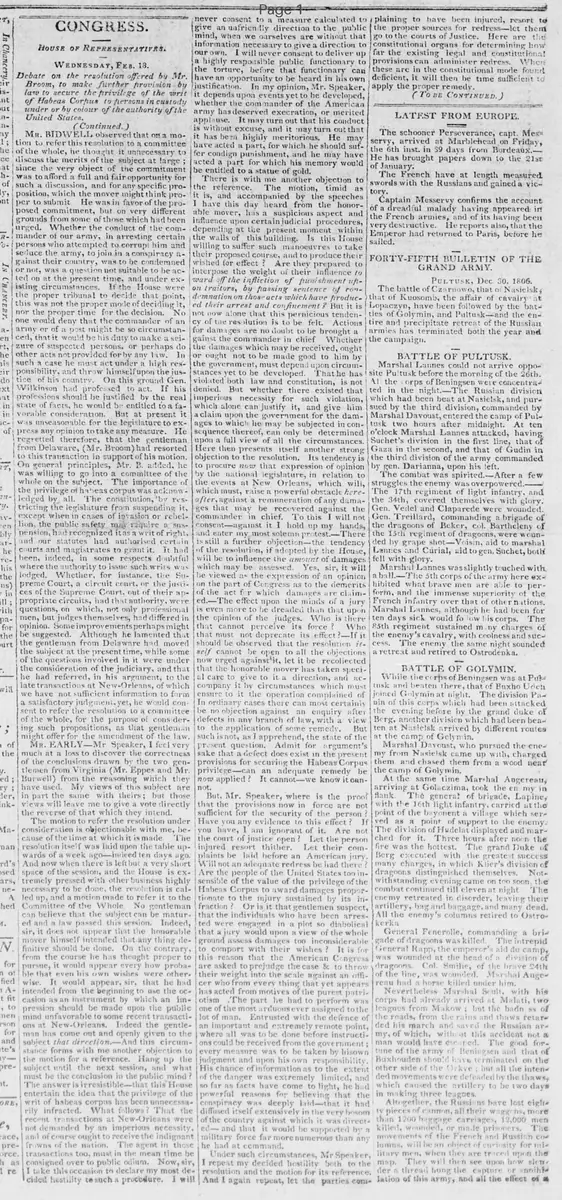
HOUSE OF REPRESENTATIVES.
WEDNESDAY, FEB. 18.
Debate on the resolution offered by Mr. Broom, to make further provision by law to secure the privilege of the writ of Habeas Corpus to persons in custody under or by colour of the authority of the United States.
(Continued.)
MR. BIDWELL observed that on a motion to refer this resolution to a committee of the whole, he thought it unnecessary to discuss the merits of the subject at large; since the very object of the commitment was to afford a full and fair opportunity for such a discussion, and for any specific proposition, which the mover might think proper to submit. He was in favor of the proposed commitment, but on very different grounds from some of those which had been urged. Whether the conduct of the commander of our army, in arresting certain persons who attempted to corrupt him and seduce the army, to join in a conspiracy against their country, was to be condemned or not, was a question not suitable to be acted on at the present time, and under existing circumstances. If the House were the proper tribunal to decide that point, this was not the proper mode of deciding it, nor the proper time for the decision. No one would deny that the commander of an army or of a post might be so circumstanced, that it would be his duty to make a seizure of suspected persons, or perhaps do other acts not provided for by any law. In such a case he must act under a high responsibility, and throw himself upon the justice of his country. On this ground Gen. Wilkinson had professed to act. If his professions should be justified by the real state of facts, he would be entitled to a favorable consideration. But at present it was unseasonable for the legislature to express any opinion to take any measure. He regretted therefore, that the gentleman from Delaware, (Mr. Broom) had resorted to this transaction in support of his motion.
On general principles, Mr. B. added, he was willing to go into a committee of the whole on the subject. The importance of the privilege of habeas corpus was acknowledged by all. The constitution, by restricting the legislature from suspending it, except when in cases of invasion or rebellion, the public safety may require a suspension, had recognized it as a writ of right, and our statutes had authorised certain courts and magistrates to grant it. It had been, indeed, in some respects doubtful where the authority to issue such writs was lodged. Whether, for instance, the Supreme Court, a circuit court, or the justices of the Supreme Court, out of their appropriate circuits, had that authority, were questions, on which, not only professional men, but judges themselves, had differed in opinion. Some improvements perhaps might be suggested. Although he lamented that the gentleman from Delaware had moved the subject at the present time, while some of the questions involved in it were under the consideration of the judiciary, and that he had referred, in his argument, to the late transactions at New-Orleans, of which we have not sufficient information to form a satisfactory judgment, yet, he would consent to refer the resolution to a committee of the whole, for the purpose of considering such propositions, as that gentleman might offer for the amendment of the law,
MR. EARLY—Mr. Speaker, I feel very much at a loss to discover the correctness of the conclusions drawn by the two gentlemen from Virginia (Mr. Eppes and Mr. Burwell) from the reasoning which they have used. My views of this subject are in part the same with theirs; but those views will leave me to give a vote directly the reverse of that which they intend.
The motion to refer the resolution under consideration is objectionable with me, because of the time at which it is made. The resolution itself was laid upon the table upwards of a week ago—indeed ten days ago. And now when there is left but a very short space of the session, and the House is extremely pressed with other business highly necessary to be done, the resolution is called up, and a motion made to refer it to the Committee of the Whole. No gentleman can believe that the subject can be matured and a law passed this session. Indeed, sir, it does not appear that the honorable mover himself intended that any thing definitive should be done. On the contrary, from the course he has thought proper to pursue, it would appear every how probable that even his own wishes were otherwise. It would appear, sir, that he had intended from the beginning to use the occasion as an instrument by which an impression should be made upon the public mind unfavorable to some recent transactions at New-Orleans. Indeed the gentleman has come out and openly given to the subject that direction.—And this circumstance forms with me another objection to the motion for a reference. Hang up the subject until the next session, and what must be the conclusion in the public mind? The answer is irresistible—that this House entertain the idea that the privilege of the writ of habeas corpus has been unnecessarily infracted. What follows? That the recent transactions at New-Orleans were not demanded by an imperious necessity, and of course ought to receive the indignant frowns of the nation. The agent in those transactions too, must in the mean time be consigned over to public odium. Now, sir, I take this occasion to declare my most decided hostility to such a procedure. I will never consent to a measure calculated to give an unfriendly direction to the public mind, when we ourselves are without that information necessary to give a direction to our own. I will never consent to deliver up a highly responsible public functionary to the torture, before that functionary can have an opportunity to be heard in his own justification. In my opinion, Mr. Speaker, it depends upon events yet to be developed, whether the commander of the American army has deserved execration, or merited applause. It may turn out that his conduct is without excuse, and it may turn out that it has been highly meritorious. He may have acted a part, for which he should suffer condign punishment, and he may have acted a part for which his memory would be entitled to a statue of gold.
There is with me another objection to the reference. The motion, timid as it is, and accompanied by the speeches I have this day heard from the honorable mover, has a suspicious aspect and influence upon certain judicial procedures, depending at the present moment within the walls of this building. Is this House willing to suffer such manoeuvres to take their proposed course, and to produce their wished for effect? Are they prepared to interpose the weight of their influence toward off the infliction of punishment upon traitors, by passing sentence of condemnation on those acts which have produced their arrest and confinement? But it is not now alone that this pernicious tendency of the resolution is to be felt. Actions for damages are no doubt to be brought against the commander in chief. Whether the damages which may be received, ought or ought not to be made good to him by the government, must depend upon circumstances yet to be developed. That he has violated both law and constitution, is not denied. But whether there existed that imperious necessity for such violation, which alone can justify it, and give him a claim upon the government for the damages to which he may be subjected in consequence thereof, can only be determined upon a full view of all the circumstances.
Here then presents itself another strong objection to the resolution. Its tendency is to procure not that expression of opinion by the national legislature, in relation to the events at New Orleans, which will, which must, raise a powerful obstacle hereafter, against a remuneration of any damages that may be recovered against the commander in chief. To this I will not consent—against it I hold up my hands, and enter my most solemn protest.—There is still a further objection—the tendency of the resolution, if adopted by the House, will be to influence the amount of damages which may be assessed. Yes, sir, it will be viewed as the expression of an opinion on the part of Congress as to the demerits of the act for which damages are claimed.—The effect upon the minds of a jury is even more to be dreaded than that upon the opinion of the judges. Who is there that cannot perceive its force? Who that must not deprecate its effect?—If it should be observed that the resolution itself cannot be open to all the objections now urged against it, let it be recollected that the honorable mover has taken special care to give to it a direction, and accompany it by circumstances which must ensure to it the operation complained of. In ordinary cases there can most certainly be no objection against an enquiry after defects in any branch of law, with a view to the application of some remedy. But such is not, as I apprehend, the state of the present question. Admit for argument's sake that a defect does exist in the present provisions for securing the Habeas Corpus privilege—can an adequate remedy be now applied? It cannot—we know it cannot.
But, Mr. Speaker, where is the proof that the provisions now in force are not sufficient for the security of the person? Have you any evidence to this effect? If you have, I am ignorant of it. Are not the courts of justice open? Let the person injured resort thither. Let their complaints be laid before an American jury. Will not an adequate redress be had there? Are the people of the United States too insensible of the value of the privilege of the Habeas Corpus to award damages proportionate to the injury sustained by its infraction? Or is it that gentlemen suspect, that the individuals who have been arrested were engaged in a plot so diabolical that a jury would upon a view of the whole ground assess damages too inconsiderable to comport with their wishes? It is for this reason that the American Congress are asked to prejudge the case & to throw their weight into the scale against an officer who from every thing that yet appears has acted from motives of the purest patriotism. The part he had to perform was one of the most arduous ever assigned to the lot of man. Entrusted with the defence of an important and extremely remote point, where all was to be done before instructions could be received from the government; every measure was to be taken by his own judgment and upon his own responsibility. His chance of information as to the extent of the danger was extremely limited, and so far as facts have come to light, he had powerful reasons for believing that the conspiracy was deeply laid—that it had diffused itself extensively in the very bosom of the country against which it was directed— and that it would be supported by a military force far more numerous than any he had at command.
Under such circumstances, Mr. Speaker, I repeat my decided hostility both to the resolution and the motion for its reference. And I again repeat, let the parties complaining to have been injured, resort to the proper sources for redress—let them go to the courts of Justice. Here are the constitutional organs for determining how far the existing legal and constitutional provisions can administer redress. When these are in the constitutional mode found deficient, it will then be time sufficient to apply the proper remedy.
(TO BE CONTINUED.)
What sub-type of article is it?
What keywords are associated?
What entities or persons were involved?
Where did it happen?
Domestic News Details
Primary Location
Washington, D.C.
Event Date
Wednesday, February 18
Key Persons
Outcome
debate ongoing; resolution consideration continued without immediate decision or referral to committee.
Event Details
House debate on Mr. Broom's resolution to enhance habeas corpus protections, linked to General Wilkinson's arrests of suspected conspirators in New Orleans. Mr. Bidwell supported referral on general principles despite timing concerns. Mr. Early opposed, arguing it would unfairly prejudice public opinion against Wilkinson and influence judicial proceedings and potential damages claims.