Thank you for visiting SNEWPapers!
Sign up free
Atlanta Daily World
Atlanta, Fulton County, Georgia
What is this article about?
The Veterans Administration launches a $10M expanded medical research program starting July 1, 1956, targeting major diseases like mental health, heart conditions, cancer, aging, TB, and more, with cooperative drug studies and radioisotope labs, in collaboration with medical schools.
Clipping
OCR Quality
Full Text
Plans
Research
Program
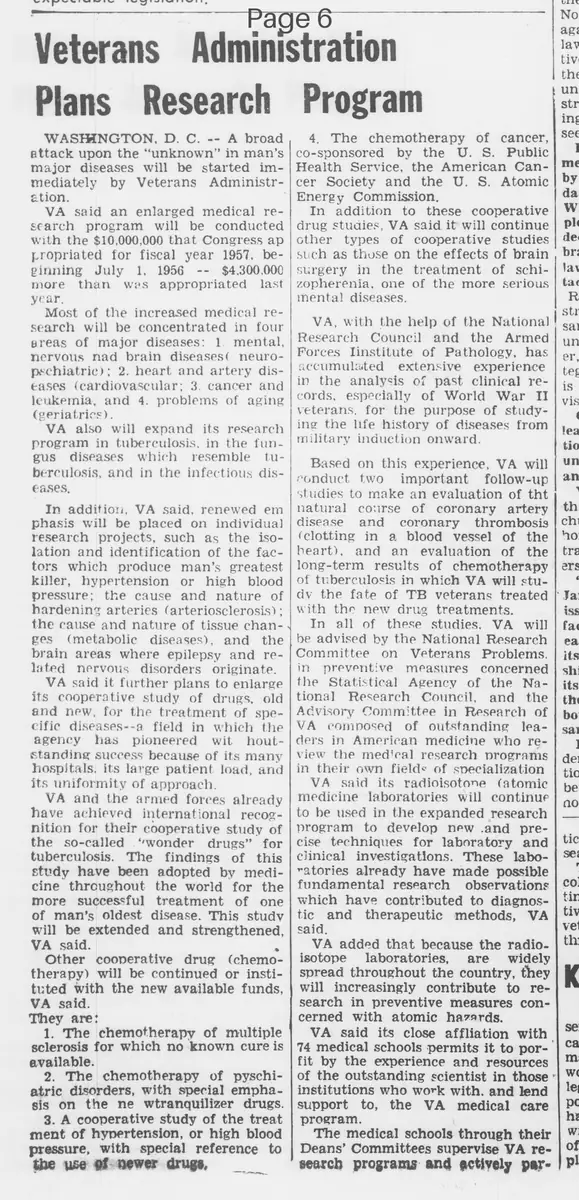
WASHINGTON. D. C. -- A broad
attack upon the "unknown" in man's
major diseases will be started immediately
by Veterans Administration,
the American Medical Association,
and the U. S. Atomic
Energy Commission.
VA said an enlarged medical research
program will be conducted
with the $10,000,000 that Congress appropriated for fiscal year 1957,
beginning July 1, 1956 -- $4,300,000
more than was appropriated last
year.
Most of the increased medical research will be concentrated in four
areas of major diseases: 1 mental,
nervous and brain diseases (neuropsychiatric); 2. heart and artery diseases (cardiovascular); 3 cancer and
leukemia, and 4. problems of aging
(geriatrics).
VA also will expand its research
program in tuberculosis, in the fungus
diseases which resemble tuberculosis, and in the infectious diseases.
In addition, VA said, renewed emphasis will be placed on individual
research projects, such as the isolation and identification of the factors which produce man's greatest
killer, hypertension or high blood
pressure; the cause and nature of
hardening arteries (arteriosclerosis);
the cause and nature of tissue changes (metabolic diseases), and the
brain areas where epilepsy and related nervous disorders originate.
VA said it further plans to enlarge
its cooperative study of drugs, old
and new, for the treatment of specific diseases--a field in which the
agency has pioneered with outstanding success because of its many
hospitals, its large patient load, and
its uniformity of approach.
VA and the armed forces already
have achieved international recognition for their cooperative study of
the so-called 'wonder drugs'
for
tuberculosis. The findings of this
study have been adopted by medicine throughout the world for the
more successful treatment of one
of man's oldest disease. This study
will be extended and strengthened.
VA said.
Other cooperative drug (chemotherapy) will be continued or instituted with the new available funds
VA said.
They are
1. The chemotherapy of multiple
sclerosis for which no known cure is
available.
2. The chemotherapy of psychiatric
disorders, with special emphasis
on the new tranquilizer drugs.
3. A cooperative study of the treatment of hypertension, or high blood
pressure, with special reference to
the use of newer drugs.
VA said its radioisotope (atomic
medicine) laboratories will continue
to be used in the expanded research
program to develop new and precise techniques for laboratory and
clinical investigations. These laboratories already have made possible
fundamental research observations
which have contributed to diagnostic and therapeutic methods, VA
said.
VA added that because the radioisotope
laboratories are widely
spread throughout the country, they
will increasingly contribute to research in preventive measures concerned with atomic hazards.
VA said its close affiliation with
74 medical schools permits it to profit by the experience and resources
of the outstanding scientists in those
institutions who work with and lend
support to the VA medical care
program.
The medical schools through their
Deans' Committees supervise VA research programs and actively par-
What sub-type of article is it?
What themes does it cover?
What keywords are associated?
Where did it happen?
Story Details
Location
Washington. D. C.
Event Date
Beginning July 1, 1956
Story Details
The Veterans Administration announces an expanded medical research program with $10,000,000 funding for fiscal year 1957, focusing on neuropsychiatric diseases, cardiovascular diseases, cancer and leukemia, geriatrics, tuberculosis, fungus diseases, infectious diseases, and individual projects like hypertension and arteriosclerosis. It includes cooperative drug studies for multiple sclerosis, psychiatric disorders, and hypertension, plus radioisotope research and affiliations with medical schools.