Thank you for visiting SNEWPapers!
Sign up free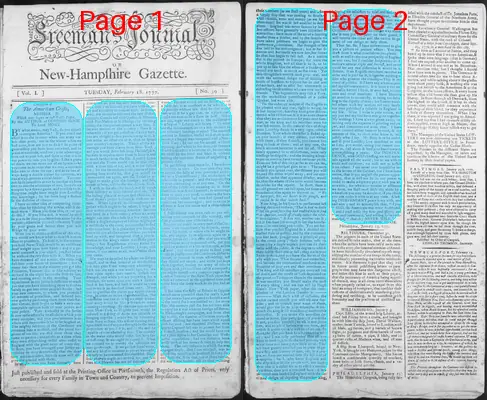
The Freeman's Journal, Or, New Hampshire Gazette
Portsmouth, Rockingham County, New Hampshire
What is this article about?
Conclusion of Thomas Paine's 'The American Crisis, Number II,' addressed to Lord Howe. It mocks British military failures in America, argues conquest is impossible due to geography and resolve, criticizes Tory support, and exhorts Americans to endure for liberty and union against British tyranny.
Merged-components note: These components form the continuation of Thomas Paine's 'The American Crisis, Number II' across pages 1 and 2, with sequential reading order and direct text flow.
Clippings
1 of 2
OCR Quality
Full Text
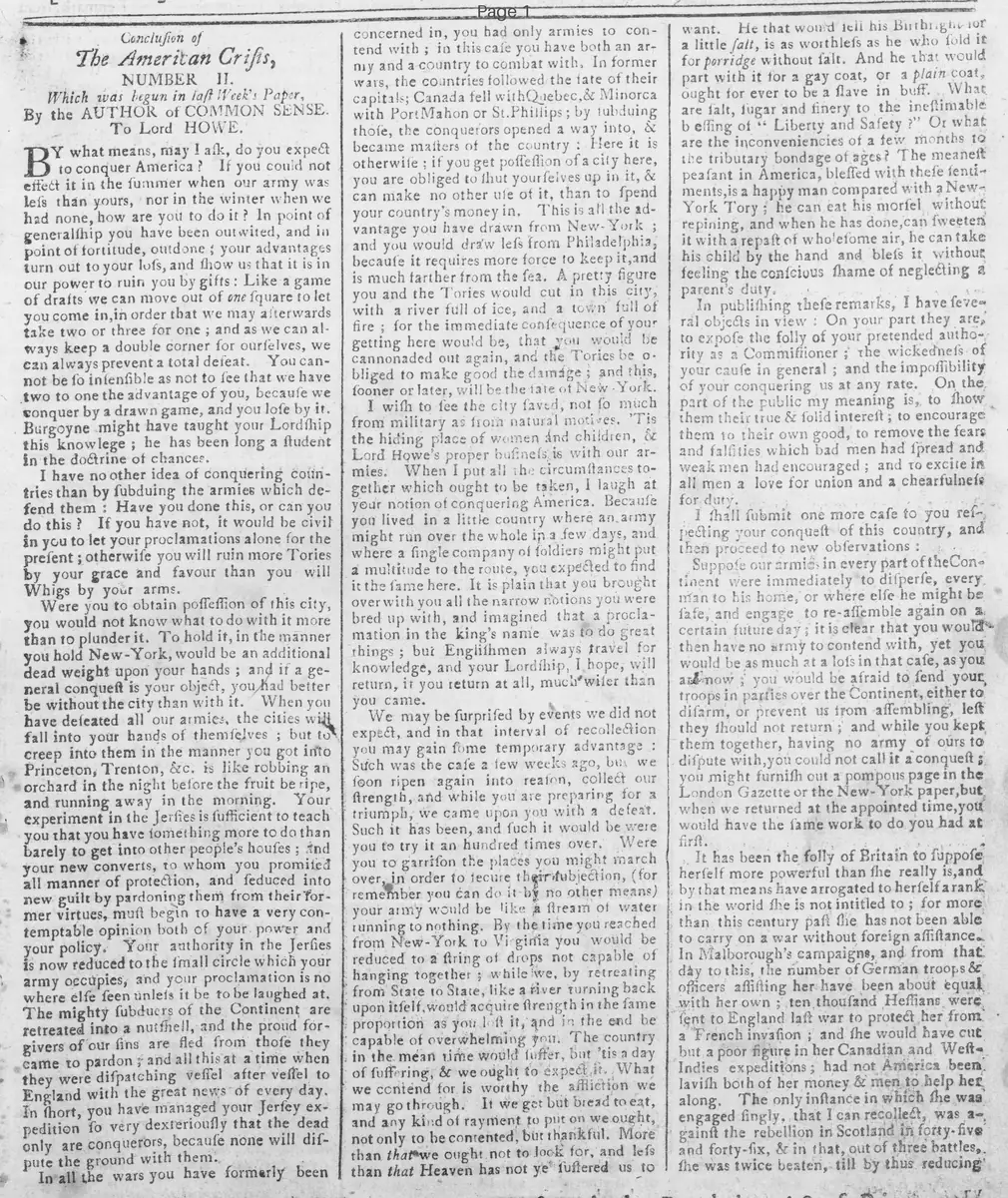
By whatever means you effect it in the summer when our army was less than yours, nor in the winter when we had none, how are you to do it? In point of generalship you have been outwitted, and in point of fortitude, outdone; your advantages turn out to your loss, and show us that it is in our power to ruin you by gifts: Like a game of drafts we can move out of one square to let you come in, in order that we may afterwards take two or three for one; and as we can always keep a double corner for ourselves, we can always prevent a total defeat. You cannot be so insensible as not to see that we have two to one the advantage of you, because we conquer by a drawn game, and you lose by it. Burgoyne might have taught your Lordship this knowledge; he has been long a student in the doctrine of chances.
I have no other idea of conquering countries than by subduing the armies which defend them: Have you done this, or can you do this? If you have not, it would be civil in you to let your proclamations alone for the present; otherwise you will ruin more Tories by your grace and favour than you will Whigs by your arms.
Were you to obtain possession of this city, you would not know what to do with it more than to plunder it. To hold it, in the manner you hold New-York, would be an additional dead weight upon your hands; and if a general conquest is your object, you had better be without the city than with it. When you have defeated all our armies, the cities will fall into your hands of themselves; but to creep into them in the manner you got into Princeton, Trenton, &c. is like robbing an orchard in the night before the fruit be ripe, and running away in the morning. Your experiment in the Jerseys is sufficient to teach you that you have something more to do than barely to get into other people's houses; and your new converts, to whom you promised all manner of protection, and seduced into new guilt by pardoning them from their former virtues, must begin to have a very contemptible opinion both of your power and your policy. Your authority in the Jerseys is now reduced to the small circle which your army occupies, and your proclamation is nowhere else seen unless it be to be laughed at. The mighty subduers of the Continent are retreated into a nutshell, and the proud forgivers of our sins are fled from those they came to pardon; and all this at a time when they were dispatching vessel after vessel to England with the great news of every day. In short, you have managed your Jersey expedition so very dexterously that the dead only are conquerors, because none will dispute the ground with them.
In all the wars you have hitherto been concerned in, you had only armies to contend with; in this case you have both an army and a country to combat with. In former wars, the countries followed the fate of their capitals; Canada fell with Quebec, & Minorca with Port Mahon or St. Phillips; by subduing those, the conquerors opened a way into, & became masters of the country: Here it is otherwise; if you get possession of a city here, you are obliged to shut yourselves up in it, & can make no other use of it, than to spend your country's money in. This is all the advantage you have drawn from New-York: and you would draw less from Philadelphia, because it requires more force to keep it, and is much farther from the sea. A pretty figure you and the Tories would cut in this city, with a river full of ice, and a town full of fire; for the immediate consequence of your getting here would be, that you would be cannonaded out again, and the Tories be obliged to make good the damage; and this, sooner or later, will be the fate of New-York. I wish to see the city saved, not so much from military as from natural motives. 'Tis the hiding place of women and children, & Lord Howe's proper business is with our armies. When I put all the circumstances together which ought to be taken, I laugh at your notion of conquering America. Because you lived in a little country where an army might run over the whole in a few days, and where a single company of soldiers might put a multitude to the rout, you expected to find it the same here. It is plain that you brought over with you all the narrow notions you were bred up with, and imagined that a proclamation in the king's name was to do great things; but Englishmen always travel for knowledge, and your Lordship, I hope, will return, if you return at all, much wiser than you came.
We may be surprised by events we did not expect, and in that interval of recollection you may gain some temporary advantage: Such was the case a few weeks ago, but we soon ripen again into reason, collect our strength, and while you are preparing for a triumph, we come upon you with a defeat. Such it has been, and such it would be were you to try it an hundred times over. Were you to garrison the places you might march over, in order to secure their subjection, (for remember you can do it by no other means) your army would be like a stream of water running to nothing. By the time you reached from New-York to Virginia you would be reduced to a string of drops not capable of hanging together; whilst we, by retreating from State to State, like a river turning back upon itself, would acquire strength in the same proportion as you lost it, and in the end be capable of overwhelming you. The country in the mean time would suffer, but 'tis a day of suffering, & we ought to expect it. What we contend for is worthy the affliction we may go through. If we get but bread to eat, and any kind of raiment to put on, we ought, not only to be contented, but thankful. More than that we ought not to look for, and less than that Heaven has not yet suffered us
want. He that would sell his birthright for a little salt, is as worthless as he who sold it for porridge without salt. And he that would part with it for a gay coat, or a plain coat, ought for ever to be a slave in buff. What are salt, sugar and finery to the inestimable blessing of Liberty and Safety? Or what are the inconveniencies of a few months to the tributary bondage of ages? The meanest peasant in America, blessed with these sentiments, is a happy man compared with a New-York Tory: he can eat his morsel without repining, and when he has done, can sweeten it with a repast of wholesome air, he can take his child by the hand and bless it without feeling the conscious shame of neglecting a parent's duty.
In publishing these remarks, I have several objects in view: On your part they are, to expose the folly of your pretended authority as a Commissioner: the wickedness of your cause in general; and the impossibility of your conquering us at any rate. On the part of the public my meaning is, to show them their true & solid interest; to encourage them in their own good, to remove the fears and falsities which bad men had spread and weak men had encouraged; and to excite in all men a love for union and a cheerfulness for duty.
I shall submit one more case to you respecting your conquest of this country, and then proceed to new observations: Suppose our armies, in every part of the Continent were immediately to disperse, every man to his home, or where else he might be safe, and engage to re-assemble again on a certain future day: it is clear that you would then have no army to contend with, yet you would be as much at a loss in that case, as you are now; you would be afraid to send your troops in parties over the Continent, either to disarm, or prevent us from assembling, lest they should not return; and while you kept them together, having no army of ours to dispute with, you could not call it a conquest; you might furnish out a pompous page in the London Gazette or the New-York paper, but when we returned at the appointed time, you would have the same work to do you had at first.
It has been the folly of Britain to suppose herself more powerful than she really is, and by that means have arrogated to herself a rank in the world she is not entitled to; for more than this century past she has not been able to carry on a war without foreign assistance. In Marlborough's campaigns, and from that day to this, the number of German troops & officers assisting her have been about equal with her own; ten thousand Hessians were sent to England last war to protect her from a French invasion: and she would have cut but a poor figure in her Canadian and West-Indies expeditions; had not America been lavish both of her money & men to help her along. The only instance in which she was engaged singly, that I can recollect, was against the rebellion in Scotland in forty-five and forty-six, & in that, out of three battles, she was twice beaten, till by thus reducing
their numbers (as we shall yours) and taken
a supply ship that was coming to Scotland
with cloaths, arms and money (as we have
often done) she was at last enabled to defeat
them. England was never famous by land :
her officers have generally been suspected of
cowardice; have more of the air of a dancing
master than a soldier, and by the ample we
have taken prisoners we begin to give the
preference to ourselves. Her strength of late
has laid in her extravagance; but as her fi-
nances and her credit are now low, her sinews
in that line begin to fail fast. As a nation
she is the poorest in Europe; for were the
whole kingdom, and all that is in it, to be
put up to sale like the estate of a bankrupt, it
would not fetch as much as she owes : Yet
this thoughtless wretch must go to war, and
with the avowed design too of making us
beasts of burthen, to support her in riot and
debauchery, and to assist her afterwards in
distressing those nations who are now our best
friends. This ingratitude may suit a Tory,
or the unchristian peevishness of a sullen
Quaker, but none else.
Tis the unhappy temper of the English to
be pleased with any war, right or wrong, be
it but successful ; but they soon grow discon-
tented with ill fortune, & it is an even chance
that they are as clamorous for peace next sum-
mer, as the king and his ministers were for
war last winter. In this natural view of things
your Lordship stands in a very ugly, critical
Situation. Your whole character is staked up-
on your laurels ; if they wither, you wither
with them ; if they flourish, you cannot live
long to look at them ; and at any rate, the
black account hereafter is not far off. What
lately appeared to us misfortunes, were only
blessings in disguise; and the seeming advan-
tages on your side, have turned out to our profit.
Even our loss of this city, as far as we can see,
might be a principal gain to us : The more
surface you spread over, the thinner you will
be, and the easier wiped away ; and our con-
solation, under that apparent disaster, would
be, that the estates of the tories would become
securities for the repairs. In short, there is
no old ground we can fail upon, but some new
foundation rises again to support us. We
have put, Sir, our hands to the plough, and
"woe be to him that looketh back."
Your king, in his speech to parliament last
spring, declared to them, "That he had no doubt
but the great force they had enabled him to send
"to America, would effectually reduce the rebel-
"lious Colonies." It has not, neither can it ;
but it has done just enough to lay the founda-
tion of its own next year's ruin. You are en-
sible that you left England in a divided dis-
tracted state of politics, and by the command
you had here, you became a principal prop
in the court party ; their fortunes rest on
yours; by a single express you can fix their
value with the public, & the degree to which
their spirits shall rise or fall ; they are in your
hands as stock, and you have the secret of the
ally with you. Thus situated and connected,
you become the unintentional mechanical in-
strument of your own and their overthrow.
The king and his ministers put conquest out
of doubt, and the credit of both depended on
the proof. To support them in the interim,
it was necessary you should make the most
of every thing ; and we can tell by Hugh
Gaine's New-York paper, what the com-
plexion of the London Gazette is.
With such a list of victories, the na-
nation cannot expect you will ask new sup-
plies ; and to confess your want of them,
would give the lie to your triumphs, & im-
peach the king & his ministers of treasonable
deception. If you make the necessary de-
mand at home, your party sinks ; if you make
it not, you sink yourself ; to ask it now, is too
late, and to ask it before, was too soon, and
unless it arrive quickly will be of no use. In
short, the part you have to act, cannot be act-
ed ; and I am fully persuaded that all you
have to trust to, is to do the best you can with
what force you have got, or little more. Tho'
we have greatly excelled you in point of ge-
neralship and bravery of men, yet, as a peo-
ple, we have not entered into the full soul of
enterprise ; for I, who know England and
the disposition of the people well, am confi-
dent that it is easier for us to effect a revolu-
tion there, than you a conquest here : A few
thousand men landed in England with the de-
What sub-type of article is it?
What keywords are associated?
What entities or persons were involved?
Editorial Details
Primary Topic
Impossibility Of British Conquest Of America
Stance / Tone
Strongly Pro American Resistance And Mocking Of British Strategy
Key Figures
Key Arguments